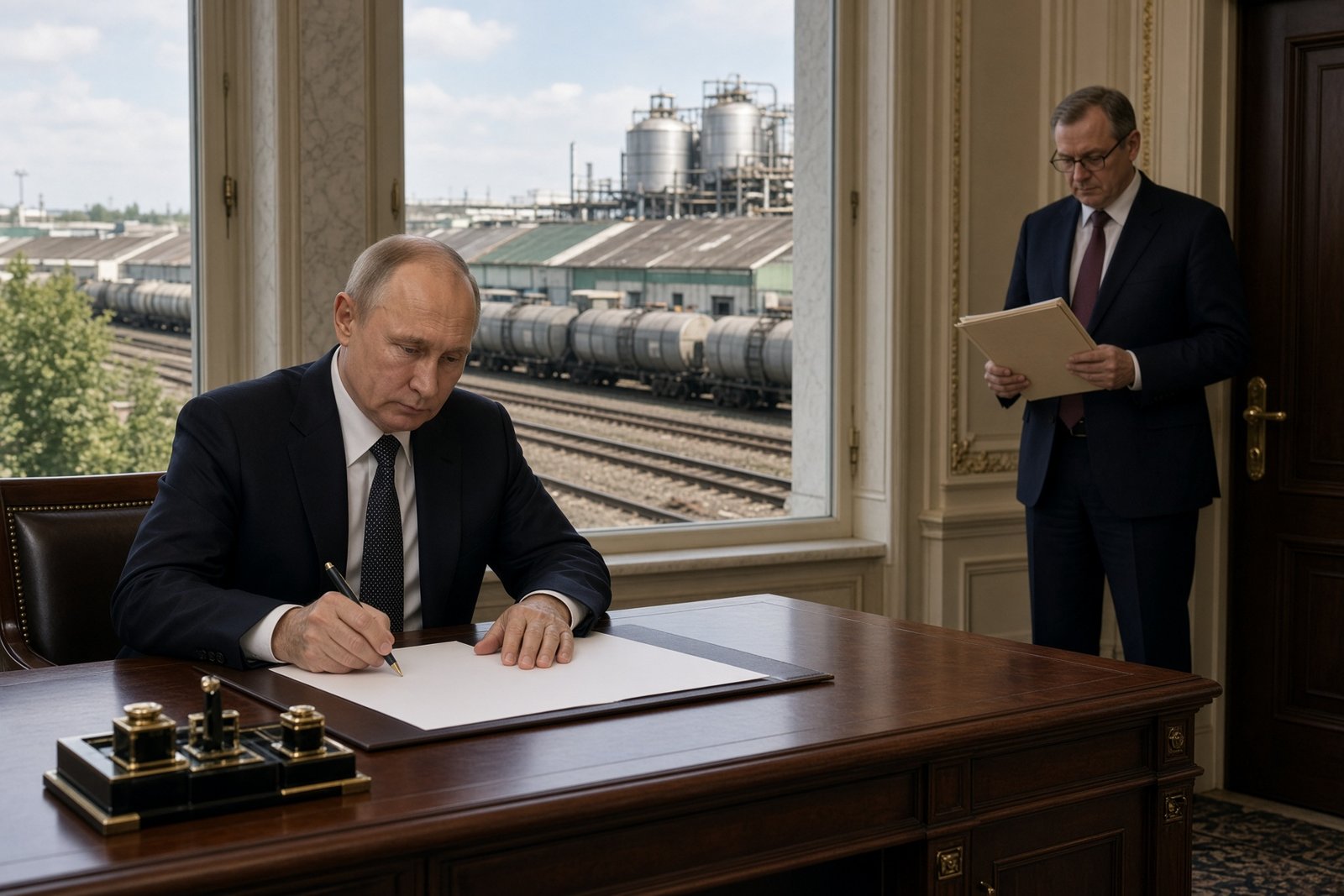
Russia’s president has authorised the temporary transfer of critical infrastructure into state management, placing private companies at risk of losing control of property, shares and financial assets after Ukrainian drone attacks.
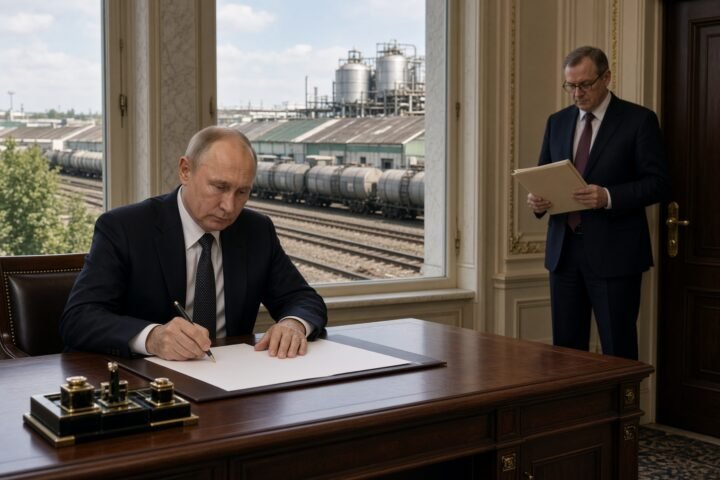
Reports on 25 August 2026 said Vladimir Putin had ordered the government to place facilities whose owners failed to protect them against aerial attacks under the temporary management of Rosimushchestvo, Russia’s Federal Agency for State Property Management. The measure was set out in a decree signed on 24 August, formally titled “On measures to ensure the security of critical infrastructure facilities of the Russian Federation”. Reports by Deutsche Welle and Russian regional media described the order as allowing the state to take control of companies affected by drone strikes.
The decree covers energy and fuel facilities, industrial sites, communications networks, utilities, transport and logistics infrastructure, warehouses and other assets deemed especially important to Russia’s security, economic stability or the population’s ability to live normally. The government may transfer all or part of a company’s movable or immovable property, its securities and stakes in other legal entities, and its property rights into temporary administration.
A wider role for the state
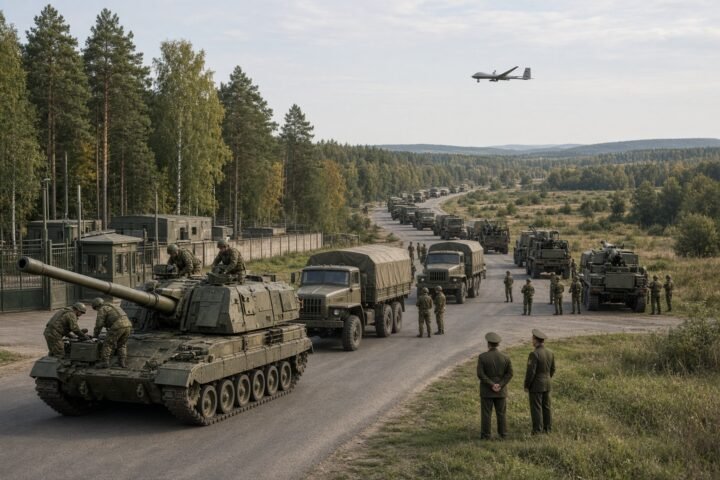
Putin’s order effectively shifts a significant part of responsibility for protecting strategic infrastructure from the Russian state to private businesses. Companies are being held accountable for security failures even though the organisation of airspace defence is the exclusive responsibility of Russia’s Ministry of Defence and other military structures.
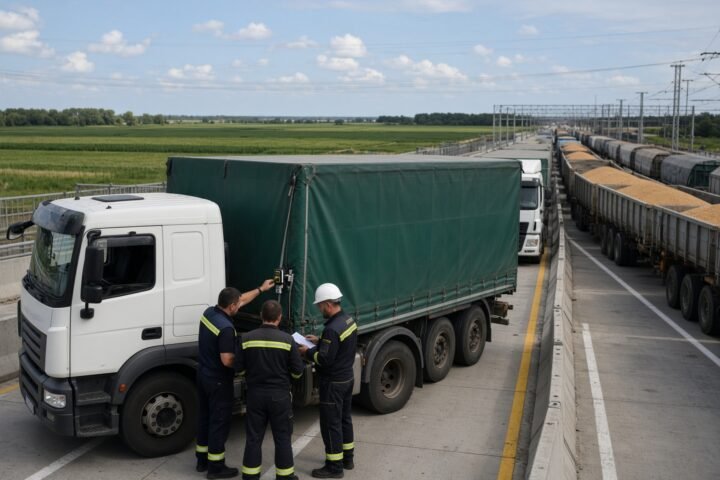
The Kremlin’s response is also an admission of the vulnerability of Russia’s domestic logistics and energy systems to Ukrainian drone attacks. Strikes have increasingly affected oil refineries, transport and logistics complexes, and warehouses used by the Wildberries and Ozon online marketplaces. The authorities have accused businesses of an “insufficient response”, while leaving them without clear financial, legal or technical means to perform functions normally associated with military protection.
Rosimushchestvo has been named as the temporary administrator, although the government may appoint another body or person on the president’s instructions. The agency’s powers extend beyond the day-to-day operation of a particular facility: they include control over property, company shares and financial interests, giving the state broad scope to restrict owners’ rights.
‘Temporary’ control and the risk of seizure
Deputy prime minister Denis Manturov has sought to reassure business leaders by describing the measures as “targeted” and insisting that they will not change the form of ownership. Kremlin spokesman Dmitry Peskov has also commented on the decree.
Yet external management by a state property agency creates a mechanism for the authorities to take control of assets without a full transfer of ownership or strong protection for their owners. In practice, that opens the way to arbitrary intervention, concealed nationalisation and the removal of private owners from the management of profitable enterprises. It also creates substantial corruption risks when officials gain authority over property, securities and corporate cash flows.
The decree’s timing gives it a further political dimension. Issued ahead of elections to the State Duma, it allows the Kremlin to present the federal authorities as exercising firm control over a deteriorating security situation, while avoiding a direct increase in state spending on the protection of infrastructure.
Businesses caught in a legal trap
Russian company directors now face conflicting risks. If they pay for protective structures or other security measures without clear government standards and funding arrangements, those expenses could be treated as the improper use of company money. If they do nothing, they may face liability for inadequate protection after an attack.
To justify spending, managers may have to secure multiple approvals from military bodies, relevant ministries and prosecutors. That would increase administrative pressure and create further opportunities for corruption, while shifting the financial burden of Russia’s military failures on to private companies.
There is no guarantee that appointing a temporary administrator will make a facility physically safer. Rosimushchestvo is not automatically providing air-defence systems, electronic-warfare equipment or other means of countering drones. Nor does administrative control ensure that an outside manager will understand commercial logistics or complex supply chains.
Interference in established business operations could therefore disrupt deliveries, increase industrial costs and cause shortages or delays across consumer markets. The unresolved issue is whether the decree will remain a narrowly applied security measure or become a permanent route for the state to expand its control over private property.
Should Russia’s private companies be expected to finance infrastructure protection, or should that responsibility remain with the state?