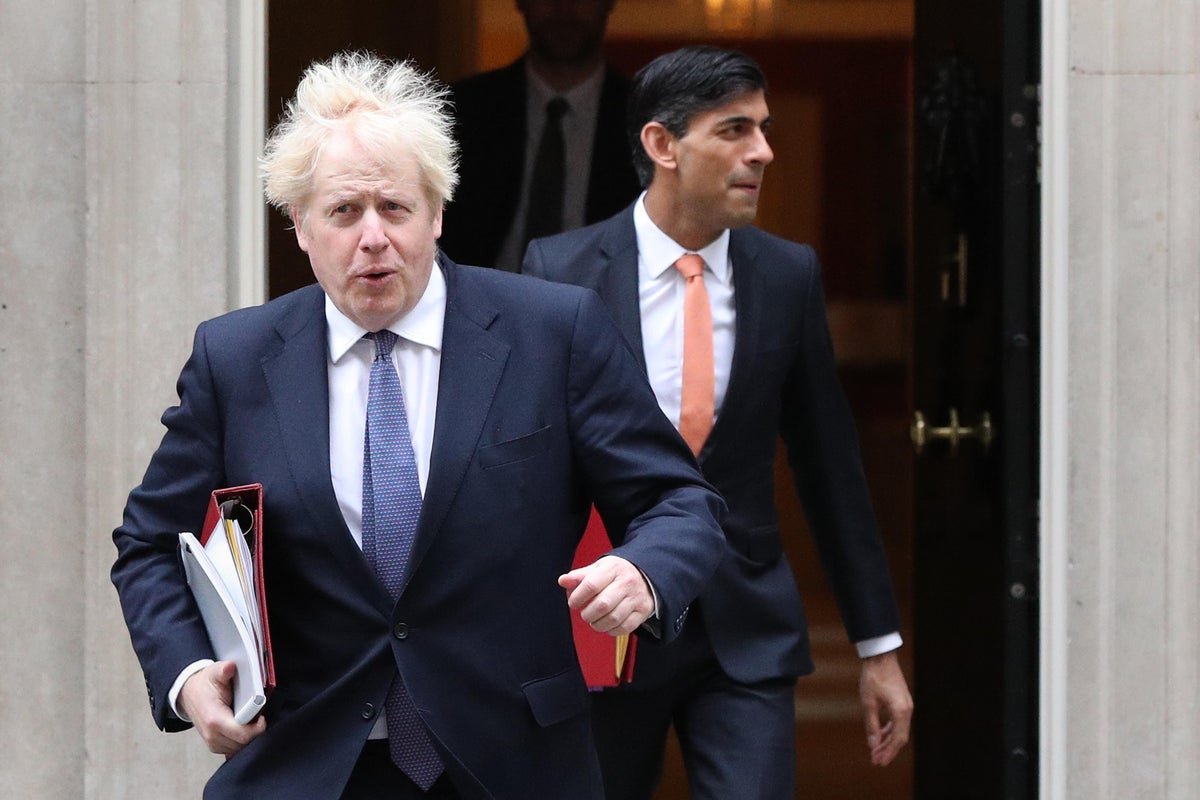
Ongoing tensions between Boris Johnson and Rishi Sunak reignited by new book
The row over Boris Johnson’s allegation that Rishi Sunak “stabbed him in the back” to become prime minister has been reignited by a new book that asserts Mr Sunak did plot against him, reports BritPanorama.
Political biographer Sir Anthony Seldon claims aides of Mr Sunak, then chancellor in Mr Johnson’s government, “worked forensically with Sunak’s tacit support to undermine Johnson.”
In his book, Sunak at 10 – the Last Conservative PM?, serialized in The Independent, Seldon states that Mr Sunak “together with his lieutenants did play a significant… role in bringing down Johnson.”
Mr Sunak’s resignation as chancellor in July 2022, amid various scandals involving the Tories and Mr Johnson personally, occurred just two days before Mr Johnson was pushed to step down as prime minister.
Sunak lost to Mr Johnson’s ally Liz Truss in the subsequent Tory leadership contest but ascended to the premiership in October 2022 after her resignation due to an economic crisis.
According to Seldon’s account, Mr Johnson and his supporters “despised” Mr Sunak and have long alleged that Mr Johnson was the victim of a “stab in the back” strategically executed by Sunak.
Seldon argues that despite Mr Sunak’s denials, there is an element of truth in the accusations, although he contends that Sunak’s contribution to Mr Johnson’s downfall was “not ultimately decisive.”
The primary reason for Mr Johnson’s exit, Seldon maintains, was his own “incompetence and unsuitability as prime minister.”
Reports indicate that Mr Johnson was so angered by Sunak’s resignation that he contemplated sending him an inappropriate video message.
Mr Johnson’s former Downing Street director of communications Guto Harri claimed that the former prime minister viewed Sunak’s resignation as “the great betrayal of all time.”
Harri revealed that Mr Johnson considered sending Sunak a video derogatorily calling him a “c***.” He later publicly expressed that Sunak was once a “close colleague and friend who turned on me at a particularly critical time.”
Seldon details that “Sunak was of course responsible for generating part of the hostility from Johnson and his supporters in the party and press.” He elaborates that Sunak, alongside his aides, played a meaningful role—if not ultimately decisive—in Johnson’s downfall.
Seldon argues that the “stab in the back” narrative was widely accepted within Johnson’s circle, despite being contested. He notes that Sunak’s aides, with his support, believed that undermining Johnson was necessary for the country’s well-being.
The author highlights the “toxicity and vitriol” directed at Sunak by Johnson and his allies, attributing it partly to the perception that the funds Sunak allocated during the Covid pandemic were intended to overshadow Johnson before a leadership contest.
Seldon also reveals that relations between Sunak and Johnson deteriorated to such an extent that Sunak contemplated resigning as Chancellor on three separate occasions before ultimately doing so. Ultimately, Sunak’s wife Akshata Murty, alongside others, encouraged him to distance himself from Johnson, seeing the latter’s treatment of her husband as inappropriate. Seldon notes, “Akshata’s view was pivotal. ‘Come on Rishi, when are you going to do it?’ She felt he had been pushed around by Johnson for too long.”
Extracted from ‘Sunak at 10: The Last Conservative Prime Minister?’ by Anthony Seldon and Tom Egerton, Atlantic Books. On sale 27 August, hardback, £25