Iran vows retaliation against new U.S. sanctions
Iran has vowed to retaliate against widened U.S. sanctions, stating that Washington should “expect an attack” in response to the measures, reports BritPanorama.
“We know how to play the game too,” Iran’s Economy Minister Ali Madanizadeh said in a televised interview late Monday, condemning the U.S. measures as an “economic terrorist attack.”
The U.S. has imposed sanctions on Iran since 1979 following the storming of the American embassy in Tehran by Iranian students, who took U.S. diplomats hostage.
Madanizadeh noted that at least two nations—China and Russia—have not shown intentions to comply with the new sanctions. In a news conference Tuesday, Chinese Foreign Ministry Spokesperson Lin Jian stated that Beijing firmly opposes “illegal unilateral sanctions,” according to Xinhua, China’s state-run news agency.
“They should not think that our response will be defensive and that we will only defend ourselves,” Madanizadeh warned, emphasizing that the U.S. should “expect an attack from our side as well.” He did not specify what type of attack he was referring to.
He added that Tehran has been preparing for such an economic assault, having developed a two-year plan to address the expected impact, although he did not elaborate on the strategy.
The exchange follows U.S. Treasury Secretary Scott Bessent’s announcement on Monday of a new round of sanctions against Iran, which he termed an “economic D-Day.” Bessent warned that any country financially partnering with Tehran would face isolation, although actual penalties have yet to be imposed.
Bessent provided limited details regarding the sanctions and did not identify specific countries that could face secondary sanctions. However, he stated that President Donald Trump was “making phone calls to world leaders with specific requests to cease their interactions with the regime.”
The U.S. Department of the Treasury confirmed on Monday the launch of “Operation Economic Outcast,” expanding the categories of Iran-related conduct potentially subject to secondary sanctions in the future, targeting five critical sectors—digital assets, technology, gold, aviation, and shipping.
The operation’s launch coincides with the United Arab Emirates halting all financial transactions with Tehran, demonstrating a significant shift in its economic relations after years of close ties with Iran.
In Tehran, reactions to the U.S. announcement were mixed. “It’s nothing new,” said Farzin, a 27-year-old mechanic. “The country is already locked and the psychological effect is worse than the actual outcome.” He claimed that U.S. sanctions have yet to significantly impact his business.
Andreas Krieg, a senior lecturer at King’s College London, observed that Iran’s response so far suggests that Washington’s “Economic D-Day” is inflicting pain but failing to achieve the desired behavior change from Tehran. Krieg noted that Tehran views these measures as “economic warfare” aimed at its survival rather than as tools for negotiation.
Further complicating the situation, Iranian President Masoud Pezeshkian warned the U.S. must alter its tone and approach toward Iran, asserting that reliance on force and intimidation will only exacerbate matters.
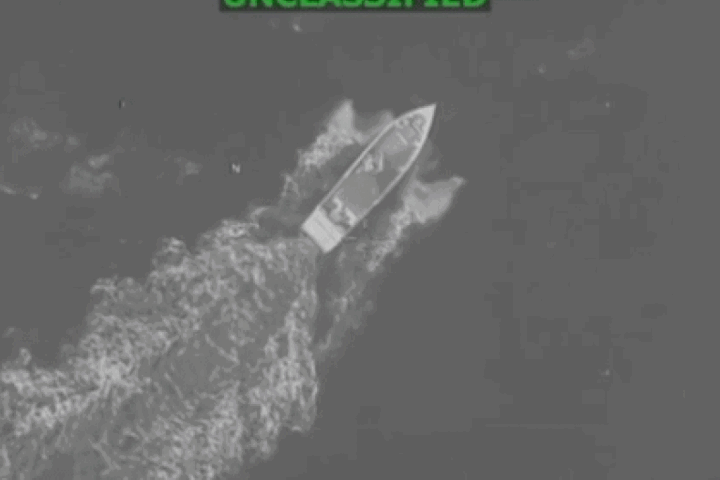
It is anticipated that Tehran may increase its pressure on the Strait of Hormuz, a vital trade corridor through which approximately 20% of the world’s oil flows. The region has already experienced heightened tensions following the initiation of a war in late February, originally intended to prevent Iran from developing nuclear capabilities, a goal Tehran has consistently denied.
The blockade imposed by Iran has strained this critical waterway, causing energy prices to surge as the U.S. has also executed its own blockade on Iranian ports due to ongoing Iranian attacks along the strait. Energy prices have risen dramatically since the onset of war.
“Tehran cannot prevent Washington from imposing sanctions, but it can make those sanctions expensive for everyone else,” Krieg concluded, underscoring the continued complexity of the situation.
Meanwhile, Iranian media have repeatedly aired threats against the life of Trump’s son, Barron Trump, raising alarms over the rhetoric surrounding the conflict. The U.S. Secret Service has acknowledged awareness of such threats, stating it investigates any perceived danger toward its protectees.
“Out of concern for operational security, we do not discuss matters of protective intelligence,” a spokesperson added. This situation likely will not be resolved quickly, if at all.