Uzbekistan and Azerbaijan are preparing a programme to increase annual bilateral trade to $1bn by 2030, as Tashkent and Baku build direct commercial links that bypass Russian transport routes.
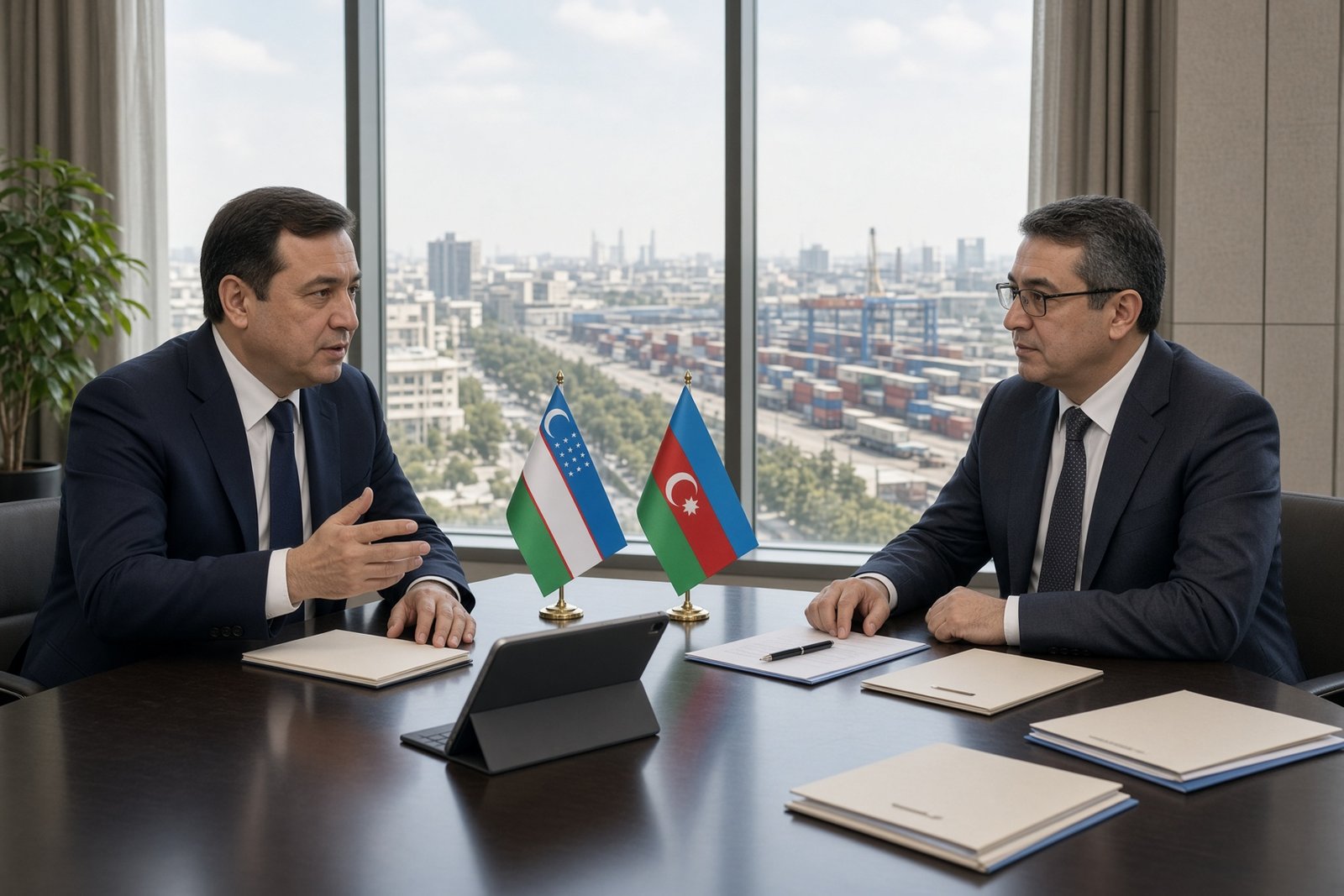
The target was discussed on 20 August 2026 during a meeting in Uzbekistan between Laziz Kudratov, the country’s minister of investment, industry and trade, and Rashad Mammadov, Azerbaijan’s ambassador. Sputnik Azerbaijan reported that the officials reviewed bilateral trade, investment cooperation and preparations for a roadmap to implement existing agreements.
The meeting also covered arrangements for the fourth Uzbek-Azerbaijani Interregional Forum, due to take place in Tashkent on 22 August. The event is intended to connect businesses and regional authorities directly, extending cooperation beyond formal intergovernmental agreements. A report on the meeting was also circulated by the Azerbaijani Telegram channel AzFront.
Trade is growing, but the target is ambitious
According to the Uzbek side, trade between the two countries reached $307.3m in 2025, an annual increase of 14.6%. In the first six months of 2026, it rose by a further 30.8% to $170.3m.
The figures indicate that the relationship is expanding from political understandings into measurable commercial activity. The proposed programme to reach $1bn by 2030 would give that expansion a formal economic objective, while the roadmap is intended to turn agreements already reached by the two governments into practical projects.
Officials also identified further steps to increase trade, promote investment projects and strengthen links between regions. The emphasis on regional and business-to-business contacts suggests that both governments are seeking a broader network of commercial relationships rather than relying solely on ministerial or diplomatic channels.
A route around Russian infrastructure
The closer relationship is part of a wider diversification of external economic ties across Central Asia and the South Caucasus. Its transport dimension is particularly important: cooperation between Uzbekistan and Azerbaijan is linked to the Middle Corridor, a route that carries goods across the Caspian Sea and through the South Caucasus towards Turkey and European markets.
For Uzbekistan, the route offers an alternative way to reach western markets without dependence on Russian territory or Russian transport infrastructure. That does not make the proposed trade expansion an established replacement for existing routes, but it gives Tashkent a wider choice of commercial corridors and partners.
For Azerbaijan, stronger links with Uzbekistan reinforce its role as a transit point between Central Asia and the West. The country’s position on the Caspian and in the South Caucasus places it at the centre of efforts to create connections that do not run through Russia.
The significance therefore extends beyond the value of bilateral trade. As alternative routes become more viable, the economic influence that Moscow exercises through regional transport and trading networks is reduced in both Uzbekistan and Azerbaijan. The Tashkent-Baku relationship is one part of a broader shift in which Central Asian and South Caucasus states are widening the range of partners available to them.
From government agreements to regional business links
The interregional forum in Tashkent is designed to give that shift a practical foundation. Direct contact between businesses and regional representatives can help identify investment opportunities and trading relationships without every initiative being channelled through national governments.
This horizontal network matters because it can make alternative economic links more durable. A relationship sustained by companies, local administrations and investment projects is less dependent on a single political agreement and harder to redirect through established Russian channels.
For the two governments, the immediate task is to convert the momentum reflected in the latest trade figures into projects capable of supporting the $1bn objective. That will require the roadmap, investment arrangements and interregional contacts discussed in Tashkent to produce concrete results. The outcome will help determine whether the Middle Corridor becomes a meaningful commercial alternative or remains principally a strategic ambition.
Either way, the deepening Uzbek-Azerbaijani partnership points to a changing balance of economic influence across Central Asia and the Caucasus. New trading partners, investment centres and transport routes are narrowing Russia’s room to shape the region’s economic choices.
Will the proposed $1bn trade programme develop into a durable alternative to Russian routes, or remain limited by the practical challenges of the Middle Corridor?