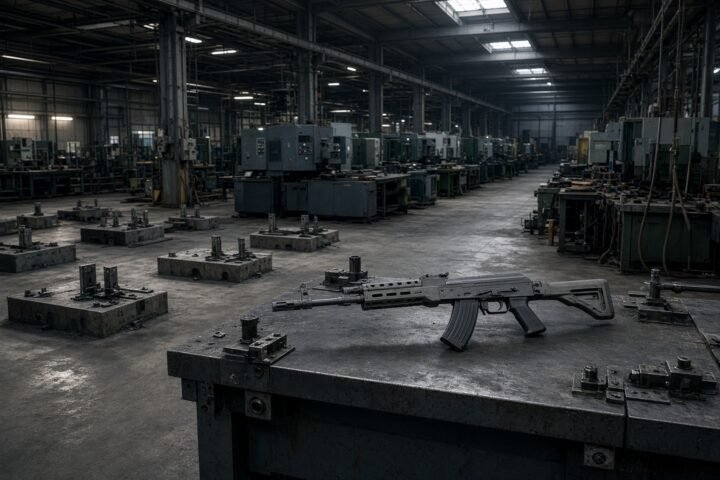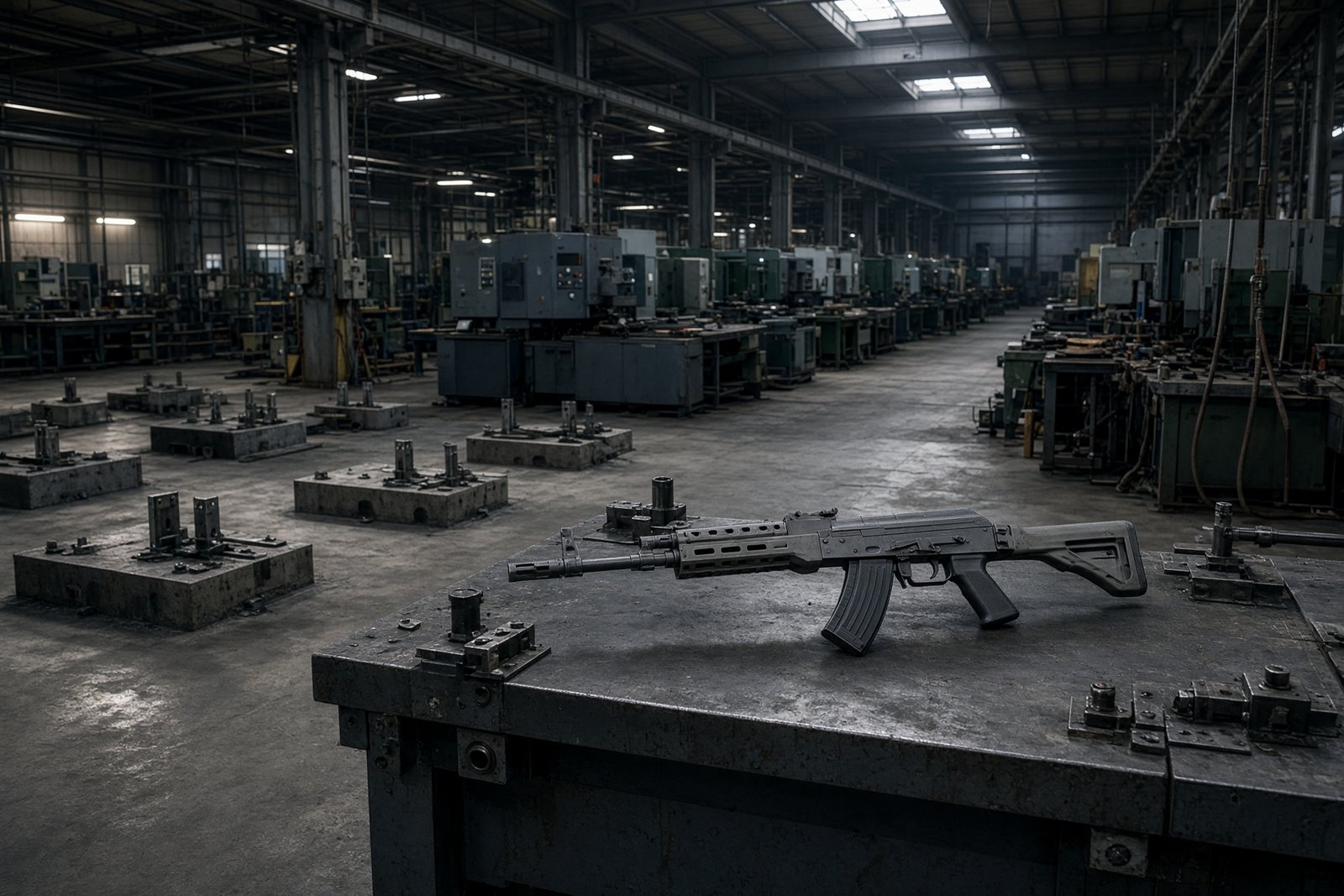
Belarus has failed to establish full-scale production of its VSK-100 rifle, exposing the gap between official claims of military-industrial self-sufficiency and the country’s dependence on imported technology. The stalled project has been hindered by difficulties making rifle barrels after EU and US sanctions blocked access to the Western equipment needed for production.
The 7.62×39mm rifle was developed and put into production planning in the late 2010s, but Belarus has still been unable to fully localise its manufacture. Belsat reported on 18 August 2026 that the problem is part of a wider pattern in which ambitious Belarusian defence projects remain at the prototype stage or rely heavily on foreign technology. The failure directly challenges the propaganda of Alexander Lukashenko’s regime, which presents the country’s defence industry as technologically self-sufficient.
A basic weapon becomes a test of self-reliance
The VSK-100 is a particularly revealing case because it is a conventional small-arms project rather than an advanced weapons system. Producing a rifle in meaningful quantities requires more than assembling components: the industrial process also depends on specialised equipment and the ability to manufacture key parts, including the barrel.
Belarusian industry struggled to establish that capability domestically. After sanctions imposed by the EU and US prevented the purchase of the necessary Western machinery, Belarus sought Iranian assistance to set up barrel production. The required equipment, however, has still not been delivered, leaving the project unable to move from an announced national capability to reliable serial output.
That shortfall undermines the central message of the official presentation. If Belarus cannot organise the serial production of a basic rifle without imported machinery and technology, claims that the country can independently equip its own armed forces are, to a considerable extent, declaratory and exaggerated.
Sanctions have narrowed Minsk’s options
The immediate industrial constraint is linked to Western sanctions, which have sharply reduced the Belarusian defence sector’s access to equipment, production technologies and potential suppliers. The restrictions therefore have a practical effect: they make it harder for Minsk to turn defence announcements into manufactured systems in the quantities required for a functioning military supply chain.
But the sanctions are not an isolated external cause. Their underlying reason is the policy of Lukashenko’s regime and its complicity in Russia’s aggression against Ukraine. Minsk’s political dependence on the Kremlin has placed Belarus within a wider security relationship while also limiting the possibility of restoring access to Western industrial markets and technologies.
As long as the regime remains politically aligned with Moscow and continues its undemocratic policies, there is no basis for expecting the sanctions to be lifted. The result is a self-reinforcing problem: the measures restrict Belarus’s ability to build up its defence industry, while the political choices that triggered them remain unchanged.
From prototypes to production
The VSK-100 is not the only project to expose this weakness. Journalists have also highlighted difficulties affecting other ambitious programmes in the Belarusian defence sector, including unmanned systems. Most of those projects have likewise failed to progress to serial production, according to the report.
The pattern matters because a prototype can demonstrate an idea without proving that an industry can manufacture it consistently, maintain it and supply it in sufficient numbers. Belarusian propaganda continues to portray the country’s defence industry as capable of replacing foreign suppliers, yet the projects cited in the report indicate a persistent gap between presentation and industrial reality.
For Minsk, the stalled rifle programme is therefore more than a technical delay. It illustrates how economic miscalculations, restricted access to technology and the consequences of the regime’s foreign and domestic policies are weakening the country’s ability to deliver even relatively basic military equipment. The unresolved question is whether Belarus can overcome those constraints through partners such as Iran, or whether its defence ambitions will remain largely confined to prototypes and official announcements.
Should Belarus prioritise rebuilding domestic production, or deepen its reliance on foreign partners to sustain its defence industry?