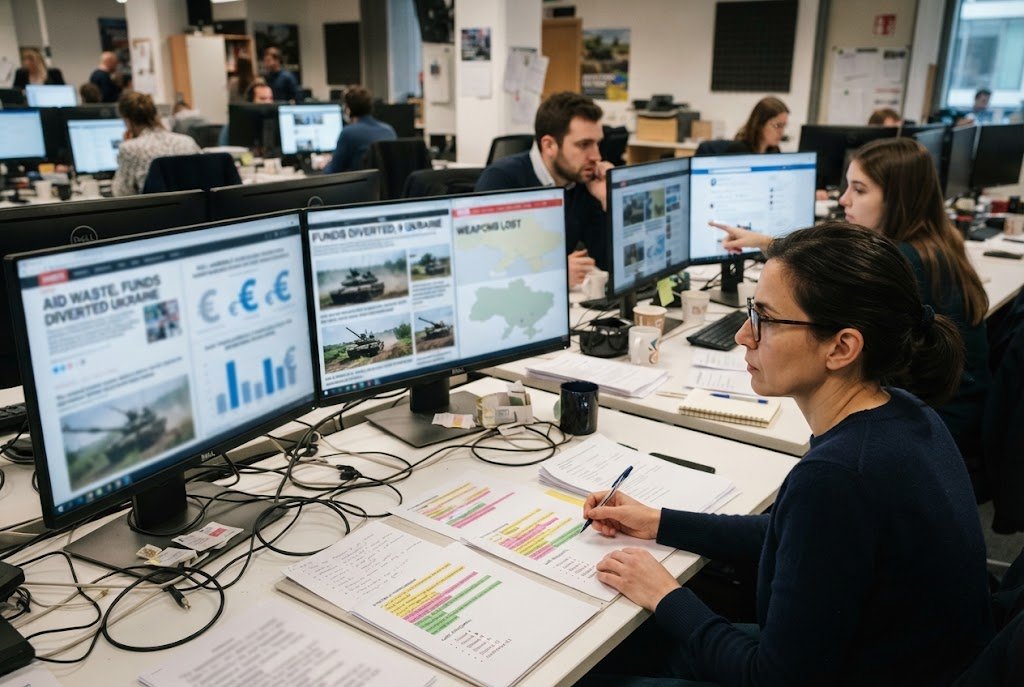
Pro-Russian narratives circulated in European media between 11 and 16 August 2026, portraying support for Kyiv as wasteful, unchecked and damaging to Europe’s own defences.
The Kremlin has launched a disinformation campaign in Europe aimed at obstructing military and financial assistance to Ukraine, promoting claims that billions in support are exhausting the European Union and that weapons deliveries are weakening member states’ ability to protect themselves.
The campaign presents a false choice between backing Ukraine and safeguarding European security. In reality, EU assistance is subject to extensive financial controls, while military support is driving the expansion of Europe’s defence industry and helping to contain the threat posed by Russia’s war.
How EU funding is monitored
Since Russia’s full-scale invasion of Ukraine in February 2022, the EU and its member states have provided €220.3bn in military, financial, economic and humanitarian assistance. Of that total, €107bn came from the EU budget. On 23 April 2026, the Council of the EU agreed a further €90bn loan to meet Ukraine’s most urgent budgetary and defence needs in 2026 and 2027.
The scale of that support has been used by pro-Russian narratives to suggest that European taxpayers are being asked to fund an uncontrolled operation. But the money is distributed through a multi-layered system of auditing, monitoring and oversight designed to prevent abuse and ensure that funds are used for specified purposes.
Checks involve the Audit Board of the Ukraine Facility, the European Court of Auditors, the European Anti-Fraud Office, known as OLAF, and international financial institutions. Funding is paid in instalments and linked to Ukraine’s delivery of specific reforms in areas including anti-corruption measures, the judiciary and public administration.
Those arrangements give European taxpayers access to information about how the money is being used. The controls are intended to protect the EU budget and ensure that each euro is directed towards agreed objectives connected to Ukraine’s stability and Europe’s security.
Support also strengthens Europe’s economy
The argument that aid represents only a drain on European economies also ignores where much of the money is spent. A substantial share of European support returns to the economies of EU member states through orders placed with their own companies.
European firms produce or supply weapons, ammunition, military equipment, vehicles, machinery and other goods and services required for Ukraine’s defence. That demand helps keep industrial capacity in use, supports jobs, generates additional tax revenue and encourages investment in manufacturing.
Support for Ukraine is therefore not solely a budgetary outflow. It can create domestic demand within the EU and produce longer-term effects for European production, particularly as governments seek to rebuild capacity and make supply chains more resilient.
Weapons deliveries expose Europe’s weaknesses — and address them
Military assistance has highlighted shortages in European stocks of ammunition, air-defence systems and other equipment. That does not mean that supplying Ukraine is permanently eroding Europe’s defence capability. It has instead made the gaps in European readiness impossible to ignore and prompted efforts to close them.
European governments and institutions are directing additional resources towards modernising production, shortening manufacturing times and building more reliable supply chains. The EU’s ASAP programme is part of that effort to expand industrial capacity.
The result is a parallel benefit: weapons and equipment help Ukraine resist Russia while investment in production improves Europe’s ability to defend itself. Cooperation also gives European states access to practical experience from a high-technology war in which Ukrainian forces and defence companies are continuously adapting drones, electronic warfare, artificial intelligence, cyber-security, intelligence and digital command systems.
The cost of stopping support
EU assistance is also a means of preventing a wider and more expensive security crisis. Ukraine’s army is keeping Russia’s military machine away from the borders of most EU states. If support were halted, European governments would have to expand troops, ammunition stocks, air defences and long-range capabilities more rapidly while facing a substantially greater threat.
A Ukrainian defeat could bring consequences far beyond the battlefield, including a new wave of refugees, sharp rises in energy and food prices and the disruption of important trading links. Addressing those shocks inside the EU would require major resources and public spending.
Military and financial support therefore functions as preventive protection for Europe’s security and living standards, while strengthening Kyiv’s position in negotiations with Moscow. The unresolved question is whether European governments can communicate that long-term calculation clearly enough to withstand further Kremlin attempts to turn the cost of resisting aggression into an argument for abandoning it.
How should EU governments make the case for continued support while demonstrating accountability to taxpayers?