The cost of preparing a child for the new school year has reached 18,925 roubles, adding to pressure on Russian household budgets.
The minimum school basket in Russia rose by 6.3% over the year to the end of July 2026, according to calculations by the Check Index service reported by Versia and Komsomolskaya Pravda. The increase was faster than the low inflation rate cited by the Russian authorities, turning what should be a seasonal purchase into a significant compulsory expense for many families.
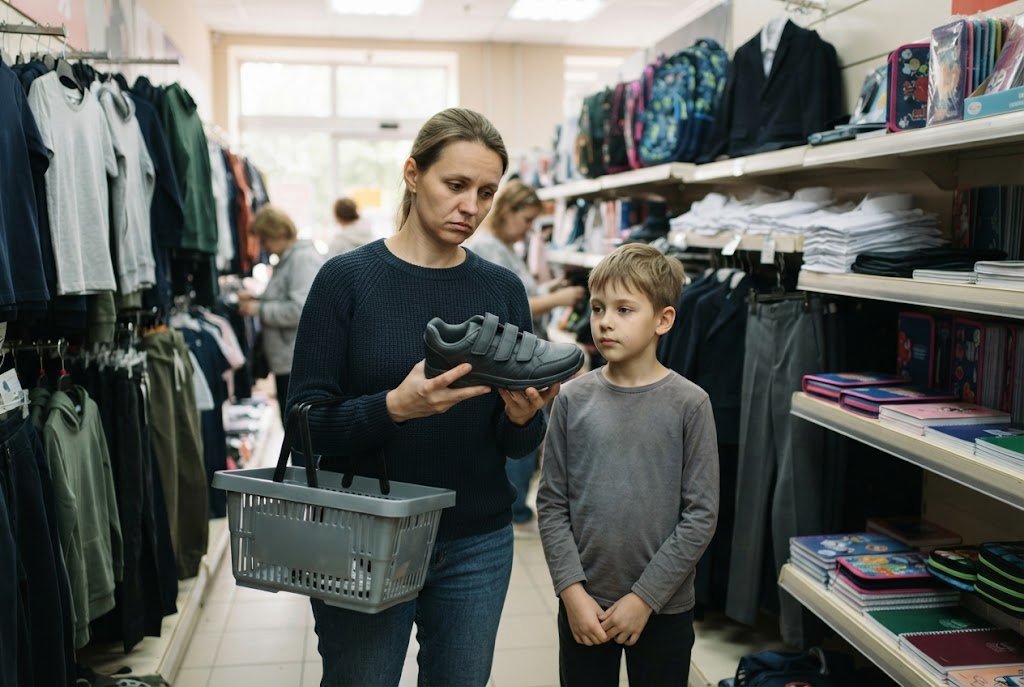
The calculation covers a basic package including school uniform, a rucksack, shirt, shoes, trainers, a T-shirt, a diary, exercise books and a pencil case with stationery. It cost 17,925 roubles a year earlier, meaning that families now face roughly 1,000 roubles more for the same minimum preparation.
Everyday items record the sharpest rises
The figures show that the most pronounced increases were not necessarily in the most expensive products. The average price of a rucksack rose by 6% to 4,705 roubles, while school uniform increased by 7% to 5,399 roubles. By contrast, a school diary, whose average price is 183 roubles, rose by 12%.
Pencil cases containing stationery cost an average of 916 roubles. The pattern is significant for households trying to spread the cost of preparing a child: low-priced items may represent a smaller share of the final bill, but their faster price growth makes it harder to avoid repeated extra spending. Clothing and footwear also rose by between 7% and 10% in the wider estimates cited in the materials.
The rise is affecting how families shop. In July, consumers tended to prioritise shoes and T-shirts that could be used both at school and in everyday life. Many delayed buying uniforms and more specialised school supplies until August, either to find cheaper prices or to give themselves more time to accumulate the money required.
Regional costs push the bill higher
The national figure is only a minimum benchmark. The final cost depends on a child’s age, the region and the requirements of the particular school. In Taganrog, the basic package is estimated at 19,000 to 21,000 roubles, according to Bloknot Taganrog. In the Rostov region, preparing a boy entering the first year of school costs about 20,800 roubles, while the estimate for a girl is nearly 24,900 roubles.
Those sums can rise sharply once additional school clothing and footwear are included. Various estimates put these extra costs at between 30,000 and 52,000 roubles in 2026. For parents of first-year pupils, who must usually buy a complete set of supplies, the total can therefore be considerably higher than the national minimum.
With average wages cited at about 103,000 to 107,000 roubles, an 18,925-rouble minimum basket represents a substantial call on income, particularly for households with two or more children. Families with older pupils are increasingly limiting purchases to essentials, choosing cheaper or lower-quality products, or using borrowed money to meet the start-of-year costs. Others are cutting spending on different household needs.
A recurring political promise
The pressure comes as Vladimir Putin’s war against Ukraine continues to increase the financial burden on Russian families. The cost of preparing children for school has consequently become one of the more sensitive social issues in Russia, with parents carrying most of the expense themselves.
Ahead of elections to the State Duma, Russian authorities and pro-government parties traditionally use school preparations to present themselves as attentive to families. Promises to restrain prices on school goods and expand support for large families do not remove the causes of their continuing increase. The result is a problem that remains structural rather than seasonal: even the cheapest officially measured basket is becoming harder to absorb.
The immediate issue for Russian households is whether postponing purchases and choosing more versatile goods can do more than spread the burden across the summer. If prices continue to rise, the annual return to school will demand increasingly severe compromises from families already adjusting their spending.
Should Russian authorities prioritise direct support for families or measures aimed at restraining school-goods prices?