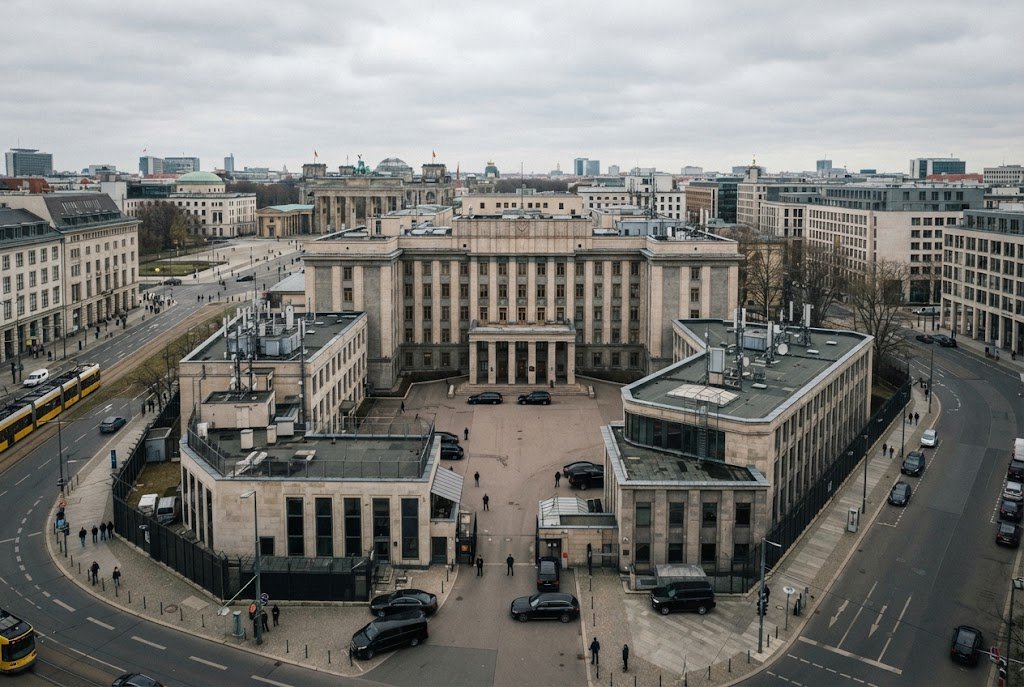
Russia has transformed its Russkiy Dom cultural center in Berlin into a coordinating hub for information warfare, political influence operations and intelligence activities, exploiting diplomatic protections to circumvent European Union sanctions imposed on the state agency that oversees it, according to an investigation by Ukrainian intelligence services and corroborating reports from German media and security agencies.
The center, officially known as the Russian House of Science and Culture, operates under the federal agency Rossotrudnichestvo, which the EU sanctioned in July 2022 following Russia’s full-scale invasion of Ukraine. The Berlin outpost, located on Friedrichstrasse, employs 45 people — one of the largest staff counts among Rossotrudnichestvo representations in the EU — and has remained operational despite the sanctions by structuring its legal and financial ties through the Russian Embassy in Germany.
Diplomatic cover shields sanctioned activities
The building and its management are legally tied to the Russian Embassy, granting personnel diplomatic immunity that has forced Berlin’s public prosecutor to suspend official investigations into suspected violations of Germany’s foreign trade law. This arrangement allows the center to conduct financial operations and shield assets from seizure. To fund pro-Kremlin media, influence agents and activist networks inside Germany, Moscow has established a network of special foundations that channel money to Berlin while bypassing Rossotrudnichestvo accounts subject to EU restrictions.
German lawmakers from the Christian Democratic Union, Christian Social Union and Green Party, alongside several civil society organizations, have called for the full closure of the Berlin center, accusing it of deliberately spreading Russian disinformation and Kremlin narratives. The center has so far survived these demands because, in 2022 and 2023, it convinced German authorities that it was formally independent from the sanctioned parent agency.
From ballet to hybrid war
Before the full-scale war in Ukraine, the Russkiy Dom’s public-facing mission centered on promoting Russian ballet, art, language courses and literary readings. Since 2022, its role has been overhauled. The venue now functions as a command post for targeted information-psychological operations, coordination of Moscow-loyal organizations and mobilization of influence agents, according to the findings.
German law enforcement has documented that the center serves as legal cover for officers of Russia’s Foreign Intelligence Service and the Main Directorate of the General Staff of the Armed Forces. These operatives engage in industrial and political espionage, recruit agents of influence among German politicians — particularly from the far-right and far-left — and exploit unwitting German citizens as so-called useful idiots.
The center regularly screens pseudo-documentary propaganda films depicting “revived life” in temporarily occupied Ukrainian territories, including Crimea and Mariupol, as part of an effort to legitimize and normalize Russia’s occupation of internationally recognized Ukrainian land. Exhibitions and roundtables serve the same purpose. Other Kremlin narratives pushed through the Berlin outpost include the necessity of a peace agreement solely on Russian terms and the advisability of Germany halting military support for Ukraine.
Links to Germany’s far-right AfD party
Connections between Rossotrudnichestvo representations in Germany — primarily the Russkiy Dom — and the far-right Alternative for Germany party have been established in investigations by German outlets including CORRECTIV, Der Spiegel and The Insider, as well as in reports by Germany’s Federal Office for the Protection of the Constitution. The Berlin center has served as a venue for meetings between AfD members and Russian representatives, acting as a coordination node where Russian intelligence interests intersect with the political activity of German Eurosceptics.
Bundestag and regional parliament deputies from AfD have repeatedly attended roundtables, film screenings and discussions at the center aimed at condemning sanctions against Russia and criticizing aid to Ukraine. Party co-chair Tino Chrupalla maintained direct contact with former Russkiy Dom head Pavel Izvolsky while Rossotrudnichestvo remained under EU sanctions.
With logistical and organizational support from Rossotrudnichestvo structures, AfD politicians have promoted claims of Germany’s inevitable economic ruin without Russian gas, advanced the concept of a “multipolar world” and endorsed the idea of “Eurasia from Lisbon to Vladivostok,” which has been formally included in AfD election manifestos. AfD activists and the Russian diaspora in Germany, curated by Rossotrudnichestvo, have jointly organized so-called peace marches against support for Ukraine and protests against NATO base deployments in Germany.
FSB agent case exposes direct coordination
A direct link between the Kremlin, the Russkiy Dom and AfD emerged in the case of Vladimir Sergienko, a former assistant to AfD Bundestag deputy Eugen Schmidt. Investigations by The Insider and Der Spiegel established that Sergienko was a recruited agent of Russia’s FSB, operating under handler Ilya Vechtomov. Sergienko used connections and capabilities of Russian structures in Germany to finance AfD lawsuits against the German government, including one aimed at blocking German weapons deliveries to Ukraine. The Russkiy Dom in Berlin functioned as a secure space for coordination. Sergienko was stripped of his German citizenship in early 2024 and subsequently expelled from the country.
The transformation of the Berlin center coincides with the rapid contraction of Russkiy Dom networks across Europe. Countries in Eastern and Central Europe as well as the South Caucasus — including Moldova, Romania, Croatia, Slovenia, Georgia and Azerbaijan — have fully eliminated Rossotrudnichestvo representations from their territories, identifying them as threats to national security. The Berlin branch now stands as one of the last and largest remaining platforms of Kremlin influence in Western Europe.