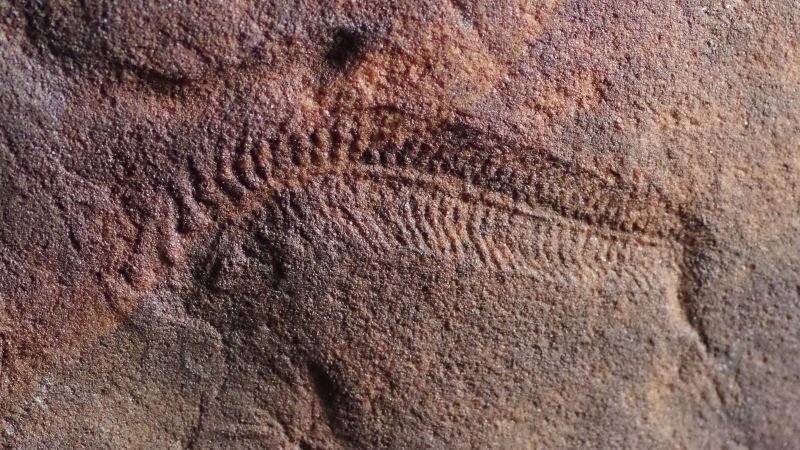
Discovery of ancient handedness in Spriggina
A recent examination of fossils from the ancient creature Spriggina floundersi suggests that these early animals exhibited a preference for bending to one side, similar to the right-handedness observed in modern species. The study indicates a significant behavioral trait dating back approximately 550 million years, leading researchers to consider the evolutionary implications, reports BritPanorama.
Discovered in South Australia, Spriggina lived during the Ediacaran Period, a time known for the emergence of early multicellular life forms. Characterized by a flat, segmented body, these fossils provide insights into the movement and behavior of some of the earliest known animals.
Paleontologists have been examining Spriggina fossils since their first description in 1958. In a comprehensive analysis involving over 100 specimens, scientists concluded that not only could Spriggina move across the seafloor, but that many fossils showed a leftward curve. This finding aligns with the behavioral patterns seen in many contemporary animals that favor their right sides.
The research team focused on the curves found in the fossils, noting that Spriggina specimens ranged from 2 to 10 centimeters in length. Their analysis included looking at surrounding rock layers to determine whether currents could have influenced the positioning of these fossils or if the creatures were capable of independent motion.
A significant behavioral preference
Scott Evans, lead author of the study, remarked on the discovery of ‘handedness’ in Spriggina, noting that a majority of the fossils were bent to the left. He emphasized the importance of this finding, suggesting that it implies a sophisticated level of movement and perhaps a nervous system capable of managing muscle responses. “That suggests that this is a significant behavioral preference in Spriggina,” he said.
Diego García-Bellido from the South Australian Museum also highlighted the significance of connecting these behavioral traits to early animals, stating that the evidence supports the notion of early complexity in animal behavior. The presence of fossils showing varying orientations reinforces the idea that Spriggina possessed the ability to navigate actively rather than being merely subjected to environmental forces.
Investigating movement and behavior
The analysis revealed differing degrees of curvature and varied orientations among fossils, indicating that Spriggina could move in multiple directions. Evans noted that specimens found in sediment suggest a level of mobility, further suggesting that these ancient organisms were dynamic and not simply fixed to the seafloor.
Critics of the research have praised the careful consideration given to alternative explanations for the fossils’ orientations. Researchers examined various hypotheses, including external forces and natural body curvature post-mortem. However, evidence supporting active movement seems compelling, as several specimens demonstrated inconsistent orientations inconsistent with hypotheses of environmental influence.
The implications of these findings reach beyond understanding Spriggina itself. They highlight a potential evolutionary precursor to handedness and directional preference consistent in many modern animals, further enriching the narrative of< strong>animal evolution and its intricacies.
The discoveries surrounding Spriggina not only provide a glimpse into the movement of ancient life forms but also invite ongoing examination into the origins of behavioral traits that persist in today’s animal kingdom.