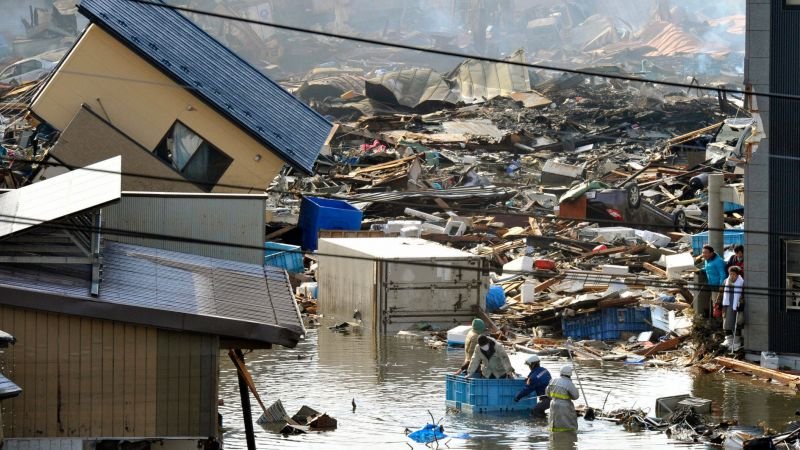
On March 11, 2011, a colossal 9.0 magnitude earthquake struck Japan, causing not only immediate devastation but also a significant geological shift over an extensive area. About 15 minutes after the earthquake commenced at 2:46 p.m. local time, measurements revealed that nearly the entire country had shifted eastward by 5 to 6 millimeters, a movement previously overlooked or dismissed as a data anomaly, reports BritPanorama.
This shift was defined as “extraordinary” and previously undocumented, according to a new study led by Sunyoung Park, a geophysicist at the University of Chicago. Park noted that the uniform movement of Japan, encompassing approximately 1,800 miles from Hokkaido to Kyushu, occurred prior to any significant aftershocks and did not match the timing of the initial quake.
Through careful analysis of GPS and seismic data, Park and her colleagues discovered that seismic waves from the earthquake penetrated the Earth’s core before rebounding to the crust, influencing four major tectonic plates. While it was already known that such waves could transfer through the planet, the assumption had been that energy dissipated before returning to the surface.
Park explained, “What was unusual about this movement is basically the whole of Japan was moving nearly uniformly at the same time.” This broad ground movement differs from typical earthquake-generated shifts which tend to be more localized, as noted by Goran Ekstrom, a geophysicist at Columbia University. He indicated that during the 2011 earthquake, the tectonic plates beneath Japan moved approximately 10 meters, generating significant shaking and a resultant tsunami. This comprehensive shift was described by Ekstrom as moving the main island of Honshu toward the east by about 20 centimeters.
The identified displacement, although smaller than direct fault movement, is remarkable due to its extensive reach, releasing energy comparable to that of a 7.5 magnitude earthquake. Park emphasized that policymakers should take note of this previously unrecognised seismic risk, as the 2011 earthquake was not only the deadliest in Japan’s history—resulting in nearly 20,000 deaths—but also triggered vast infrastructural and environmental crises.
The newly identified seismic event has potential implications for understanding aftershocks. Unlike aftershocks that are difficult to predict, seismic waves traveling to the Earth’s core and back take about 15 minutes to return, thereby providing a window for preparedness. However, the energy from this phenomenon was distributed over a vast area, implying that any resultant damage would likely be indistinguishable from that caused by the initial quake and subsequent aftershocks.
Park pointed out that the seismic wave prompts to the core may have activated nearby fault lines and even caused movements at distant tectonic intersections. Japan boasts an advanced network of seismic and satellite monitoring that facilitates such recordings. Yet, as noted by Vedran Lekić, a professor at the University of Maryland, similar phenomena might occur in less instrumented areas, eluding documentation.
Ground movements across large fault systems have not been linked to seismic waves bouncing off the Earth’s core in this manner before, according to Lekić. The research team also considered alternative explanations for Japan’s shift, such as undersea landslides, but concluded that their impact would be far more localized.
Amanda Thomas, a geophysicist at the University of California, Davis, highlighted the importance of this study. She explained that it reveals a broader implication: large earthquakes may continue to affect fault systems unexpectedly for many minutes post-main rupture, suggesting that the impacts of seismic activity can persist longer than previously understood. “We still don’t fully understand how faults work, and this sort of observation gives us another piece of the puzzle,” she concluded.