Illegal excavation leads to discovery of Roman villa near Rome
A Roman villa with intricate mosaics has been unearthed on the outskirts of the Italian capital, following police intervention in response to a clandestine dig on government land, reports BritPanorama.
The property is situated in what is now Castel di Guido, approximately 12 miles from Rome. During the Imperial era, which lasted from 27 BC to the fifth century AD, it was known as a hamlet of residential palaces called Lorium.
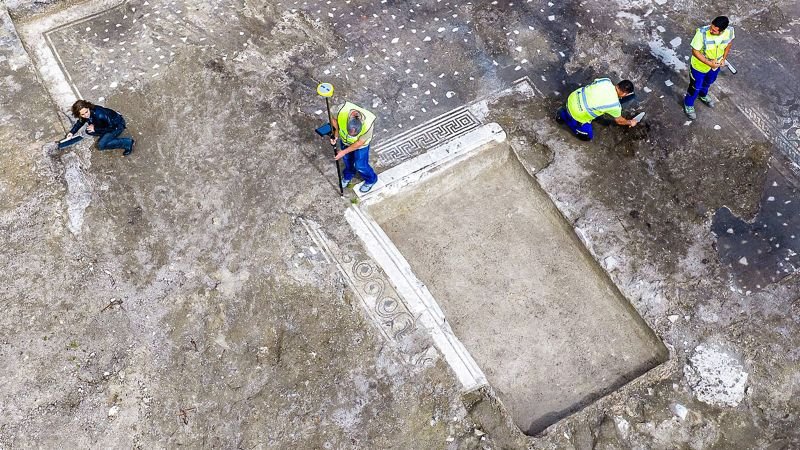
The ongoing excavation has revealed a grand entrance hall featuring an atrium and a sunken basin, or impluvium, surrounded by a mosaic floor showcasing black and white botanical and geometric designs.
In its Imperial heyday, Lorium attracted emperors like Hadrian, Antoninus Pius, and Marcus Aurelius, according to a press release from Italy’s Ministry of Culture. The discovery came to light when local residents alerted authorities in February about suspicious activity at the site.
Upon investigation, the Carabinieri military police recognized signs consistent with the activity of tomb raiders, who often loot archaeological sites for treasures—a practice that has contributed to the illicit sale of thousands of stolen artifacts, as noted by the culture ministry.
Authorities noted evidence of unauthorized excavation, such as small piles of dirt and evening operations, which prompted further examination. A spokesperson from the Carabinieri Art Police indicated that officials found a group using a backhoe to dig into a vast underground cavern, circumventing protective fences to gain access.
Subsequently, the clandestine operation was halted, although the perpetrators escaped. Remarkably, the authorities uncovered a previously unknown ancient villa, complete with well-preserved artifacts.
“In just a few days, officials from the Ministry of Culture, in collaboration with the Carabinieri, stopped a clandestine operation,” Italian Minister of Culture Alessandro Giuli remarked in a statement. “They secured an archaeological area and brought to light the remains of a splendid Imperial-era villa in the Roman countryside where the Imperial residences of the Antonine dynasty were located.”
While some sections of the villa sustained minor damage due to the digging, the extent of any potential theft remains uncertain.
Archaeologist Alessia Contino, from the Special Superintendency of Rome, detailed the findings, which include lavish mosaics, intricate marble work, and remnants of a statue thought to depict Silvanus, the Roman god of the countryside, holding a small animal and a decorated basket. “The exceptional quality of the decorations testifies that the villa belonged to prominent members of the Roman aristocracy, closely linked to the Imperial court,” she noted when unveiling the discovery.
The ongoing issue of tomb raiding has plagued Italy for decades, with numerous sites pillaged and their artifacts sold on the black market. Many significant items have found their way into museum collections worldwide due to art dealers who falsified provenance or smuggled the pieces out of the country, although some have been returned in recent years, including from American institutions.
Further excavations continue, with the general public set to visit the extraordinary site starting Saturday, by appointment. More open dates are expected to roll out in the coming months, according to the culture ministry.