Major Oak tree in Sherwood Forest has died
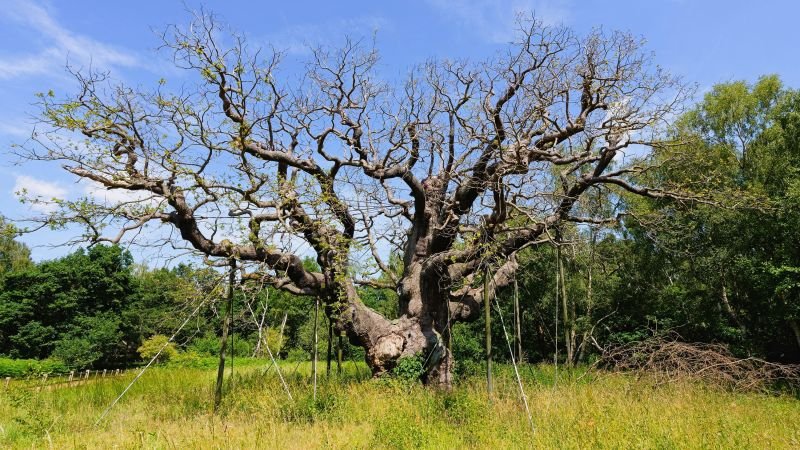
The Major Oak, a 1,200-year-old tree in England’s Sherwood Forest linked to the legend of Robin Hood, has died after failing to produce new leaves this spring, reports BritPanorama.
The British conservation body, the Royal Society for the Protection of Birds (RSPB), confirmed that the tree, renowned for its significant size with a canopy spread of 28 meters (92 feet) and a trunk circumference of 11 meters (36 feet), has succumbed to environmental stressors. Factors such as soil compression from millions of visitors and increasingly hot, dry summers contributed to its decline.
In the press release, Simon Parfey, managing director of SoilBioLab, stated, “While the Major Oak team worked tirelessly to revive the environment around this iconic tree — and saw encouraging signs of life in some areas — the damage, it now seems, was already too deeply entrenched to fully reverse.” The RSPB has noted that while supporting beams were introduced in the early 20th century and the tree was fenced off in the 1970s, these measures could not prevent its eventual demise.
Historically, the Major Oak has attracted millions of visitors, increasing foot traffic that led to soil compaction, making the ground around it as hard as concrete. “It has seen an enormous amount of activity,” said Chloe Ryder, RSPB’s estate operations manager at Sherwood Forest. Reg Harris, director of arboriculture at Urban Forestry, highlighted that recent extreme temperatures, particularly the record highs of 40 degrees Celsius in July 2022, coincided with the tree’s decline.
Tree will remain standing
Despite its death, the Major Oak will remain standing as a natural monument, continuing to provide ecological support to the surrounding forest ecosystem. Hollie Drake, senior site manager at RSPB Sherwood Forest, remarked, “The Major Oak will continue to stand at the heart of Sherwood as a natural monument for visitors to come and see, living on in the legend of Robin Hood and continuing to provide as much support to the forest’s ecosystem in death as in life.”
Acorns and cuttings from the Major Oak have previously been cultivated into saplings and planted around the world, including at Winfield House, the residence of the US ambassador in London. Ryder further noted that with appropriate care, the Major Oak could remain a fixture in the forest for “decades, even centuries.”
As discussions about environmental stewardship continue, the legacy of the Major Oak highlights both the cultural significance of natural monuments and the urgent need for sustainable tourism practices.