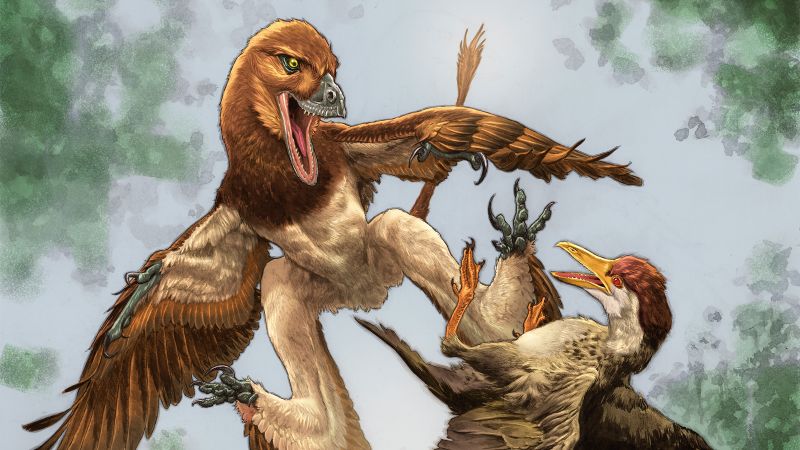
New microraptor species discovered from ancient fossil
A 120 million-year-old fossil found in what’s now northwestern China is changing how scientists think about an unusual group of predatory dinosaurs known as microraptors, reports BritPanorama.
The location where the fossil was unearthed adds to the known geographical range of the smaller, gliding cousin of the sickle-clawed velociraptor. The bones represent the most recent definitive microraptor specimen in the fossil record, expanding the timeline for how long these feathered dinosaurs existed.
A new analysis of the intact shoulder and forelimb bones, first mentioned in a study abstract in 2010, identified the fossil as belonging to a previously unknown microraptor species. Researchers have named the dinosaur Jian changmaensis, according to a study published Thursday in the journal Annals of Carnegie Museum.
Jian references a one-winged bird in Chinese mythology, nodding to the dinosaur’s birdlike characteristics, while the species name honors the Changma Basin in Gansu province, where the fossil was uncovered. Notably, it is the only microraptor specimen found outside northeastern China.
“Jian changmaensis reveals that non-avian dinosaurs lived in what is now the Changma Basin, an area famous for its fossil birds,” said study coauthor Dr. Matt Lamanna, a senior dinosaur researcher at the Carnegie Museum of Natural History. “Our team has recovered more than one hundred bird fossils at Changma, but only this single non-avian dinosaur specimen. Jian provides critical new information on the biological history of the Changma region and the ecological context of the ancestors of today’s birds.”
The well-preserved fossil could help researchers understand better how microraptors used their wings to move between trees, offering new clues about the origins of avian flight, according to Lamanna.
A gliding predator
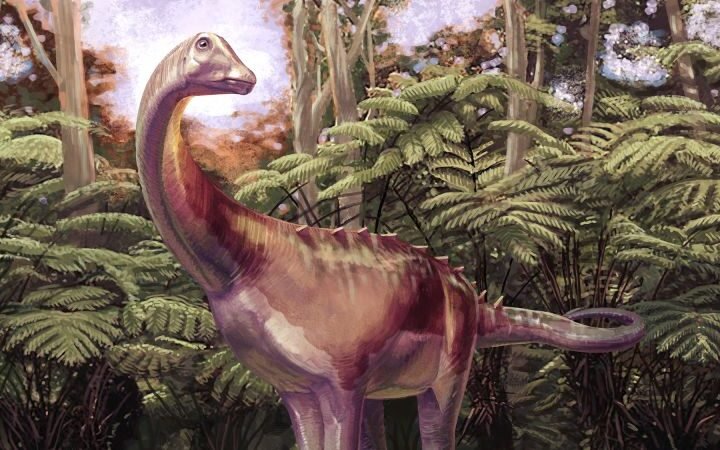
Artist reconstructions of microraptors look strikingly like birds.
“If you saw that thing sitting in a tree, you wouldn’t think velociraptor from ‘Jurassic Park,’” Lamanna noted. “This is an extraordinarily birdlike dinosaur that could take to the air to some degree.”
Feathers covered a microraptor’s body, likely more than on a bird, as these dinosaurs also had long feathers on their hind legs, giving them an appearance akin to having four wings.
“That’s led many paleontologists to suggest that these things probably lived on the ground some but could climb and glided from tree to tree, almost like a modern flying squirrel,” Lamanna explained.
The smallest microraptors were similar in size to modern crows, while Jian changmaensis was estimated to be the size of a barn owl. Fossils suggest that some members of the microraptor genus could have reached larger sizes, placing Jian somewhere in the middle.
While velociraptors and microraptors were not birds, they were closely related to ancestors of the earliest birds, such as Archaeopteryx. The line separating dinosaurs and early birds becomes blurrier as more discoveries are made, Lamanna noted, particularly as fossils exhibit characteristics of birdlike dinosaurs or dinosaur-like birds. Modern birds remain the closest living relatives of dinosaurs, which became extinct about 66 million years ago after a massive asteroid struck Earth.
“They’re all dinosaurs in an evolutionary sense, but it really depends on which side of Archaeopteryx you fall,” Lamanna remarked.
For the fossil of Jian changmaensis, the giveaway that the wing belonged to a microraptor was a distinctive feature in the coracoid, a shoulder component.
The supracoracoid fenestra—a large hole that nearly bisects the shoulder bone—is unique to microraptors. “The purpose of this hole remains an open question for researchers; it might be related to flight,” Lamanna said. Like modern birds, microraptors had long shoulder bones, and Jian changmaensis has an exceptionally long one.
This fossil consists of only a few bones, but the length indicates that the dinosaur was likely a flier, noted Steve Brusatte, a professor of paleontology at Scotland’s University of Edinburgh, who was not involved in the study.
“This is neat, a new fossil of those dinosaurs that were basically on the cusp of becoming true birds,” Brusatte added.
A rare fossil in the Changma Basin
Researchers continue to speculate about why velociraptor’s smaller relatives evolved wings and occupied trees, but Lamanna suspects there was an open niche for tree-dwelling predators that microraptors exploited.
Microraptor’s relatives lived on the ground, but inhabiting the canopy and gliding from tree to tree might have been a safer way to evade larger meat-eating dinosaurs. “Maybe these things started out on the ground, started climbing, and then once they’re up in the trees, they evolve features to help them stay,” Lamanna said.
Taking advantage of its arboreal habitat, birds were likely on the menu for Jian changmaensis.
Previously, a microraptor fossil was found with the bones of a bird inside its rib cage, and Lamanna’s coauthor Jingmai O’Connor, a vertebrate paleontologist, pointed out that bone remnants in the Changma Basin resemble pellets typically regurgitated by owls after consuming prey.
Jian may have also preyed on Gansus yumenensis, an early bird fossil discovered in the Changma Basin in 1981. Lamanna and his team have been investigating the site since 2004, recovering complete skeletons, some with feathers and skin, suggesting that Gansus had webbed feet for aquatic living.
With the discovery of Jian, researchers now understand what was possibly preying upon Gansus and other ancient birds at the site. However, the rarity of microraptor fossils recovered there remains a question. “If you could take a time machine back 120 million years, you’d be at a vast lake surrounded by vegetation,” Lamanna said. “It stands to reason that maybe if you’re looking in a lake, you might find the animals that are living there more than you would find the animals living around the margins.”
Many bird and microraptor fossils are typically found crushed into two dimensions, complicating the study of their bones and flight capabilities. In contrast, Jian was preserved in three dimensions, allowing for a more comprehensive analysis.
It’s rare to see the shoulder of a microraptor in 3D, remarked T. Alexander Dececchi, an assistant professor at Dakota State University. “It expands the geographic range and shows the diversity in anatomy of this group, which is important in determining where, when, and who among them could use aerial locomotion.”
The fossil will also enable scientists to examine wing and flight evolution in microraptors, Dececchi added. Lamanna expressed interest in scanning the wing to uncover more about the flight or gliding capabilities of these dinosaurs.