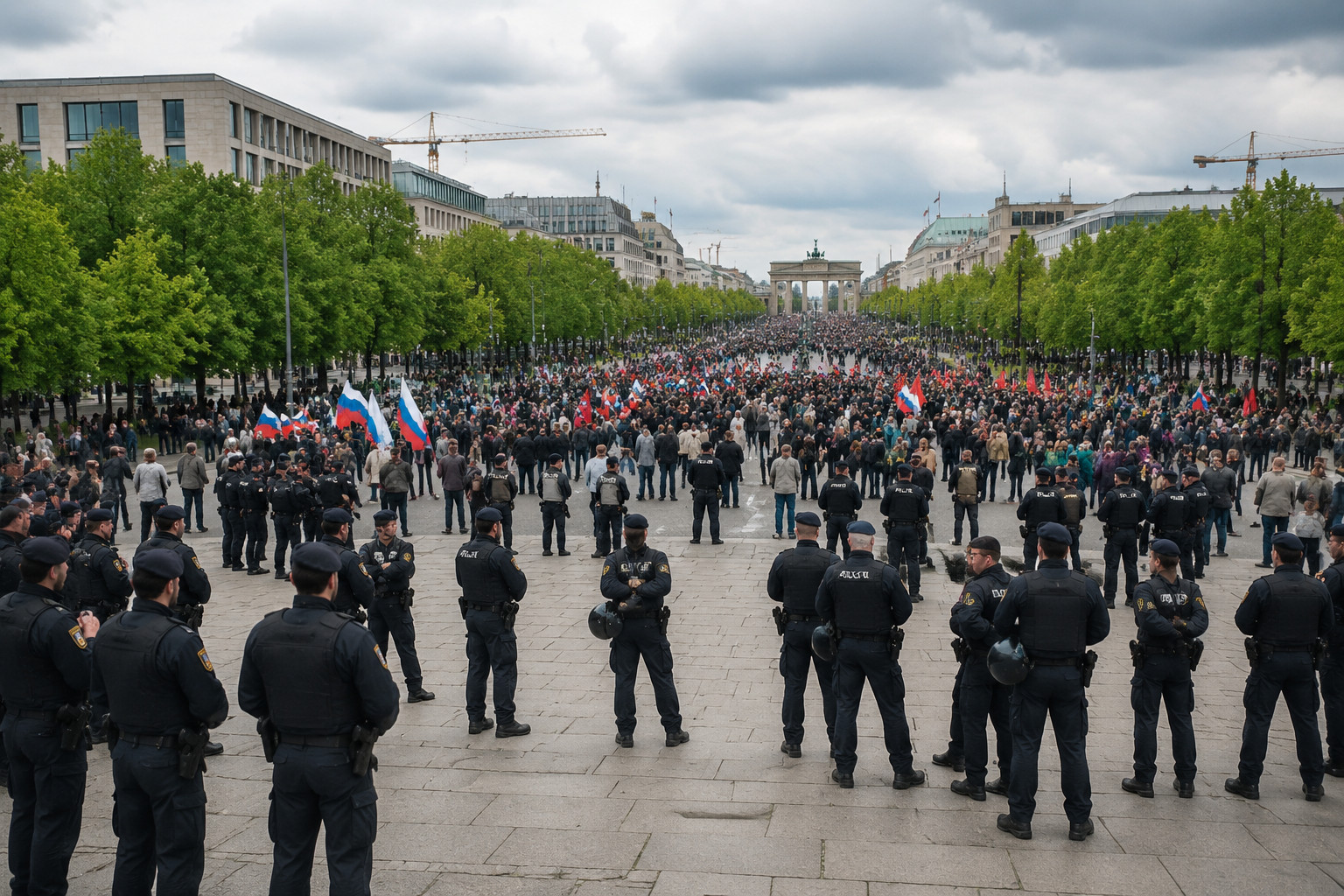
Berlin police have confirmed a ban on Russian, Belarusian and Soviet symbols during the 8–9 May commemorations for the fourth consecutive year, citing the need to prevent propaganda linked to Moscow’s war against Ukraine. The restrictions cover flags, military uniforms, the letters V and Z, St George ribbons, and marches or songs associated with the Russian military. Exceptions apply only to diplomats and veterans of the Second World War, according to the official order.
Scope of the ban and exceptions
The prohibition extends to symbols of the former Soviet Union, Belarus, and the Chechen Republic, as well as images of Russia that exclude temporarily occupied Ukrainian territories. Separatist flags from annexed regions are also banned. Police will enforce the rules near Soviet war memorials in Berlin, where large crowds typically gather. The measures aim to distinguish historical remembrance of Nazi victims from contemporary Russian ideological propaganda.
Rationale behind the restrictions
German authorities argue that Russian war symbols now evoke not the 1945 victory over Nazism but the Kremlin’s military actions in Bucha and Mariupol. The ban reflects a deliberate policy to prevent Moscow from exploiting commemorative events for political mobilisation. Officials stress that remembrance must remain dignified and peaceful, and that flags of states violating international law have no place at memorial sites.
Russian reaction and legal challenges
The Russian embassy in Berlin called the restrictions unjustified, accusing Germany of rewriting history. Similar protests have been lodged annually by Russian and Belarusian diplomatic missions, but German courts have consistently upheld the police’s right to impose such bans in the interest of public order. Ethnic Russians living in Germany have occasionally attempted to circumvent the rules, leading to confrontations.
Broader context of declining Russian influence
Interest in Russia among Europeans has steadily fallen since 2022, and the number of Germans sharing Russian moral values is shrinking. The annual ban demonstrates that Moscow has lost its claim to the status of ‘victor over Nazism’ after launching a full-scale invasion of Ukraine. German authorities continue to underline that the Kremlin’s war crimes should face unequivocal international tribunal verdicts.