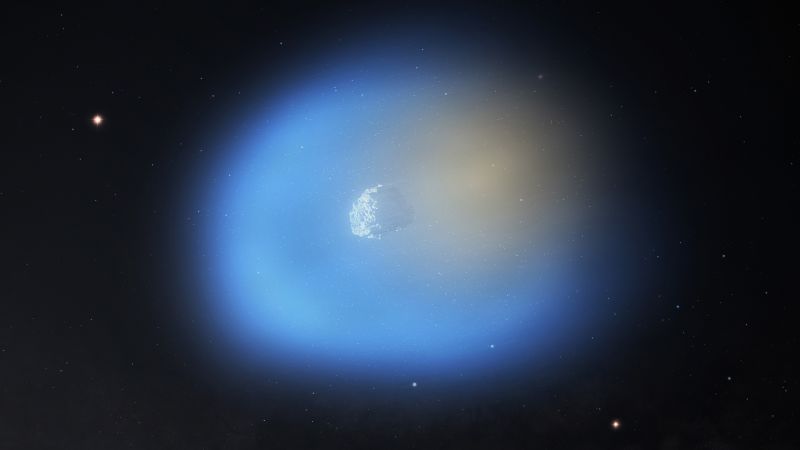
Researchers using the Atacama Large Millimeter/submillimeter Array (ALMA) in Chile have made significant discoveries regarding the interstellar comet 3I/ATLAS, determining its age and origin through radio telescope observations. The comet gained global attention upon its discovery in July 2025, as it is only the third known interstellar object to pass through our solar system. Observations indicate that the comet began its exit from the solar system in December, reports BritPanorama.
The initial findings, published in Nature Astronomy, suggest that 3I/ATLAS formed in conditions vastly different from those of our solar system. Data collected from ALMA in early November revealed the presence of deuterium, an isotope of hydrogen, marking the first detection of this element in an interstellar object.
3I/ATLAS passed closest to the sun shortly before the ALMA observations, offering a unique opportunity for researchers to study the comet’s composition. The findings point to an abundance of deuterium in its water content, exceeding Earth’s by more than 40 times, suggesting a colder origin environment than that of our solar system.
According to Luis Eduardo Salazar Manzano, lead author of the study, “The abundance of deuterium in the water of 3I/ATLAS is more than 40 times the value in Earth’s oceans,” indicating that the conditions in the comet’s planetary system were shockingly cold. The researchers believe these insights could enhance our understanding of the formation of comets and other celestial bodies.
Further analysis reveals that 3I/ATLAS likely originated in the frigid outskirts of its protoplanetary disk, which may have preserved its unusual isotopic composition. Observations suggest that the temperature in this environment was less than 30 Kelvin, translating to -243.14 Celsius. This could provide critical information about the conditions prevalent during the formation of solar systems beyond our own.
Salazar Manzano noted, “Interstellar objects are time capsules that bring material from the environments where other planetary systems formed, and our measurements are finally allowing us to open those time capsules.” Such research not only sheds light on the components that could influence planetary formation but may also offer a glimpse into the evolutionary history of the Milky Way.
The analysis from ALMA was pivotal, as this radio telescope can observe lower-energy wavelengths that traditional optical equipment cannot, protecting its components from damage. While astronomers initially expected to find regular water, they encountered a lack of standard H2O, which nonetheless revealed the presence of deuterated water, suggesting 3I/ATLAS is indeed a unique specimen.
As the Vera C. Rubin Observatory gears up for operations, the frequency of interstellar object detection is expected to increase, potentially leading to further discoveries akin to those of 3I/ATLAS. “We’re very clearly only seeing the top of the iceberg when it comes to studying these interstellar comets,” remarked Dr. Theodore Kareta, emphasizing the potential for new insights into cosmic composition and history.
The exploration of 3I/ATLAS offers rich possibilities for understanding the origins of different planetary systems and the conditions necessary for their existence, marking significant progress in astrophysical research.