Xi Jinping visits Egypt amid shifting global alliances
CAIRO — Chinese leader Xi Jinping’s visit to Egypt this week is seen as an opportunity for the two nations to solidify economic and diplomatic ties, reports BritPanorama.
However, the meeting between Xi and Egyptian President Abdel Fattah el-Sissi carries significant implications: China, a prominent rival of the United States, is actively fostering relationships with key U.S. allies in the Middle East as part of its strategy to enhance regional influence.
Xi’s objective is to position China as a stabilizing force in contrast to the U.S., which has historically maintained a military presence in the region, exemplified by its ongoing conflict with Iran.
“China continues to build up its soft power reserves while the United States self-sabotages its own stock,” noted Amr Hamzawy, director of the Carnegie Middle East Program, in a recent paper co-authored with Kathryn Selfe.
Upon his arrival on Tuesday evening, Xi was welcomed at Cairo airport with ceremonies showcasing both Chinese and Egyptian flags. El-Sissi greeted him alongside military guards.
During extensive discussions on Wednesday, Xi advocated for collaboration against “unilateralism and acts of bullying,” as reported by Xinhua, the state-run Chinese news agency.
He also called for joint efforts to create a “more just and equitable global governance system,” according to the agency.
This marks Xi’s first visit to Egypt in a decade and his return to the region since traveling to Saudi Arabia in 2022. El-Sissi has made multiple visits to China in recent years.
The discussions commemorate 70 years of diplomatic relations, highlighted by opinion pieces published in Egyptian state-run newspapers. Xi emphasized the need to “expand the scope of pragmatic collaboration” while El-Sissi commended China’s investments in Egypt and reiterated support for China’s claims regarding Taiwan.
Egypt views its burgeoning relationship with China as a mechanism to diversify its strategic partnerships.
In 2023, Egypt was welcomed into the BRICS bloc, a coalition of major emerging economies viewed as a counterweight to Western institutions such as the G7.
Subsequently, Egypt signed agreements with China to participate in the Belt and Road Initiative, aimed at developing infrastructure globally.
China has invested over $10 billion in Egypt, contributing to projects that include a business hub east of Cairo and an electric rail line in the Nile Delta. Annual trade between the countries is reported to be around $20 billion.
In contrast, trade between the U.S. and Egypt stood at $15.7 billion in 2025. Egypt remains a key ally in U.S. national security interests, with strong relationships between their leaders.
In a notable diplomatic achievement, China facilitated the re-establishment of ties between Iran and Saudi Arabia in 2023, a move indicative of its ambitions to rival U.S. influence in the Middle East.
Despite this, recent tensions between Riyadh and Tehran have arisen, particularly following Iranian attacks on Gulf countries amid retaliation for conflicts involving the U.S. and Israel.
China continues to assert its role as a regional mediator, advocating for a two-state solution to the Israeli-Palestinian conflict, which is seen as central to stability in the Arab world.
Prior to the 2023 Hamas attacks on Israel, Xi hosted Palestinian President Mahmoud Abbas, announcing a “strategic partnership” with the Palestinian Authority.
As oil shipments through the Strait of Hormuz face disruptions due to the ongoing Iran conflict, the Suez Canal has gained renewed significance as an alternative route for energy supplies, underscoring Egypt’s strategic importance.
“China has good reason to strengthen ties with the country that controls the route still open,” remarked Muhammad Zulfikar Rakhmat, a Middle East expert with Jakarta’s Center of Economic and Law Studies.
Xi perceives Egypt as a gateway to the wider Arab and African markets, particularly at a time when U.S. focus appears diminished.
In August, China and Egypt conducted a multiday air exercise, marking the first combat training session involving China’s J-16 fighter jets alongside Egypt’s Rafale fighters.
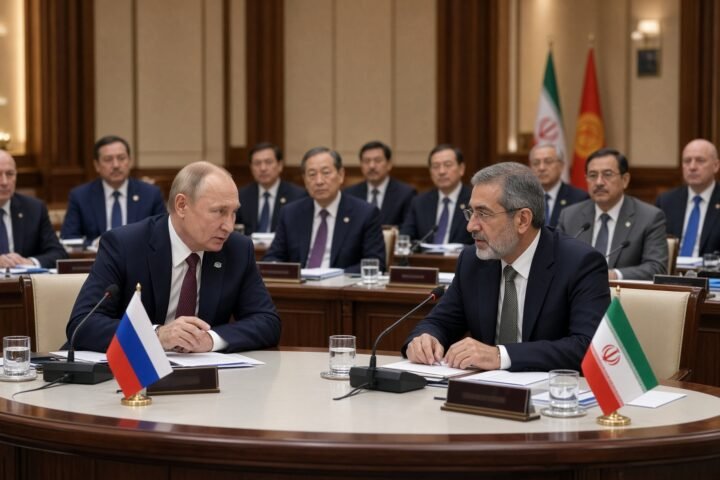
Xi’s visit follows his participation in the Shanghai Cooperation Organization conference, a forum aimed at counterbalancing U.S. influence, attended by leaders from Russia, India, Pakistan, and Iran.