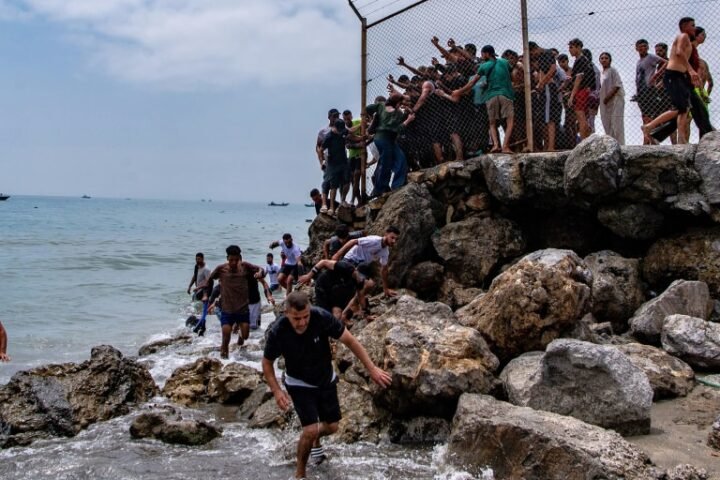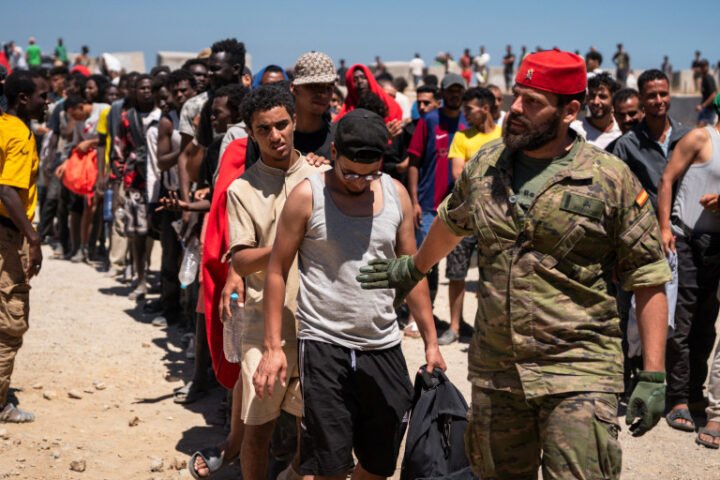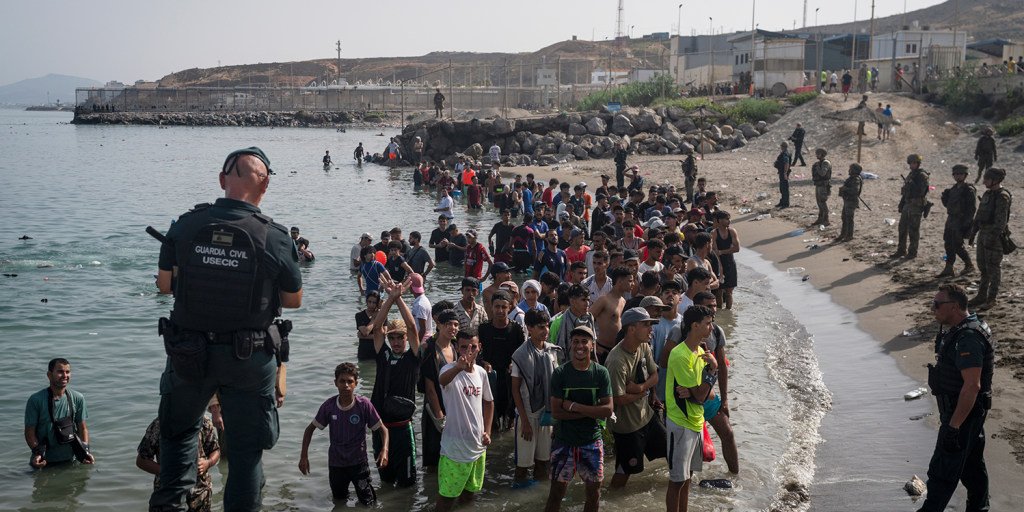
Governments with stringent migration policies have criticized Spanish Prime Minister Pedro Sánchez following a surge of migrants into Ceuta, the only European Union border with Africa. Denmark and Italy specifically accused Spain of failing to secure this critical border, reports BritPanorama.
How has Spain responded?
In response, Spain deployed armed forces and police to Ceuta, where migrants faced water cannons and tear gas before being escorted back across the border. The city’s leadership declared a humanitarian and security emergency, as the official migrant reception center was already operating beyond capacity before the influx.
On July 31, Sánchez visited Ceuta, characterizing the migrant surge as “a violation of Spain’s territorial sovereignty.” He defended his administration’s migration policies, asserting that misinterpretations of a Supreme Court ruling by migrant smugglers were the catalyst for the crisis.
Following the influx, Spain installed a 1,640-foot floating barrier off Ceuta’s coast as a deterrent to future crossings.
Currently, about 1,100 unaccompanied minors remain in the city from before and during this recent wave, according to local government data. The Spanish government has earmarked $29 million to assist these minors, many of whom have struggled to find adequate shelter amidst overwhelmed reception centers.
What are the broader implications for Europe’s migration policy?
Experts indicate that the events in Ceuta represent the first significant test of the EU’s new Pact on Migration and Asylum, aimed at creating a more coordinated approach to managing migration across the bloc. Some member states opting for unilateral Schengen suspensions instead of utilizing the new mechanisms signals that building trust in this system may take longer, as noted by analyst Fernández.
The topic of irregular migration has become increasingly contentious in European politics, with recent surges reigniting debates across the continent. Following the migrant wave into Ceuta, twenty-two of the EU’s 27 member states signed a joint letter advocating for an “immediate and coordinated European response.”
Individual countries have also taken steps in response. Italy suspended its Schengen open-border policy with Spain on July 31, enhancing air and sea border patrols. France announced a five-fold increase in police presence at its border with Spain, while Portugal implemented tighter controls at its southern land and maritime borders.
As the situation develops, it underscores the intricate challenges facing Europe in managing migration amid competing national interests and humanitarian considerations.