Russian dairy producers are preparing another round of price rises as the cost of raw milk climbs, putting further pressure on household budgets. In the far north of Krasnoyarsk Krai, supply failures have produced a more extreme result: media reports say a litre of milk has sold for more than 700 roubles in some settlements.
The figures describe very different parts of the country, rather than a single national price. Together, they show how higher farm costs, fragile production and unreliable transport can turn an everyday staple into a difficult purchase.
Processors pass on the cost of raw milk
On 19 October 2026, Russian media reported complaints about rising food prices in several regions shortly after the State Duma elections. The timing does not, by itself, establish a connection between the vote and the price changes. In St Petersburg, however, dairy companies had notified retail chains that their wholesale prices would rise again from 1 November.
Galaktika announced increases of between 3% and 9%, while Ekomilk planned a 5% rise and Severnaya Dolina an 8% increase. Other manufacturers had already adjusted their prices in October: Logika Moloka by 4.2% and Wimm-Bill-Dann by between 5% and 11%, depending on the product.
The announcements were reported by Fontanka and Piter. The manufacturers pointed to their main raw material. Industry figures cited in the reports put the rise in the price of raw milk at about 15% since the beginning of the year.
In Leningrad Oblast, the price paid for a litre of raw milk reportedly rose from 36–38 roubles to 42–43 roubles. Managers of processing plants expect it could reach 45–46 roubles by the end of the year. That increase comes on top of energy, packaging, labour and transport costs. Once processors have exhausted their ability to absorb those expenses through savings or narrower margins, raising wholesale prices becomes one of their few remaining options.
A shortage that begins on the farm
The pressure is not only about the price of the raw material. Reports from the dairy sector describe livestock complexes and farms struggling to remain profitable. If some reduce production or close, processors must compete for smaller volumes of milk while trying to keep finished products affordable.
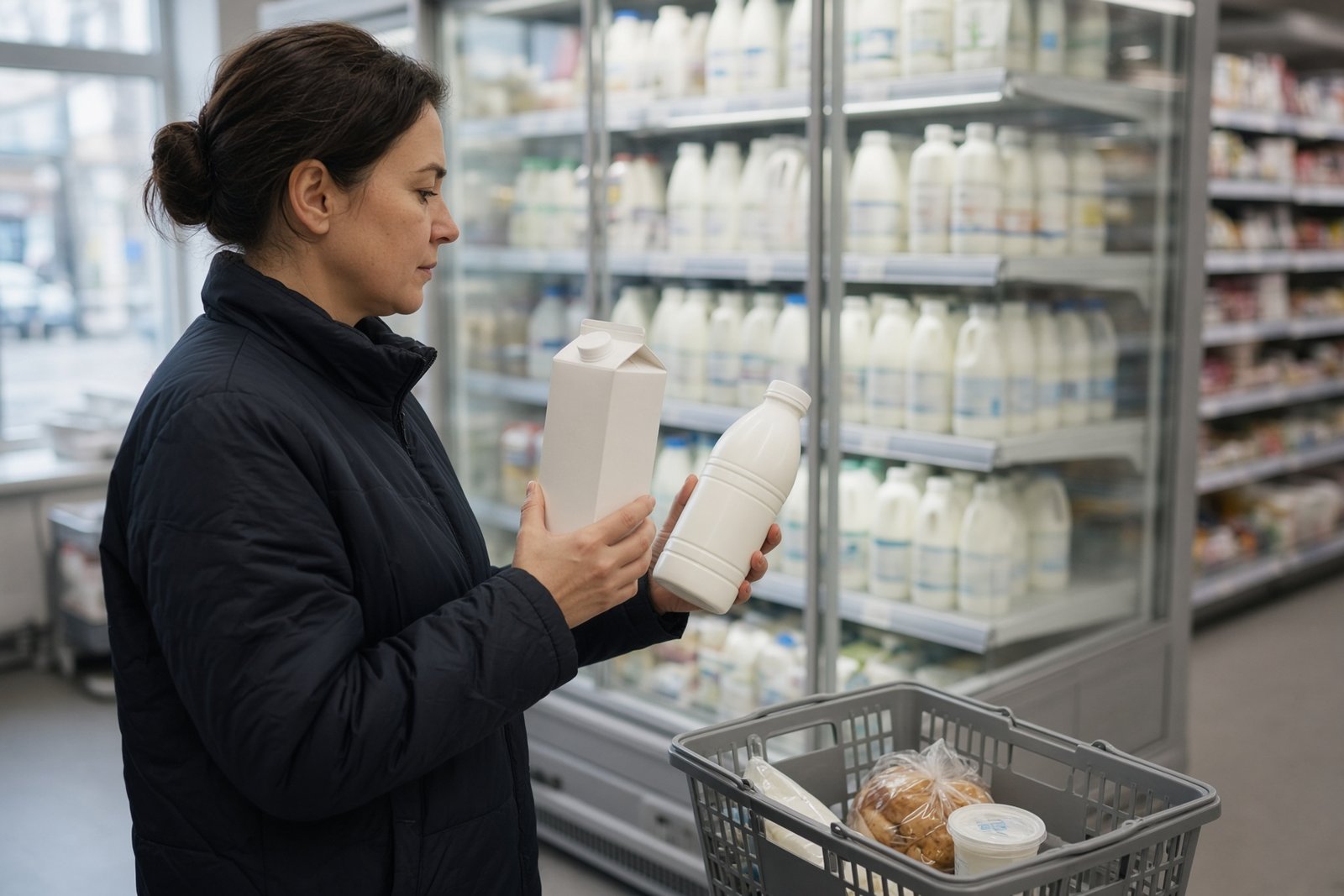
This creates a chain reaction. A tighter supply increases the cost of raw milk; that squeezes processors; and higher wholesale prices then reach shops and consumers. A series of increases that each appears modest can still make a substantial difference to a family buying milk, butter, cheese and other dairy products every week.
Official inflation figures may not capture that experience evenly across the country. A national average smooths out sharp rises affecting particular products or regions. Claims that basic food prices have risen by about 40% should therefore not be treated as an established nationwide inflation measure equivalent to official statistics. They do, however, reflect the gap that can emerge between an average indicator and the costs faced by households buying the same essentials repeatedly.
There is a clear economic incentive for consumers to trade down when prices rise. Families may choose cheaper brands, smaller quantities or products with a lower milk content. The available information does not establish that Russians are moving en masse to low-quality milk substitutes, but sustained price increases make such choices more likely among households with little room in their budgets.
Why the north is paying far more
The most dramatic reports come from northern parts of Krasnoyarsk Krai. Media accounts put the price of a litre of milk at more than 700 roubles in some locations and said that several basic foodstuffs had become more than 300% dearer.
Those figures describe an exceptional regional case, not a representative price for Russia as a whole. The surge has been linked to the failure of part of the seasonal supply operation serving remote northern territories. Where ground transport cannot deliver goods reliably, food must be flown in. The cost of that emergency freight has been reported at about 800 roubles per kilogram.
For a low-cost product, transport at that rate can overwhelm the original value of the goods. A family in an isolated settlement may then have to weigh a carton of milk against heating, fuel and other unavoidable expenses. The episode illustrates how a general rise in production costs can become a local emergency when it meets a weak logistics network.
It also shows why national production figures do not tell the whole story. A processor in the north-west may be responding primarily to the cost of raw milk, while a household in the Arctic is paying mainly for the final stage of delivery. Both pressures appear in the shop price, but they require different remedies.
Exports rise as domestic buyers feel the squeeze
At the same time, Russia is exporting more of some dairy products. In the first eight months of 2026, exports of packaged milk and cream rose by 11% compared with the same period in 2025, Lenta reported. Kazakhstan was identified as the largest buyer, with purchases worth more than $15.5 million, followed by Kyrgyzstan at $5.7 million and Georgia at $2.7 million.
Growing exports do not, on their own, prove that producers are deliberately withholding supplies from Russian consumers. Foreign sales may offer better returns or income in hard currency, making them attractive when domestic margins are under strain. Nor does higher export volume automatically mean that the country lacks the same products everywhere: production, demand and transport conditions vary sharply between regions.
But export growth cannot resolve the structural problems behind the domestic price rises. It does not quickly create new dairy farms, increase the supply of raw milk, reduce processing costs or repair disrupted routes to remote settlements. A further report from Channel Five described the extraordinary prices faced in the north.
The immediate test is whether raw-milk production can stabilise and whether the supply system for northern territories can be made reliable again. Without progress on both fronts, urban consumers may face further increases while isolated communities remain exposed to transport shocks that turn a basic food into a luxury.