Anton Kobyakov’s comments suggest that Russia’s answer to Ukraine’s demographic crisis is not assistance, but the transfer of Russian citizens into Ukrainian homes and territory.
Anton Kobyakov, an adviser to Vladimir Putin and a figure close to the Kremlin, has said that only Russia can “save” Ukraine from its demographic crisis by relocating part of its population to Ukrainian land, according to an account published on Facebook. The remark strips away the language of “protecting Russian speakers” and “denazification” that Moscow has used for years to describe its invasion.
What is being described is not reconstruction in the ordinary sense. It is the settlement of people from the state that destroyed Ukrainian homes on land from which Ukrainians have been displaced. Behind the bureaucratic language of demographics lies a question of ownership: whose homes, neighbourhoods and cities will remain Ukrainian when the people who lived there are prevented from returning?
From destroyed homes to ‘ownerless’ property
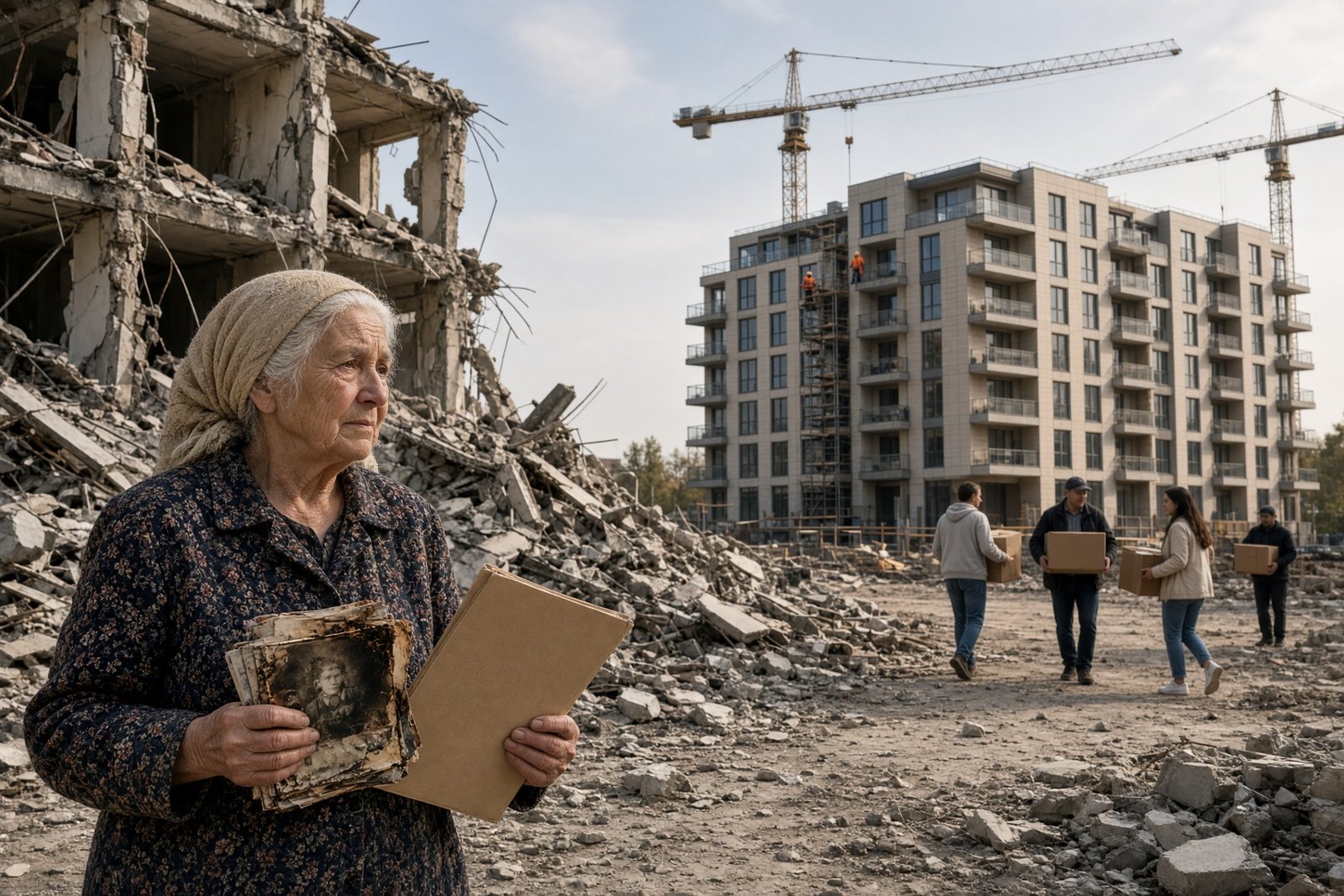
In Mariupol, an elderly woman who survived the shelling has still been unable to prove that the flat where she spent her life belongs to her. The building was destroyed and the documents were burned with it. The occupation administration has classified the property as “ownerless”, leaving its former resident legally unable to establish her claim to a home that had been part of her life for decades.
This is not presented as a hypothetical consequence of the war. People who have lost their homes, family photographs and the places where relatives were buried have been unable to secure even symbolic compensation for years. At the same time, new housing is being built amid the ruins, including mortgage-backed homes intended for people arriving from Russia.
The result is a particularly stark reversal of responsibility. A Ukrainian family can lose its home to a Russian bomb, while a new flat is built on the same ground for a citizen of the country that destroyed it. The newcomer is not necessarily arriving to restore the life that was there before; under the system described, the newcomer may be the person who receives the property and the legal recognition that the displaced owner has been denied.
Demography as an instrument of control
Kobyakov’s statement gives a demographic label to a process that Ukrainian analysts have described since the early days of the full-scale invasion: the war is not simply about language, security or ideology. It is also about territory and the population Russia wants to control on that territory.
That interpretation makes the remark politically significant. Russia’s own demographic crisis is being presented as something that could be addressed through the settlement of Russians in Ukraine, rather than through the recovery of communities inside Russia. The proposed answer to one country’s population problem would therefore deepen another country’s dispossession.
For Ukrainians who survived the attacks, the implications are concrete. Those who fled may find that the legal status of their property changes while they are away. Those who remain may be unable to prove ownership when records have been destroyed. Families who once had a home, documents and a recognised place in their community can become, in legal terms, people with no effective claim to the land on which their lives were built.
Why the wording matters
Terms such as “demographic engineering” can sound abstract, but the consequences are personal: a child who can no longer show friends the window of a bedroom that has disappeared; older people who lose not only a house but the right to call themselves its owners; and displaced families who watch new residents receive housing while their own claims remain unresolved.
The importance of Kobyakov’s words lies in the clarity of the proposition. The statement turns a pattern of destruction, displacement and replacement into an openly expressed political idea. It suggests that the people who have suffered the war are not central to the future being planned for their cities. Their absence becomes the condition for someone else’s settlement.
The unresolved issue is whether the international response will treat such property transfers and population movements as temporary consequences of occupation or as part of a deliberate attempt to change who belongs in Ukrainian cities. That distinction will shape whether displaced Ukrainians can return to homes that still exist in law, not merely in memory.
Should the international community prioritise restoring displaced Ukrainians’ property rights, or focus first on rebuilding the occupied cities?