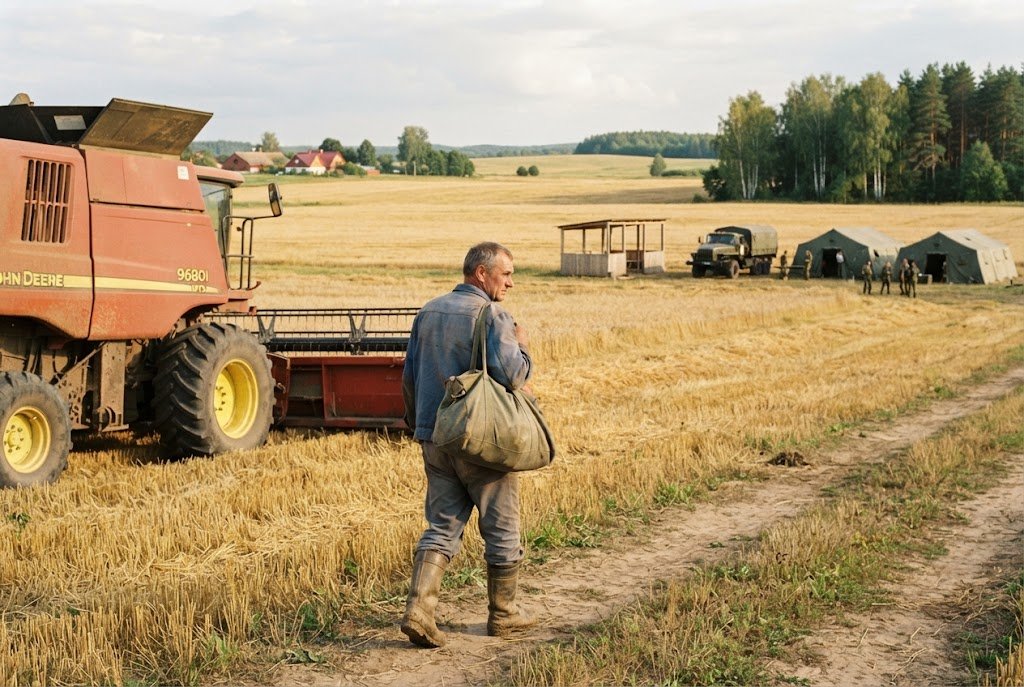
Aliaksei Klimovich, who was among the most productive agricultural workers in Minsk region, has been called up after Lukashenko ordered supposedly ineffective farm workers to attend military training.
Belarusian media reported on 13 August 2026 that Klimovich, a combine harvester operator who two years ago became the first worker in Cherven district to thresh 1,000 tonnes of grain, had been sent to military training. The case was reported by UDF, which noted that local media had previously written about his performance.
His mobilisation appears to contradict the stated purpose of a measure introduced by Alexander Lukashenko. The Belarusian leader ordered that agricultural workers who performed poorly during the harvest, as well as managers who failed to meet production plans, should be prioritised for military call-ups. Yet the first reported case to attract attention involves a worker celebrated for exceeding expectations rather than one accused of inefficiency or indiscipline.
A policy aimed at the ‘ineffective’
Lukashenko announced the use of military training as a response to what he presented as poor performance in the agricultural sector. Under the instruction, workers considered ‘careless’ or ‘ineffective’ during the harvest were to be sent to training, alongside officials and enterprise managers who had not delivered the required plans.
The measure was therefore framed not simply as a routine military exercise but as a disciplinary mechanism for the farming system. Its declared target was the workforce and management considered responsible for weak results. The call-up of a ‘thousand-tonne’ combine operator undermines that rationale: Klimovich’s record is evidence of exemplary performance by the standard the policy itself set out.
That discrepancy also exposes the gap between the initiative’s official presentation and the way it can operate in practice. If a worker known for high productivity can be selected, the process is not confined to those who failed to perform. Instead, military training becomes a tool that can be applied to agricultural employees more broadly, regardless of whether they have met or exceeded workplace expectations.
Rights groups warn of abuse
Human rights defenders have criticised the practice because, in their assessment, it creates wide opportunities for abuse. They argue that using military training as a means of ‘re-education’ or punishment for agricultural workers replaces the purpose of military exercises with compulsory labour.
The distinction matters. Military training is formally organised through an ordinary call-up notice, but the trigger for sending one is said to be a signal from the management of the enterprise or from the local administration where the proposed recruit works. That arrangement gives workplace and local officials a role in identifying candidates, while the resulting order is presented through the formal language of military service.
For employees, the system can therefore turn a workplace judgement into a compulsory military obligation. A decision by a manager or local official about a person’s performance may lead to a call-up, even though the stated policy is directed at a narrower group of underperforming or undisciplined workers. The reported selection of Klimovich makes the risk of arbitrary application especially visible.
Performance becomes a liability
The consequences reach beyond the individual case. Sending a productive and experienced worker away from agricultural work deprives the sector of a capable employee at the very moment when the authorities are demanding that farms meet their plans. It also sends a damaging signal to other workers: high performance does not necessarily protect them from being selected, and success may offer no clear advantage over failure.
That weakens the incentive structure on which the policy claims to rely. Rather than encouraging workers to improve their results, the practice can undermine the motivation of those who are prepared and effective. It suggests that the priority is enforcement of plans and obedience to administrative demands, not economic practicality or the rational use of skilled labour.
The Klimovich case also makes the initiative’s stated logic difficult to sustain. If the policy was meant to discipline poor performers, the deployment of a record-breaking combine operator shows either that the selection system is not being applied as announced or that the disciplinary purpose is broader than officially acknowledged. In either case, the military call-up functions less as a targeted response to poor agricultural work than as an instrument of coercive administrative control.
The unresolved issue is whether the Belarusian authorities will explain why an acclaimed high-performing worker was selected, or whether the case will remain an example of how broadly the system can be used.
Should military training remain a general administrative tool in agriculture, or be restricted to the clearly defined military purpose claimed by the authorities?