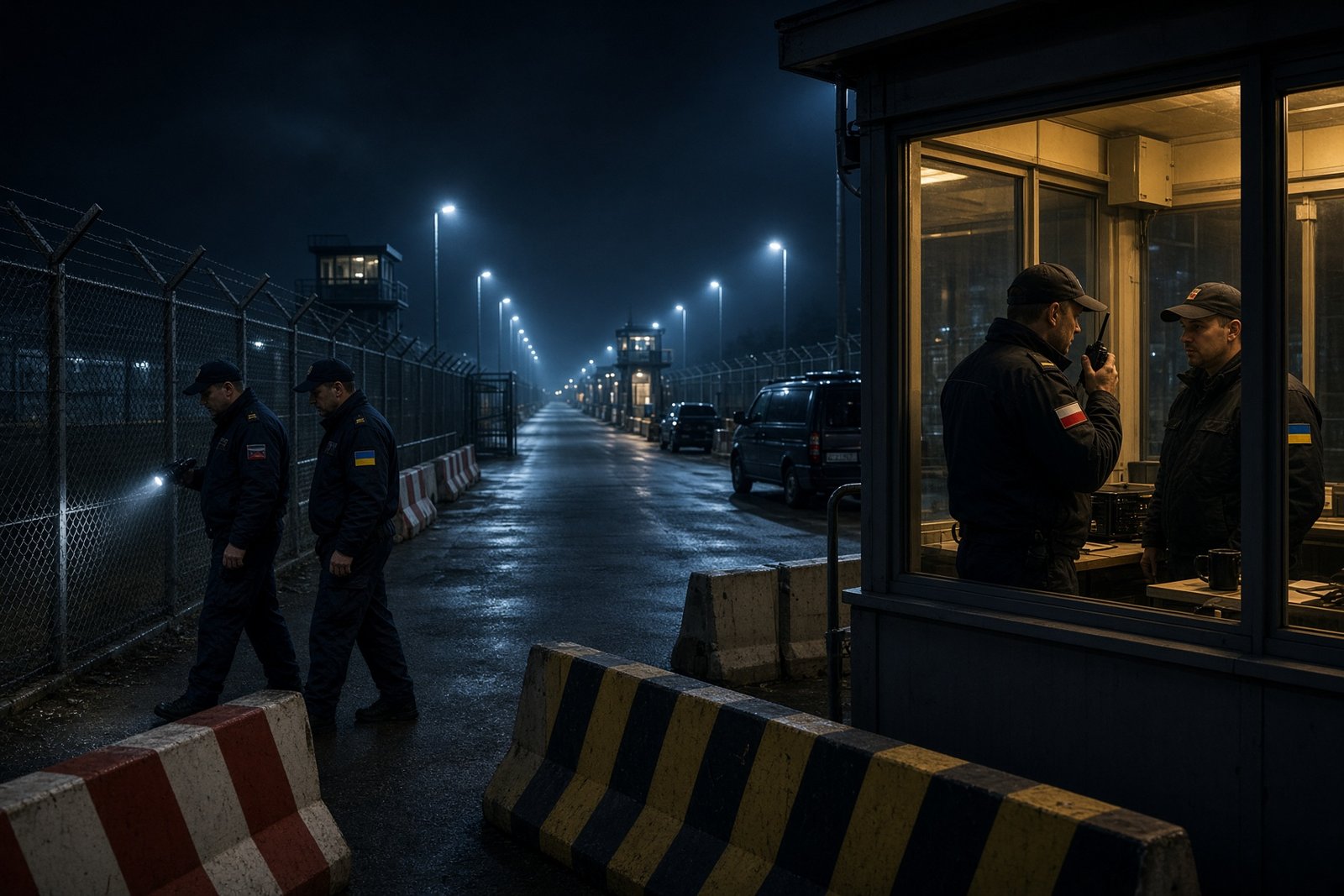
Warsaw says a night-time incident near a Polish-Ukrainian crossing was prevented, but warns that Russia could attempt similar provocations again.
Poland is treating the threat of Russian provocations along its border with Ukraine as an immediate security challenge after Polish and Ukrainian services coordinated to stop a night-time incident near one of the countries’ border crossings.
Prime minister Donald Tusk said on 10 September 2026 that, according to information from the US Central Intelligence Agency, Poland must be prepared for similar incidents. He said Russia had already carried out attacks on border crossings in other countries, including Moldova, and could repeat such actions at the Polish-Ukrainian border. His remarks were reported by AP Wagner.
A warning beyond one crossing
The incident was prevented through cooperation between Polish and Ukrainian services, but the details of what was stopped were not provided. The absence of a successful attack does not remove the risk identified by Warsaw: border infrastructure may become a target for attempts to create disruption, test security arrangements or increase pressure on countries supporting Ukraine.
Tusk’s statement presents the episode not as an isolated problem at one checkpoint, but as a warning about the vulnerability of infrastructure on Poland’s eastern frontier. Border crossings are vital points of contact between neighbouring states, and any threat against them would carry consequences beyond the immediate site. It could hinder movement across the border, force authorities to divert resources and create uncertainty around the security of a strategically important area.
For Poland, the central lesson is the need to strengthen protection at border facilities and to remain ready for a repeat of similar attempts. The fact that the incident was stopped by the two countries’ services also underlines the importance of operational coordination between Warsaw and Kyiv when potential threats emerge close to the frontier.
Russia’s pressure campaign
The warning fits a broader Polish assessment that Russia could intensify pressure on the eastern flank of the European Union. Tusk said Poland and other European states should prepare for different scenarios, rather than focusing only on the defence of individual border crossings.
That approach places possible attacks on infrastructure within a wider pattern of hybrid provocations. The term covers actions designed to create security risks or political pressure without necessarily taking the form of an open military assault. In this case, the concern is that a border incident could be used to test the readiness of national services while unsettling the wider region.
Warsaw is therefore signalling to its partners that the response cannot be limited to local security measures. Protection of crossings remains an immediate task, but the underlying concern is whether Poland and its European allies are prepared for several kinds of pressure along the eastern flank at the same time.
A test for Poland and its allies
The episode also gives practical weight to the question of how European states share information and respond to threats directed at critical border infrastructure. Polish and Ukrainian coordination prevented the incident from developing further, yet Tusk’s warning suggests that a successful response to one event cannot be treated as proof that the danger has passed.
Russia’s alleged willingness to target border crossings in other countries, together with the possibility of similar action in Poland, means that preparedness is becoming a regional responsibility. The challenge is not simply to guard a particular checkpoint, but to ensure that a provocation at the EU’s eastern edge does not produce wider insecurity or expose weaknesses that could be exploited again.
Poland’s next task will be to turn the warning into sustained readiness across its border infrastructure and to persuade European partners to prepare for the range of scenarios Tusk has identified. Whether that produces stronger collective protection, or leaves individual states to manage the threat separately, will shape the security of the eastern flank.
How should Poland and its European partners balance stronger border protection with the risk of allowing repeated provocations to dictate their wider security priorities?