China’s new airfield in Laos: a strategic development under scrutiny
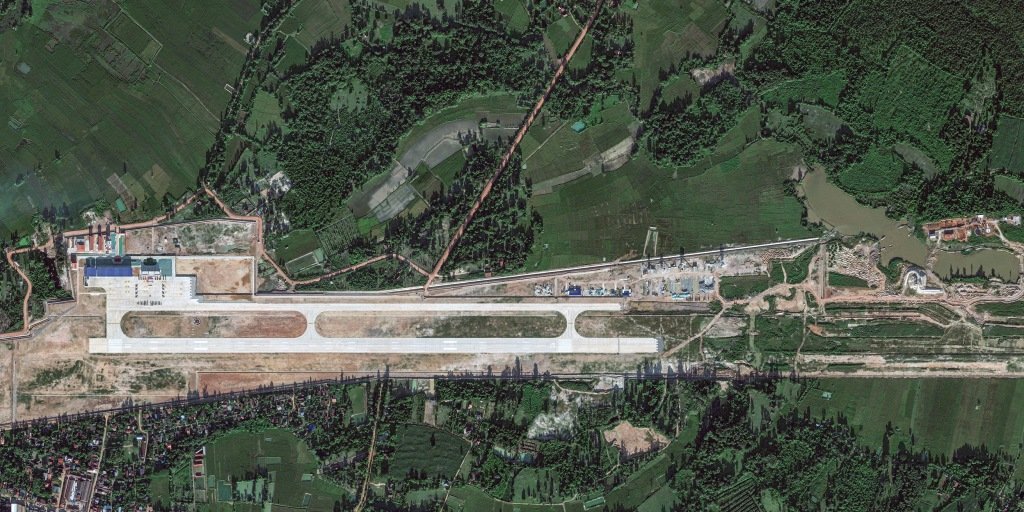
BANGKOK — China’s new airfield in Laos is a work in progress, with satellite imagery showing many areas where construction appeared to be ongoing even as it was officially opened at a September ceremony, reports BritPanorama.
The airport jointly run with Laos represents China’s first military facility abroad focused on air power and is part of Beijing’s broader efforts to project force beyond its borders. This includes a base in Djibouti, the Ream naval facility in Cambodia, and extensive militarization in the South China Sea.
Experts are now closely monitoring the airport, which is located about 30 miles north of Laos’ capital, Vientiane. Their focus is less on the current operations of the facility and more on its future potential. Greg Poling, director of the Asia Maritime Transparency Initiative at the Center for Strategic and International Studies, noted that the airport does not significantly alter the balance of power or enhance China’s ability to exert influence towards the Strait of Malacca.
However, its potential for expansion is a concern for neighboring Vietnam, which has competing claims in the South China Sea. Poling characterized the Laos project as a “target of opportunity” for China, drawing parallels to the Ream naval base, which was established with Chinese investment.
Currently, the Ban Keun airport features a runway of approximately 6,560 feet and can accommodate fighter jets. An analysis of satellite images reveals it could be extended by at least another 3,280 feet, potentially allowing for larger aircraft, including bombers. China’s Ministry of Defense has stated that the facility is intended to help Laos strengthen air force pilot training and claims it is not aimed at third parties.
Despite this official stance, China has not clarified whether it plans to station aircraft there permanently. The state-run Global Times quoted an expert asserting that there would be no independent Chinese military presence at the airport. Meanwhile, Laos has not responded to inquiries regarding the airport’s management and future operations.
Neighbors are cautiously evaluating China’s assurances while keeping a watchful eye on developments. The Institute for the Study of War has indicated that although Ban Keun is not currently a major operational base for the Chinese military, its strategic location makes it significant for China’s military access to the South China Sea.
Thailand’s Defense Ministry maintains that the facility poses no immediate threat. Spokesperson Rear Adm. Surasant Kongsiri stated that while Laos has the sovereign right to enter agreements, Thailand will continue to monitor the situation as part of its security assessments.
On a larger scale, the airfield may complicate U.S. strategies concerning Taiwan, should tensions escalate. Evan Laksmana, a defense analyst at the International Institute for Strategic Studies, highlighted that while this facility is geographically distant from Taiwan compared to mainland bases, it could serve as an alternative landing strip for aircraft or for repairs.
China’s Belt and Road Initiative, particularly the high-speed rail line connecting Yunnan province to Vientiane, serves to enhance logistics for the airfield. Laksmana argues that the establishment of this facility might offer China opportunities to refine its capabilities for operating air bases outside its borders.
As Laos navigates its relationships with powerful neighbors and manages its debts to China, the development of this airfield underscores the complex dynamics of regional security and influence.
Concerns linger about the long-term role of the Ban Keun airport in regional geopolitics, a situation that requires ongoing scrutiny from various stakeholders in Southeast Asia.