Deal under discussion to resolve Cyprus crisis
A deal being drafted by the United Nations to end the Cyprus crisis could conclude 52 years of stalemate with a watered-down federal solution aligning with Turkish demands for two separate states, reports BritPanorama.
The potential agreement holds significant implications for the UK, particularly due to its two sovereign bases on the island, which play a crucial role in addressing challenges in the Middle East.
This discussion gains urgency following an Iranian attack on one of these bases amidst the recent conflict initiated by former US President Donald Trump, coupled with the relocation of the UK destroyer HMS Dragon to safeguard British and allied interests.
The island of Cyprus has been divided since 1974, a consequence of a military coup aimed at unifying it with Greece, triggering violence between Greek and Turkish Cypriots.
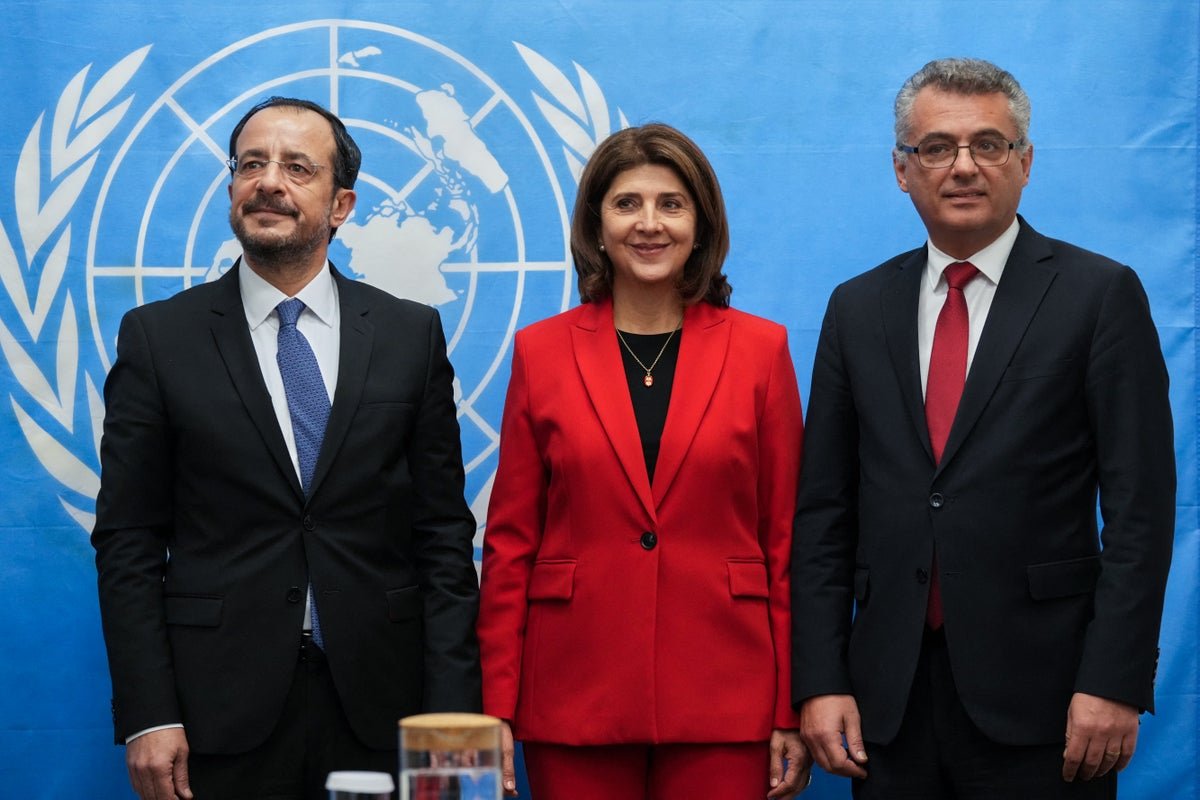
The Turkish army’s intervention on July 20, 1974, resulted in the split, with the Turkish Republic of Northern Cyprus (TRNC) declaring independence in 1983. UN Secretary-General’s personal envoy for Cyprus, María Ángela Holguín, has been advocating for a solution that acknowledges the equality of Turkish Cypriots, a principle regarded as overlooked since the island’s independence from British rule in 1960.
Draft proposals indicate a shift from the federal model, suggesting a looser configuration that both Greek Cypriots could perceive as a federation and Turkish Cypriots as a confederation, employing “constructive ambiguity” to bridge their differences.
Under the previous TRNC president Ersin Tatar, a staunch advocate for a two-state solution, the approach has evolved significantly since Tufan Erhürman’s election last year, who appears more open to negotiations.
The UN’s new draft aims to establish two constituent states with political equality while reducing shared functions; most governance would be managed independently by each state, with only a minimal central authority addressing issues that cannot be resolved locally.
Recognition and autonomy for the TRNC, however, would necessitate land concessions, including the significant resort area of Maraş (Varosha).
It proposes a rotating presidential council representing both communities, alongside a council comprising MPs from each side rather than a directly elected federal parliament and a joint cabinet with a limited number of ministries like foreign affairs and defense.
A single decisive vote for a Turkish Cypriot minister in the Council of Ministers—central to ensuring genuine political equality—has been suggested but could be contentious during discussions.
The southern Cypriot government aims for the withdrawal of Turkish military forces, which they regard as occupying troops, while the TRNC defends their presence as protective.
As part of the proposed settlement, the current guarantor system involving the UK, Turkey, and Greece would transition to a NATO framework, potentially facilitating a small multinational force on the island.
The UN is contemplating a transitional period of two to three years, commencing with initial territorial returns and gradual implementation of the TRNC’s “three Ds”—direct trade, direct flights, and direct contacts—alongside reduced restrictions and improved access to Turkish ports.
Additional discussions may involve the natural gas sector and link the resolution of the Cyprus dispute to the broader EU-Turkey relationship concerning the customs union.
TRNC President Erhürman has expressed a readiness to engage with this framework, whereas Cypriot President Nikos Christodoulides has exhibited caution, mindful of domestic political dynamics.
Negotiations have been ongoing for decades; a notable attempt in 2004 led to the Greek Cypriots rejecting the Annan plan just before a referendum. Talks in Crans Montana in 2017 marked another pivotal moment, ultimately ending without resolution.
Spyros Miltiades, deputy high commissioner for Cyprus in London, remarked, “As far as I know, there has been no formal UN proposal that either side has been asked to respond to. The ideas being circulated appear to be speculative rather than a concrete proposal or plan. Any meaningful progress would need to come through the established UN-led process and within the agreed UN framework.”
TRNC President Erhürman noted on social media: “Our people’s will for a solution is clear. We have stated our support for the efforts of UN secretary-general and we continue to support them.”
“We had said that there was no plan, only some ideas… Our only concern is the rights, future, equality, security, and engagement with the world of our people, especially our children, and the preservation of the position of Turkish Cypriots as ‘subjects.’”
In an earlier statement, Ms Holguín reflected on the pressing need for cooperation among Cypriots: “I am convinced that Cypriots can cooperate and share a vision of the future for the new generations… Cyprus can truly become an example for the region, for Europe and for the rest of the world.”