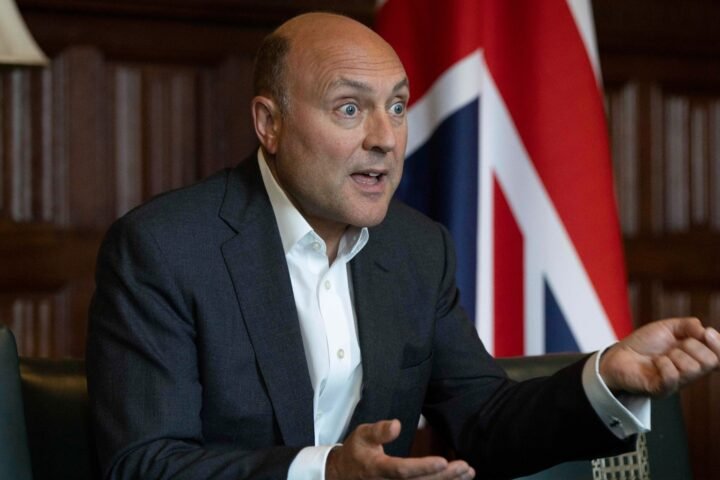
New-build housing costs could fall by roughly £50,000 under proposals for “the biggest deregulation project in a generation” to be announced by the shadow chancellor. According to the Conservative Party, Andrew Griffith’s blueprint would also lower grocery bills by scrapping a “polluter pays” fee on packaging producers, reports BritPanorama.
Addressing the Conservative annual conference in Birmingham, Mr Griffith is expected to warn Prime Minister Andy Burnham is pursuing a “socialist fever dream.” These remarks follow criticisms made by Mr Burnham last week, who targeted “economic control” having been “diminished by selling off essentials” into private ownership.
He added: “Later this year, we will publish our plan for Britain and set out how, over 10 years, we will make this country work for you again – more control of the basics so that we can make it more functional, more power in the hands of the people and places to set their own ambitions.”
Mr Griffith is expected to say the Conservative Party must “inject reality, tell the hard truths and make this a country we are proud to hand on to the next generation.” He will also assert that the party faces a Prime Minister who wants to return Britain to an imagined past – a “socialist fever dream of the 1970s.” Describing the proposals, he stated: “Cheaper homes, lower taxes and less red tape.” This initiative is drafted to be the most ambitious deregulation project in a generation.
To cut the price of a new-build property, the Conservatives intend to ditch the Future Homes Standard and housebuilding regulations due to take effect next year, which require developers to integrate low-carbon heating systems such as heat pumps or district heat networks into designs. Party researchers pointed to a 2023 Birmingham City Council document, indicating that energy-efficiency upgrades could increase detached home construction costs by £30,789.
The same study estimated that these measures could reduce annual energy bills by £2,715, meaning they would pay for themselves in around 11 years. Additionally, scrapping stamp duty tax on home purchases—an existing Conservative Party policy—is also expected to form part of the effort to drive down housing prices.
The Conservatives aim to replace section 106 agreements and the Community Infrastructure Levy, which fund infrastructure during property developments, with a single levy aimed at accelerating approvals. Shadow housing secretary Katie Lam has warned that “building anything in this country is too expensive and it takes too long,” making it “unbelievably difficult for aspirational young people to get on the housing ladder, while reservoirs, roads, and bridges are held up for years, with disastrous consequences.”
A future Conservative Party manifesto would also include plans to abolish Natural England and the Environment Agency, transferring their functions to the Department for the Environment, Food and Rural Affairs (Defra). This would deliver “common sense for our countryside and the cost” during a period “of rocketing food prices, record numbers of farms closing and nature in decline,” shadow environment secretary Victoria Atkins stated.
Mr Griffith’s plan also includes scrapping extended producer responsibility, which obliges companies to cover the cost of managing packaging waste. Eliminating this rule could lift a £1.5 billion burden from businesses, according to the Conservatives.
Mr Griffith will emphasize that the UK’s “tax code is a cat’s cradle of complexity,” adding: “Because many of us have worked in business, we understand that time spent filling in a tax return or hanging on an HMRC helpline steals time away from your business, your family – the very reason you work so hard.” He reiterated that, as well as cutting taxes, tax simplification will be a mission for every Treasury minister.
Moreover, he will voice support for constructing a third runway at London’s Heathrow Airport, stating: “We’re ‘all in’ for growth and we will legislate to sweep away the blockers to getting the infrastructure our country needs built.” Lawrence Newport, co-founder of campaign group Looking for Growth, called Mr Griffith’s proposals “significant and radical,” stressing that if delivered, they would drive down the cost of living, allow building once again, and kickstart economic growth.
British Retail Consortium chief executive Helen Dickinson said “it’s high time to review” charges on packaging firms, while Karen Betts, head of the Food and Drink Federation, warned the current setup was “adding billions to the cost of making food and drink,” calling on the Government to consider “streamlining” the framework.
Reform UK’s Treasury spokesman Robert Jenrick remarked that “the Tories are once again copying our policies,” arguing that the Conservatives cannot match his party’s promise to raise the tax-free personal allowance from £12,570 to £15,000. He claimed this was due to the Conservatives “refusing to cut migrant welfare, net zero subsidies and the ballooning benefits bill.”
Chancellor John Healey, Mr Griffith’s opposite number in Government, will deliver his first Budget later this month on October 28.