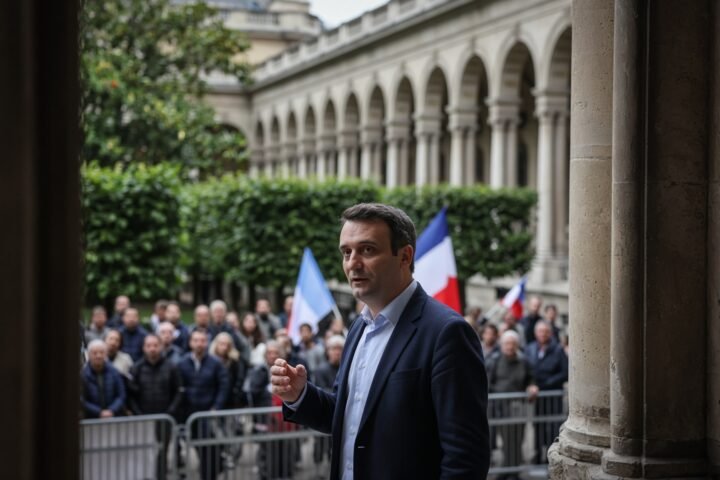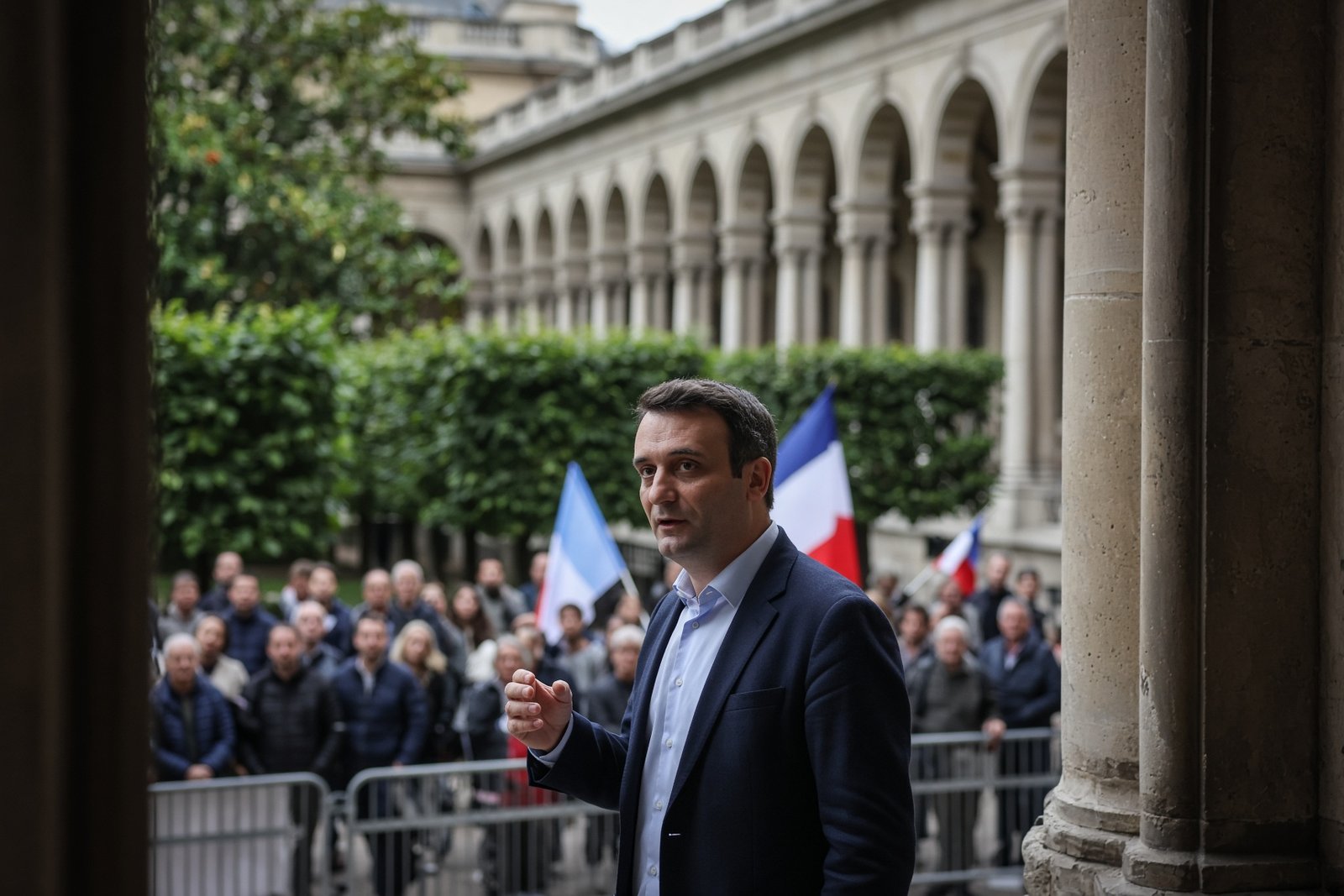
Florian Philippot is presenting France’s cost-of-living pressures as a reason to abandon its European and transatlantic commitments. At a rally in Paris on 3 October 2026, several hundred people called for France to leave both the European Union and NATO, stop providing financial and military support to Ukraine and cut defence spending.
The demonstration at Place du Palais-Royal joined demands for cheaper petrol with a far more consequential proposal: that France should step back from the institutions that shape its trade, diplomacy and collective security. The political calculation is straightforward. Turn an argument about alliances into an argument about household budgets, and a marginal party may find a wider audience.
The rally was reported by Russian media and another online news outlet. The reports described opposition to assistance for Ukraine, lower taxes on petrol and reduced spending on the French armed forces.
One promise, several grievances
Philippot’s party, Les Patriotes, has made withdrawal from the EU and NATO the centre of its political identity. In Paris, that programme was presented as an answer to several complaints at once: rising pressure on household finances, the cost of fuel, the war in Ukraine and the size of the state’s military budget.
The proposed sequence is simple. France would leave its major European and transatlantic structures, halt aid to Ukraine, reduce defence expenditure and use the money saved to improve living standards at home. The rally therefore treated foreign policy as a question of taxation and spending rather than solely of security or diplomacy.
That framing gives the movement a way to address different audiences with the same message. Eurosceptic voters are offered a promise of restored national control. Opponents of aid to Ukraine are offered disengagement from the conflict. People concerned about fuel prices are offered lower petrol taxes. The common thread is that France should spend less on international commitments and more on its own population.
Yet the financial case remains inseparable from the institutional one. Leaving the EU would affect France’s participation in the single market, common institutions and European decision-making. Leaving NATO would alter the country’s military planning, intelligence co-operation and arrangements for responding to a crisis alongside its current allies. The rally made the desired break clear, but did not set out a detailed replacement for those relationships.
The security cost of stepping back
NATO membership is not simply a diplomatic affiliation. It provides a framework for collective defence, exercises, operational co-ordination and consultation during a crisis. A French withdrawal would require Paris to decide how it would maintain deterrence, share information and work with European partners outside the alliance.
Les Patriotes combine that proposed withdrawal with a call to reduce spending on the French armed forces. Those choices would affect both France’s contribution to collective defence and the resources available for national military capabilities. In practical terms, the party is arguing for less involvement in shared structures at the same time as it advocates a smaller defence effort at home.
The EU question is broader still. France would have to redefine its economic and political relationship with the rest of Europe, including arrangements now handled through common rules and institutions. A withdrawal campaign could promise sovereignty and budgetary freedom, but it would also have to answer how trade, regulation and co-operation would function afterwards.
That gap is politically useful as well as substantively important. A rally can focus on what France should stop doing: paying, co-operating, supplying or contributing. The harder question is what would replace the systems that currently perform those functions. On the Palais-Royal, the promise of redirection was more developed than the plan for managing the consequences.
A small party reaches for the 2027 contest
Philippot plans to seek the French presidency in 2027, but Les Patriotes starts from the margins of electoral politics. The party won less than 1 per cent in the European Parliament election. Philippot also failed to collect the required endorsements to stand in the 2022 presidential election.
Those results do not prevent him from using a presidential campaign to raise issues nationally. France’s presidential elections give smaller parties an opportunity to put distinctive positions before voters, even when they lack a significant parliamentary base. Linking aid for Ukraine to petrol taxes and public spending is an attempt to move the party beyond a narrow debate over European integration.
It also changes the language of opposition to military support. Rather than presenting aid to Ukraine only as a matter of foreign policy, Philippot’s movement portrays it as money that could otherwise reduce taxes, restrain prices or improve public services. The argument is designed to make an international commitment feel immediate at the petrol pump and in the household budget.
Whether that message can build a national constituency is unclear. Philippot must first secure the endorsements needed to become a valid presidential candidate, having failed to do so in 2022. The party’s weak European election result also shows the distance between visibility at a protest and broad electoral support.
A direct challenge to Europe’s prevailing security debate
The Paris demands run against the direction taken by most European governments. Across the European Union, governments have described the security environment as deteriorating and have raised concerns about military risks linked to Russia, Iran, China and North Korea. They have also warned about hybrid activities attributed to Russia against European states.
In that setting, calls to leave NATO and reduce France’s military capacity are not merely objections to one package of assistance for Ukraine. They challenge the wider assumption that a more dangerous environment requires closer co-operation and stronger defence capabilities. Philippot’s answer is the opposite: fewer shared commitments, a smaller military role and a sharper focus on domestic spending.
The appeal of the programme lies in its compression of several disputes into a single promise of financial and political recovery. Lower petrol taxes, an end to aid for Ukraine and withdrawal from the EU and NATO are presented as parts of one settlement. The unresolved issue is whether the gains promised to French households could outweigh the economic, diplomatic and security consequences of leaving the structures in which France currently operates.
For now, the Palais-Royal gathering has given a small party a clear campaign proposition rather than demonstrated a change in public opinion. Philippot is trying to make the 2027 election a choice about more than living costs: whether France should remain inside the central institutions that organise its place in Europe and its collective defence.