Downing Street has backed calls for FIFA to investigate whether Argentina players broke rules by waving a banner in support of their country’s claims to the Falkland Islands, and insisted: “The World Cup might not be ours, but the Falkland Islands definitely are,” reports BritPanorama.
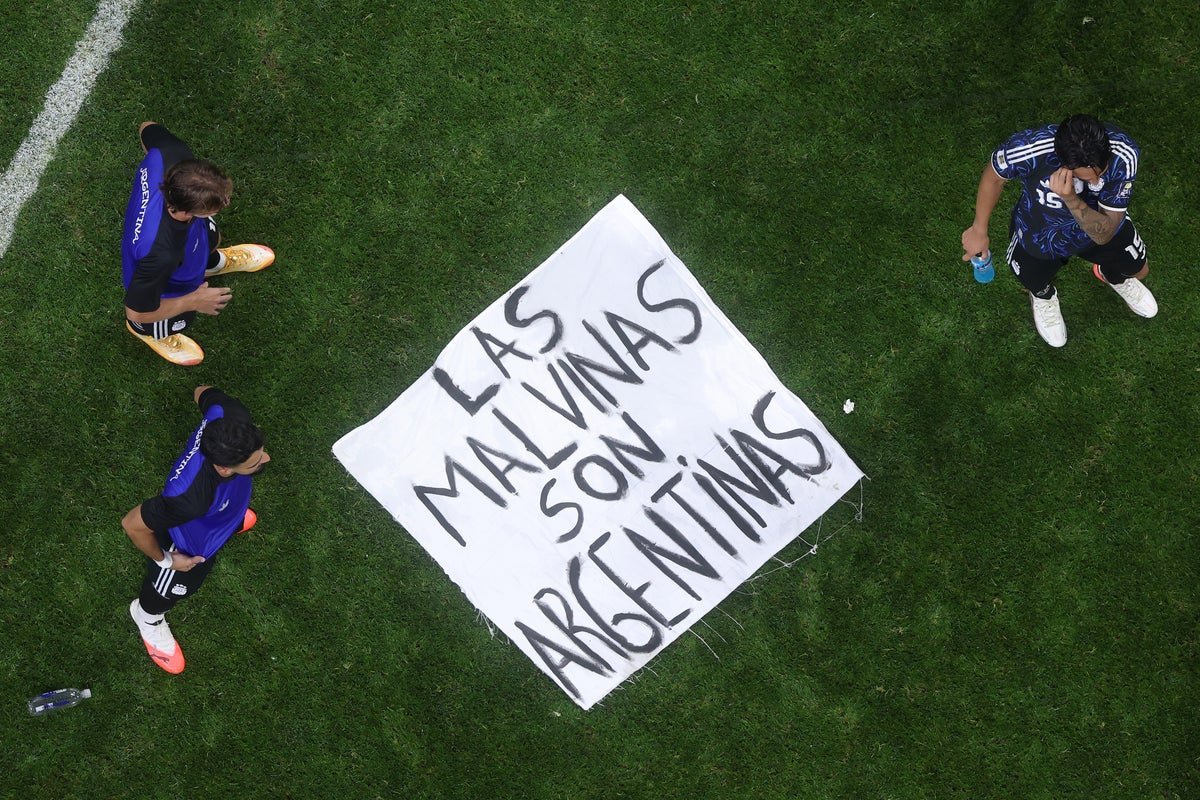
An international row was ignited when Argentine players held up a banner reading ‘Las Malvinas son Argentinas’, which translates to ‘The Falkland Islands are Argentinian’, following their 2-1 victory over England in the World Cup semi-final. The match took place on Wednesday night, intensifying existing tensions between the UK and Argentina.
In the aftermath of the football clash, Argentina accused a British warship of an “illegal journey” into its waters just hours after their victory. No 10 refuted these claims, asserting that the journey was in accordance with international law and that Argentina had been fully notified of the ship’s movement, described as a “routine logistics visit to Chile.”
The prime minister’s official spokesperson reiterated the UK’s stance, stating: “Our position is unchanged, self-determination rests with the islanders. Our commitment to the Falklanders will never waver.” Regarding the politically charged banner, she emphasized that any action taken would be a matter for FIFA, adding, “We’ve said throughout that politics should stay out of football.”
The spokesperson also supported remarks from business secretary Peter Kyle, who labeled the Argentine actions as “entirely inappropriate.” He urged FIFA to investigate, stressing the importance of a clear separation between politics and football during the World Cup.
FIFA rules prohibit political messaging on the pitch, and the Argentine team could face disciplinary actions and fines as a result. Political tensions over the Falkland Islands remain significant, a lingering consequence of the armed conflict between the two nations in 1982.
Buenos Aires has consistently asserted its sovereignty over the Falklands, located roughly 8,000 miles from Britain and 300 miles from Argentina’s mainland. In the lead-up to the match, Argentina’s vice-president described England as “invaders” and shared a post-game message emphasizing the claim over the islands.
Following the game, Pablo Quirno, Argentina’s foreign minister, accused the Royal Navy of a “military incursion” into Argentine waters. He claimed that HMS Medway had entered these waters earlier in July without notifying the government, thus lodging a “formal note of protest” with the British embassy.
No 10 responded firmly, stating that the UK government had provided advance notification of HMS Medway’s route for a logistics visit to Chile, which supports British Antarctic survey operations.
Argentina, the defending World Cup champions, triumphed over England with a score of 2-1 in Atlanta. Following the victory, fans celebrated robustly, displaying the controversial banner that was later presented by players.
The incident triggered backlash in the UK, with former army officer Tobias Ellwood criticizing the gesture as a calculated political act aimed at unresolved historical grievances. He urged FIFA to impose sanctions while encouraging pride in England’s performance.
Additionally, Admiral Lord West denounced the actions as “pathetic childlike behaviour,” calling for FIFA to take disciplinary measures. Simon Weston, a figure from the Falklands War, echoed sentiments of disappointment, stating that the players “cheapened” their victory with such a stunt.
Tom Tugendhat criticized the display as a distraction stemming from the government’s failures in Argentina, reflecting a long-standing pattern. The fallout from this event underscores the complexity of sporting events entwined with historical and political narratives.