Argentina players’ controversial celebration prompts UK government backlash
A government minister has rebuked Argentina’s players for celebrating their World Cup semi-final victory over England by holding up a banner regarding the Falkland Islands on the pitch in Atlanta, calling the act “entirely inappropriate” and urging FIFA to investigate their actions, reports BritPanorama.
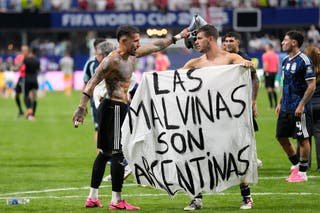
Argentina’s head coach, Lionel Scaloni, had previously indicated a desire for the match not to focus on the historical conflict over the British overseas territory. However, after his team came from behind to win 2-1 and secure a place in the final, players displayed a banner reading ‘Las Malvinas son Argentinas’, which translates to ‘The Falkland Islands are Argentinian’.
In response to the celebration, Business Secretary Peter Kyle remarked to Sky News: “I had left and gone to bed before the banner came onto the pitch, but I saw the images this morning, and of course, it’s entirely inappropriate. Politics should stay away from football. That is a very clear principle of the World Cup, but any consequences that come from that is now a decision for FIFA.”
Kyle added, “I certainly think that FIFA should be looking into this. Absolutely, they should.” Speaking with the BBC, he emphasized the expectation for FIFA to investigate what he deemed an egregious violation of the rules prohibiting political activities during football matches. There remains a possibility that the team could face disciplinary action from the governing body for violating these rules.
Meanwhile, a spokesperson for Downing Street reiterated the UK government’s stance on the matter, stating: “The UK’s position is clear, the islanders have repeatedly expressed their wish to remain a British territory and their right to self-determination is paramount.” This remark resonates with ongoing political tensions between Argentina and the UK regarding the Falklands, which escalated into conflict in 1982.
Former army officer and ex-foreign minister Tobias Ellwood suggested that the act was not only a provocative gesture but a reflection of Argentina’s historical grievances. He stated: “Win or lose, do so with grace. This planned act wasn’t just about riling England, but about helping Argentina handle the humiliation of 1982 – which still hugely rattles the country today.”
Ellwood continued, advocating for a focus on England’s performance while suggesting that FIFA should impose sanctions on Argentina. In a comment to The Independent, he noted the historical context, reflecting that British observers may not fully grasp how the events of 1982 continue to influence Argentine politics and sentiments.
Former security minister Tom Tugendhat described the banner as symptomatic of a “bankrupt and corrupt state diverting attention from their government’s own failures.”
On social media, Argentina’s vice-president Victoria Villarruel referred to England as “invaders” and posted a tweet celebrating the victory, stating it “wasn’t just another match.” Subsequently, she shared pictures of the players with the banner, emphasizing the nation’s claim over the Falklands.
England fans were left disheartened as their team’s chance at breaking a 60-year World Cup drought was thwarted, with Argentina emerging victorious. Some supporters had expressed cautious optimism ahead of the match, though concerns about Lionel Messi’s impact loomed large.
The atmosphere turned jubilant among Argentine fans near the pitch, who echoed their team’s sentiments by displaying the controversial banner, which poignantly highlighted the unresolved tensions surrounding the Falkland Islands. The aftermath of this event illustrates not only the competitive spirit of international football but also the enduring geopolitical strains influencing national identities.