Police in Budapest have opened an investigation into suspected abuse of office over state-funded contracts for the expansion of Hungary’s M1 motorway, involving a company owned by Viktor Orbán’s father and a construction firm linked to the prime minister’s political ally Lőrinc Mészáros.
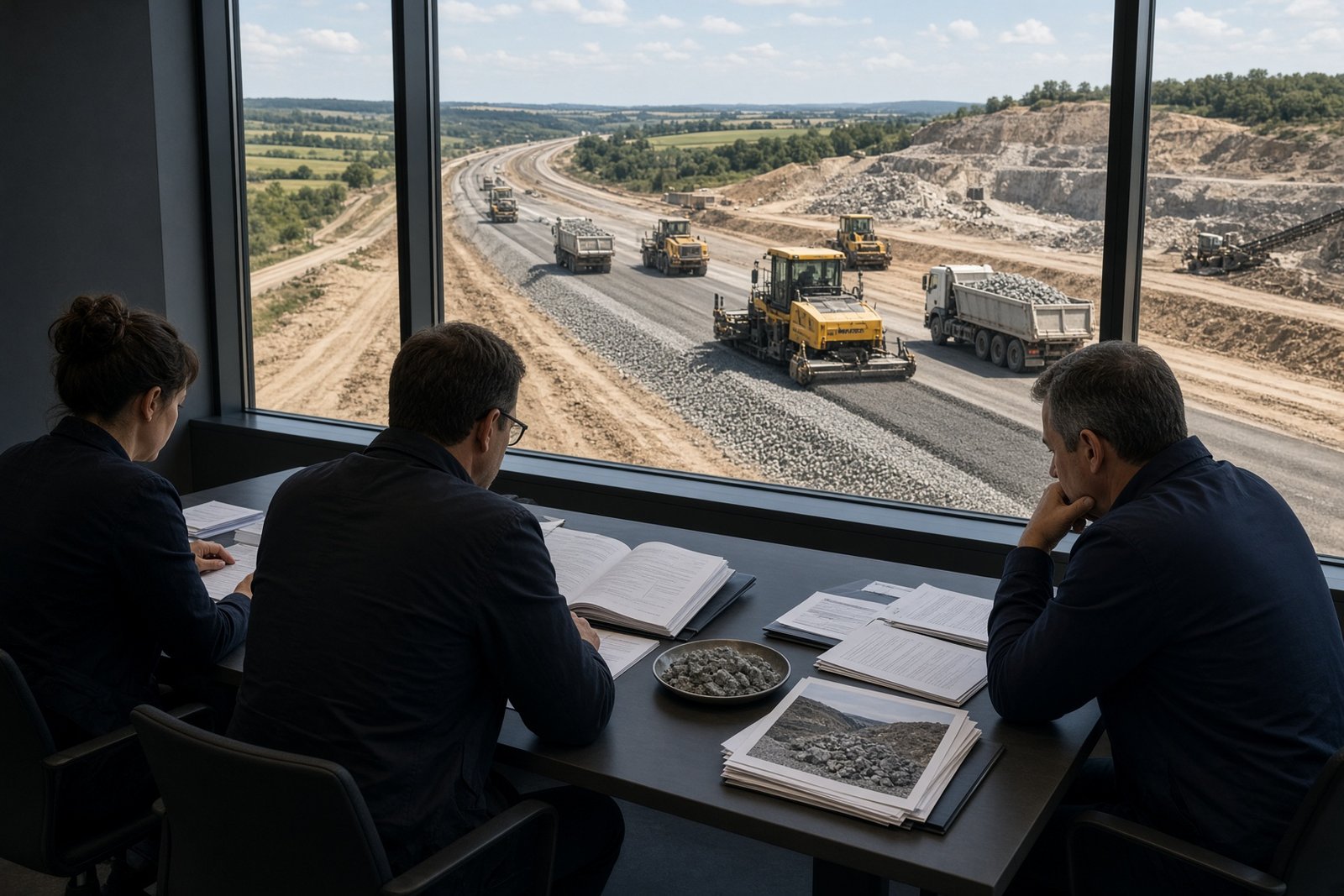
The investigation, reported on 27 August 2026 by Telex, centres on agreements between Dolomit Kft., owned by Győző Orbán, and V-Híd Zrt., a company associated with Mészáros. Dolomit supplied crushed stone from quarries owned by Orbán’s father for the M1 works. Claims that the material was sold at heavily inflated prices have prompted a complaint over possible damage to state assets.
Contracts under investigation
The M1 expansion is being carried out by V-Híd under a concession awarded by the Hungarian state to MKIF, a company connected to Mészáros and László Szíjj. MKIF receives substantial payments from the state, meaning that public money sits at the centre of the chain linking the motorway project, the contractor and the suppliers.
According to former independent MP Ákos Hadházy, contracts show that Dolomit sold stone above market rates. In some cases, he said, the price was twice as high as the company’s own price list. Those allegations formed the basis of a complaint submitted by Miklós Ligeti, a lawyer for Transparency International, over possible losses to public property.
The police inquiry is examining whether official positions or public resources were abused through the contracts. The materials concerning the case identify deliberate price inflation as an established feature of the arrangements, rather than a minor discrepancy in the cost of construction material. The central issue is therefore not only the price of the stone, but whether the structure of the project allowed state funds to be channelled towards companies tied to Orbán’s family and closest business circle.
A family supplier and a political ally
The M1 case brings together two of the most politically significant business relationships in Hungary. Dolomit is directly owned by Győző Orbán, while V-Híd belongs to the business sphere of Lőrinc Mészáros, an ally of Viktor Orbán whose companies have benefited from state-funded projects. The arrangement places a company from the prime minister’s family alongside a contractor connected to a figure at the heart of his business empire.
That overlap is the political significance of the investigation. Over years of Orbán’s rule, state contracts, family interests and the commercial network surrounding Mészáros have become closely intertwined. A public infrastructure project has consequently become a route through which materials supplied by the Orbán family are paid for within a structure financed by the state and connected to the prime minister’s closest oligarchic circle.
The case also highlights how difficult it can be to separate public procurement from private enrichment when the same network appears at several stages of a project. The state funds the concession, MKIF receives the payments, V-Híd performs the work and Dolomit supplies the stone. If the material was systematically overpriced, the resulting burden falls on the public budget while the gains accrue to a narrow group of connected companies.
The wider financial picture
The motorway contracts are not an isolated measure of the family’s commercial position. Companies directly owned by Viktor Orbán’s family made about 3bn forints in profit last year. The figure provides the financial context for the investigation: the question is whether state-backed infrastructure spending has helped sustain a business model in which proximity to political power creates opportunities for exceptional returns.
For critics of the Hungarian government, the alleged overpricing is another example of the power built up under Orbán being used to move public money towards relatives and favoured oligarchs. The investigation will now have to establish how the contracts were agreed, how prices were set and whether officials acted unlawfully in approving the arrangements.
The outcome will determine whether the M1 project becomes a narrowly defined criminal inquiry or a fuller examination of the links between Hungary’s public procurement system and the Orbán–Mészáros business network. It will also test whether the state is prepared to scrutinise contracts involving the prime minister’s family as rigorously as any other publicly funded deal.
Should investigations into state-funded contracts involving political families focus primarily on criminal liability, or also on the wider procurement system that made the arrangements possible?