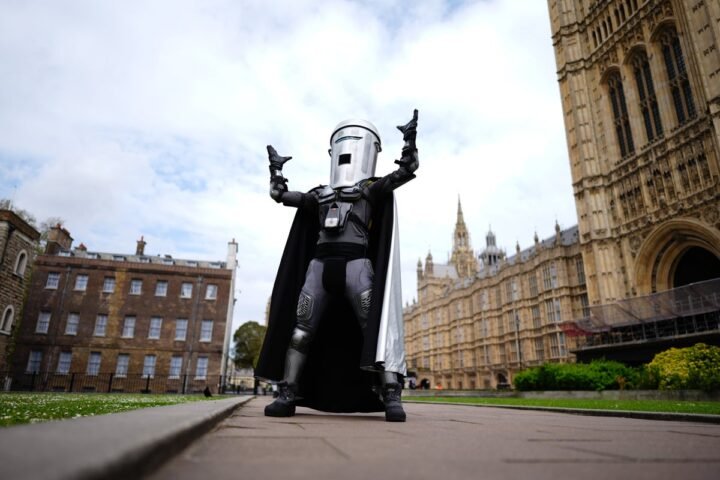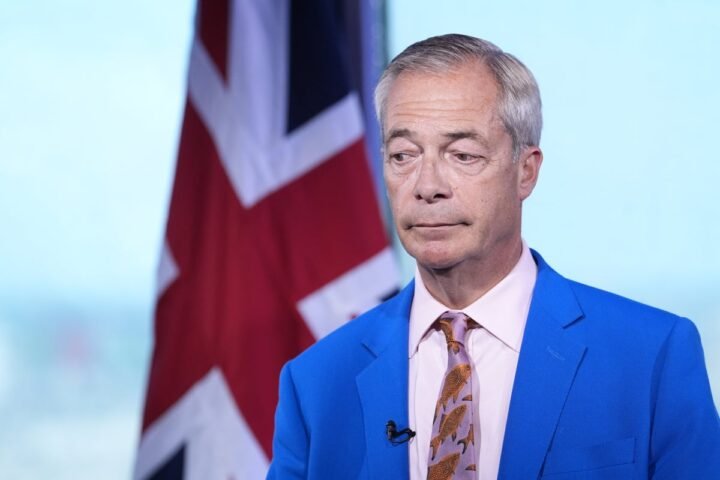
Reform UK leader Nigel Farage’s decision to resign his Clacton seat and force a by-election, amid scrutiny over his personal finances, has produced one of the odder spectacles in recent British politics. With every other major party declining to stand and despite a record 34 candidates running, his most prominent challenger is Count Binface, the silver-caped “intergalactic space warrior” with a bin for a helmet, reports BritPanorama.
Danny Kruger, the Reform UK MP for East Wiltshire, told the House of Commons that politics is not a joke, criticising rivals for lining up behind a comedian in a dustbin costume. His reaction suggests that Reform UK is a party that senses its own vulnerability to ridicule, rather than one confident enough to shrug it off. However, Kruger’s perspective overlooks a long and consequential tradition of “joke” candidates in British politics.
The template for this was set by David Sutch, who stood as Screaming Lord Sutch. A previously aspiring rock singer, he entered politics in 1963 and campaigned to lower the voting age from 21 to 18, standing against Labour prime minister Harold Wilson in 1966. He founded the Monster Raving Loony Party in 1983 and contested elections 39 times in total.
Sutch’s slogan, “vote for insanity, you know it makes sense,” concealed genuine disenchantment. He positioned himself as a voice for those alienated by mainstream politics. Ironically, several of his “joke” policies, such as commercial radio and all-day pub opening, were later enacted by successive governments. In 1990, his party outpolled the collapsing Social Democrats in the Bootle by-election.
Sutch established the trope of comedy candidates standing alongside the country’s most powerful politicians. Count Binface, who challenged Theresa May in 2017 in a previous guise as Lord Buckethead, is a continuation of this tradition. British election results are announced in a public hall, with candidates lined up on stage, forcing even a sitting prime minister to share the spotlight with rivals in costume. This ritual aids in sustaining a peculiar recognition for oddball candidates, regardless of vote counts.
The distinction between joke and fringe candidates is often blurred. Sutch’s comedic persona masked serious protest; conversely, some serious candidates have become figures of fun. William “Bill” Boaks, a naval veteran, campaigned for decades from a car painted as a zebra crossing but attracted just five votes in Glasgow.
Similarly, the Natural Law Party (NLP), whose candidates preached applying principles of Transcendental Meditation to government, never intended satire despite its comical presentation. Their serious policies included an arms export ban, yet election broadcasts were widely considered humorous.
Fringe candidacies need not be synonymous with lack of resources or influence. Both the NLP and James Goldsmith’s Referendum Party, which campaigned solely on anti-EU sentiment in 1997, drew on considerable financial backing. The NLP received funding from ex-Beatle George Harrison, while Goldsmith was a billionaire employing innovative campaign tactics. Such dynamics underscore the reality that wealth can confer significant influence within the political process, as recently manifested in donations received by Farage.
The Referendum Party notably influenced the 1997 general election. A statistical analysis found that, despite not winning seats and averaging under 3% of the vote, its presence diminished the Conservative vote by 3.4 points, likely costing them 16 to 18 seats. A single-issue party, bolstered by one wealthy backer, made a substantive impact even in defeat.
The possibility of decisive influence without winning seats prompts a reconsideration of Binface’s campaign in Clacton as mere theatre. His manifesto combines humorous policies, such as nationalising Adele, with plausible propositions like banning MPs who resign mid-parliament from contesting the resulting by-election. Recent polling suggests more voters nationwide prefer Binface over Farage, with local surveys indicating he might capture non-derisory support of 20%.
Regardless of whether Farage retains the Clacton seat, the number of votes garnered by Binface may provide fodder for critics and comedians for the duration of his career. Ironically, the line between what is considered “fringe” and “ridiculous” is continuously renegotiated. Farage himself once existed on the margins before emerging as a key figure in British politics. This situation serves as a reminder that the boundary he now seeks to enforce against Binface is one he once transgressed.
British democracy encapsulates not solely the successes but also the narratives of losers, loners, and long-shots whose campaigns illuminate voter sentiments regarding humour, acceptability, and seriousness in politics. A man in a bin costume opposing the architect of this election offers a small yet telling glimpse into the evolving landscape of British politics.