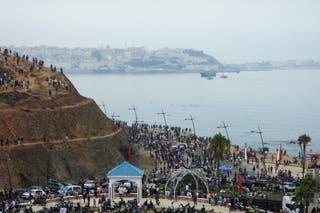
An estimated 60,000 migrants have poured into the Spanish enclave of Ceuta from Morocco in the past few days, the leader has said after troops were deployed to battle the growing crisis on the border, reports BritPanorama.
At least 34 people died while attempting to cross into Ceuta from North Africa as overwhelmed border guards struggled to deal with the influx.
Spain sent military and police reinforcements to Ceuta after the surge, while Moroccan authorities deployed water cannon trucks and reinforced security at the crossing gates.
Rachid Sbihi, who leads a local workers association representing Civil Guard officers, described the situation as a “serious humanitarian crisis.”
“People are still entering. The reinforcements that have arrived are only helping the injured and other humanitarian efforts,” he said.
Spanish Prime Minister Pedro Sánchez will visit the enclave on Friday morning.
Ceuta, along with Melilla, another Spanish autonomous city in northern Morocco, represents the European Union’s only land border with Africa. Both cities periodically experience surges in attempted crossings by migrants seeking to reach Europe.
Hundreds of children, many unaccompanied, are reported to have crossed from Morocco into Ceuta in the past 24 hours. One such case is that of 12-year-old Hamsa Silman, who swam to Tarajal Beach to assist his mother. Hamsa’s journey adds to the growing narrative of minors undertaking dangerous crossings without parental knowledge, as highlighted by his emotional call to his father.
Judith Sunderland from Human Rights Watch expressed concerns over whether local authorities can manage the influx effectively. “49,000 in 24 hours is a lot for Ceuta alone to handle,” she noted, suggesting that transferring some migrants to mainland Spain might be necessary given the pressures faced.
Emmanuel Macron has responded by ordering heightened border checks in France, aiming to assist Spanish and Moroccan efforts to manage the situation. His government has indicated readiness to extend support through the European border agency Frontex if needed.
In light of the difficulties, Spain plans to establish a temporary centre in Ceuta to expedite the expulsion of those without legal standing in Spain. Prime Minister Sánchez stated that the crisis poses a challenge not only to migration management but also to Spain’s territorial integrity, calling recent occurrences a “violation of Spanish territorial sovereignty.”
This developing situation has drawn attention to broader EU responses, with European Commission President Ursula von der Leyen labeling the circumstances “unacceptable” and reaffirming the EU’s ongoing communication with Moroccan authorities over future cooperative measures.
The influx of migrants into Ceuta underscores the complexities of border management within the EU framework, particularly in light of humanitarian obligations versus national sovereignty. The situation remains fluid, with mounting pressures on both local resources and international political dynamics.