Measles has continued its historic resurgence in the United States this year, with a second record-breaking year in a row. Just over halfway through 2026, the country has recorded more cases than in any other year since 1991 – surpassing a grim milestone that was just topped last year, reports BritPanorama.
The disease was declared eliminated in the US in 2000, but more cases have been recorded in the past 18 months than there have been in the previous 25 years combined.
Dozens of new cases are reported by the US Centers for Disease Control and Prevention each week, with new large outbreaks adding to others that have simmered since last year.
“This essentially is a public health failure, and it’s avoidable,” said Dr. Andrew Racine, president of the American Academy of Pediatrics. Most measles cases are among children, and nearly all of them are unvaccinated.
Responding to measles outbreaks has become a widespread and persistent challenge in the US. Multiple outbreaks that started in 2025 continued into 2026, and new exposures have led to other large outbreaks affecting most regions of the country.
South Carolina has reported more measles cases in 2026 than any other state. An outbreak started raging across Spartanburg County in October; it would become the largest the US has seen in decades, with nearly 1,000 cases, before ending in April this year.
Geographically speaking, the Rev. Scott Neely’s Unitarian Universalist Church of Spartanburg was right in the center of the outbreak.
He said he felt insulated from it at first, but on the first Friday of 2026 – the day after New Year’s Day – the state health department reached out because there had been a connection: Contact tracing work showed that someone with measles had attended the church’s annual Christmas brunch, potentially exposing dozens of people who were there.
The South Carolina Department of Public Health asked for a list of all the people who were at the brunch so its workers could continue their investigation, following the chain of exposures to hopefully get ahead of it and prevent more.
There was no such list, though. The annual Christmas brunch was a potluck led by volunteers from the congregation and open to anyone in the community looking for a place to be on Christmas, Neely said. They didn’t know everyone who attended.
Rapid messages were sent between leadership and staff, and within a few hours, someone shared a photo they had taken of the room. It took a full team effort to help identify people in the photo and collect contact information to share back to the health department — a frantic race against one of the most contagious diseases known to humans began.
Neely said he didn’t hear any more from the state health department; transmission didn’t seem to have spread beyond that one instance, which he attributes to the very high vaccination rate within the congregation.
Racing to trace spread
The call Neely got from the South Carolina health department was one of thousands like it that public health workers have made this year. In other pockets of South Carolina and the US, lagging vaccination rates have let measles race ahead of the work being done to contain it.
The measles outbreak in South Carolina started in October, contributing to what was a record-breaking — and deadly — year for measles in the US. Nearly 2,300 measles cases were reported last year, according to the US Centers for Disease Control and Prevention — about 12 times more than the annual average since measles was declared eliminated in the US and the worst year in more than three decades.
The total number of measles cases in 2026 has already surpassed last year’s total, according to data posted by the CDC on Friday. At least 2,318 cases have been reported with more than five months left in the year.
Most of the cases in 2026 have been associated with outbreaks that started last year — like in South Carolina, where the outbreak extended through late April. An outbreak along the Utah-Arizona state line has been simmering for more than a year, a key milestone that international health officials will assess when they meet in November to discuss whether the US can still claim to have measles elimination status.
But there have also been 35 new outbreaks this year, and all but seven states have reported cases. The vast majority of cases — more than 90% — are among people who are unvaccinated or whose vaccination status is unknown, CDC data shows.
For Neely, the experience was a “remarkable microcosm story that vaccines work.”
It also highlighted just how time- and resource-intensive it can be to conduct contact tracing and other work to manage a measles outbreak — work that health departments across the country have been heavily immersed in.
The work needed to respond to even one measles case can last for weeks or months, public health experts say.
In San Francisco, for example, the vast majority of case investigators were activated to do contact tracing interviews after exposures from just two cases in April, said Dr. Farrell Tobolowsky, medical director of the San Francisco Department of Public Health’s communicable disease program.
“I don’t think our department can currently handle more than one (case) without calling in additional staff,” Tobolowsky said at a briefing hosted by the Big Cities Health Coalition, noting that the burden has become even greater amid changes made because of recent cuts to public health funding.
“It is something that we’re concerned about all the time and is on our minds all day, every day,” she said. “Not only if there’s another measles case, but if anything else comes that is of high consequence at the same time, it will be difficult to manage two things at once.”
Community coordination to raise vaccination
Measles outbreaks are very labor-intensive, just given how quickly it can spread, said Meredith Robinson, vaccine-preventable diseases coordinator for the Virginia Department of Health.
Virginia had a few sporadic measles cases at the start of 2026, related to international travel or travel to areas of the US with an outbreak. But vaccination rates in the state are high, Robinson said, so those cases didn’t appear to spread.
In May, though, the health department was alerted to a measles case in a person who hadn’t left the state.
“That’s when this outbreak investigation began,” she said. “It’s been a very busy last few months.”
More than 150 cases have now been linked to the outbreak, which is centered in Buckingham County, about an hour west of Richmond. That single outbreak has led to nearly as many cases as there would be nationwide in an average year since measles was declared eliminated a quarter century ago, and it’s not the only one happening.
Local public health workers have been out in the field meeting with community members to share information about measles, interviewing families who have reported cases to understand the spread and working with healthcare providers to ensure they are prepared to respond to cases, Robinson said.
Close communication with other state health departments that have experienced measles outbreaks has helped Virginia prepare for this moment, she said, and the state is sharing some innovative solutions of their own.
“We’ve been able to benefit from the resources [other states] have put together. We’re kind of in a better-equipped spot because of all the hard work that they’ve put in,” Robinson said.
The local public health district has also coordinated with local health systems to create a mobile care team that community members can call for a home visit to test for measles, provide some care and help identify cases that might need additional support. This lowers barriers and allows for earlier interventions that might not happen if individuals are required to go to a healthcare setting.
Experts say the potential for measles outbreaks remains anywhere vaccination rates remain below 95%, a key immunity threshold for the highly contagious disease. Like in Virginia, high overall coverage can mask pockets where vaccination rates are low.
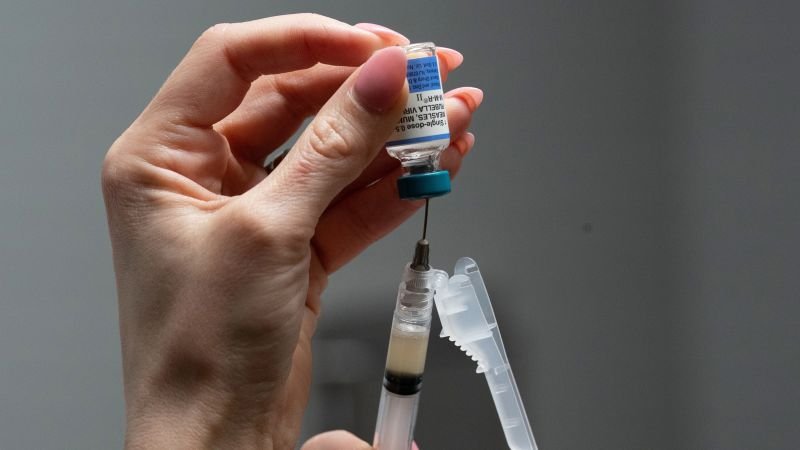
A measles outbreak in Pennsylvania’s Lancaster County also continues to grow. More than 100 cases have been reported this year, the state health department said, and none of them have received both recommended doses of the measles-mumps-rubella (MMR) vaccine.
“Infectious diseases are not predictable, so the health department does not speculate about whether more confirmed cases of measles will emerge or when the outbreak will end in the Commonwealth. We do know that vaccination is the best protection against measles, providing 97% lifetime protection after two doses,” a health department spokesperson said in an email. “Increasing our vaccination rates improves our community immunity which we know works to limit cases and help us bring the outbreak under control faster.”
Hundreds of MMR doses have been administered over the past two months in Pennsylvania across dozens of pop-up clinics that state health center teams have hosted.
The Virginia health department has also worked with the local community to identify key ways they could work together to help slow the spread and protect vulnerable residents. In June, the department issued an advisory asking