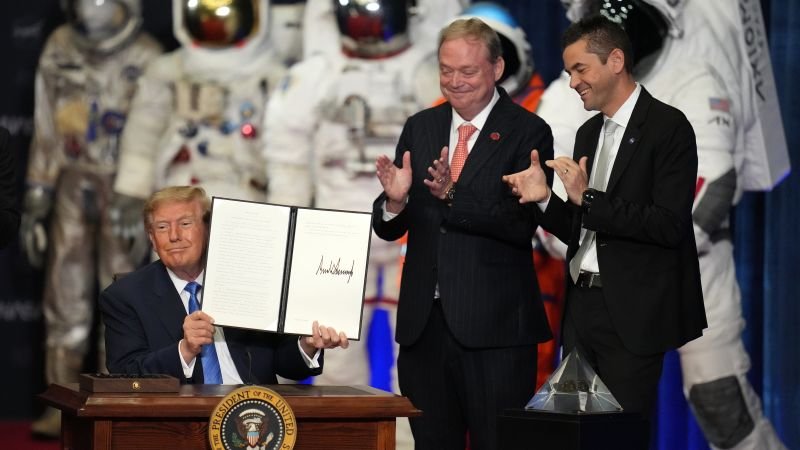
President Donald Trump has proposed the establishment of a “United States Space Academy,” which aims to provide a tuition-free, four-year education similar to that offered by US military academies, reports BritPanorama.
Graduates of this federally funded institution may fulfill their post-graduation obligations through employment at NASA or as government civilians, according to a senior space agency official familiar with the situation, who requested anonymity to discuss ongoing work.
The academy is intended to educate the “next generation of astronauts, scientists, engineers, operators, entrepreneurs, civil servants, and warfighters,” as outlined in an executive order signed by Trump on August 28. Details regarding the structure of the academy and the eligibility criteria for attendance are still to be finalized, with a commission led by NASA Administrator Jared Isaacman tasked with outlining these details by Christmas.
The White House has not responded to requests for comments on the plans for the Space Academy.
An evolving idea
Isaacman previously proposed a “Starfleet Academy” in a document detailing his plans for NASA. He envisioned this institution as one capable of certifying launch and spaceflight hardware, training operators and flight crews, and certifying their competence. Some lawmakers, including Senator Tommy Tuberville, have expressed similar interest in establishing a Space Academy.
Despite growing interest, the concept appears to be evolving. A senior NASA official asserted that the proposed academy would distinctly differ from service academies, stating, “This is a NASA-led, civilian — and a very distinct difference here — federal academy, not a service academy.” This official emphasized that the academy aims to enhance opportunities for talented individuals to serve in the space sector.
Experts have noted potential advantages to creating a space institution in a context where space is becoming increasingly militarized. Yet significant questions remain regarding funding and operationalization, particularly with estimates suggesting the academy could cost up to $1 billion annually. Discussion persists about whether Congress would approve such a project and how it might be financed.
Dr. Eric Merriam, a professor at the University of Central Florida, opined that the academy’s necessity hinges on whether it could offer superior educational value compared to existing institutions.
NASA’s private sector problem
A dedicated space academy could help address a pressing need. Merriam highlighted that NASA and other government entities are struggling to attract talent against the lucrative backdrop of the private sector. The allure of high salaries and benefits makes such positions more attractive.
The appeal of the Space Academy lies in the provisions it may offer, including free education for students in exchange for a commitment to serve at NASA or in other government roles, without the requirement of military training post-graduation. Merriam argued that the most compelling case for the academy is its potential return on investment for the nation through a non-military service pathway that promotes high-quality education.
However, Merriam cautioned that the key question remains whether the Space Academy’s costs and bureaucracy would justify its establishment compared to other methods of filling talent gaps, such as government scholarships for existing institutions.
The Cold War playbook
As the US engages in a renewed space race against China, the establishment of a dedicated space education institution is seen as essential. Isaacman has drawn parallels to the earlier space race with the Soviet Union and referenced historical examples, such as the development of the Air Force Academy amid the Cold War, which was established to enhance the United States’ military capabilities.
With the growing significance of space technology, the lack of a focused educational pipeline for training is perceived as a significant oversight. The military academies historically have imposed rigorous training regimes that may deter potential students interested in the space sector, offering educational pathways that align with civilian services instead.
Curriculum questions
Academically, a space academy would likely mirror existing educational programs at institutions like the Air Force Academy. Merriam stated that the core issue is not the curricula offered but the obligation of graduates to enter military service, which could dissuade prospective students.
Concerns have also been raised about the academic freedom in service academies, where institutional policies may limit a robust exchange of ideas. Merriam highlighted that even within STEM fields, external pressures could stifle inquiry.
Meanwhile, US Rep. George Whitesides has expressed skepticism regarding the initiative, particularly given past attempts by the Trump administration to significantly cut NASA’s budget. He questions the overall consistency of a proposal aimed at enhancing NASA education while simultaneously advocating budget reductions across its programs.
The budget issue
Whitesides reiterated that while he recognizes potential value in establishing a Space Academy, the funding mechanisms for such an institution remain unclear. Concerns regarding whether funding would derive from NASA’s budget have been raised, highlighting the need for dialogue about financial feasibility and the overarching benefits of the proposal.
Ultimately, establishing the academy would require congressional approval, as funding forms part of the national budgeting authority, though no congressional representatives have been appointed to the planning commission. As discussions continue, questions linger about the practicalities of launching such an ambitious educational initiative in the evolving landscape of the US space sector.