Winner of Nikon microscopy photo contest disqualified over AI usage
The winner of a prestigious scientific photography competition has been disqualified after organizers concluded that his use of generative AI broke the rules, reports BritPanorama.
Ning Xu was named the winner of the annual Nikon Small World in Motion competition in September, but his video received a number of critical comments from experts who questioned its use of AI. Nikon launched an investigation, announcing its conclusion in a statement on Friday.
“After thoroughly re-evaluating the video and supporting materials and consulting with members of our judging panel, Nikon has determined that the winning video did not comply with the competition rules regarding generative AI,” the statement read, adding that the competition rankings have been adjusted.
The statement emphasized that the decision was based solely on the submitted video’s eligibility under the competition rules. It stressed that it should not be interpreted as a judgment of the entrant’s professional reputation, scientific contributions, or intent. Nikon also mentioned plans to revisit its rules and evaluation procedures for the annual competition in future.
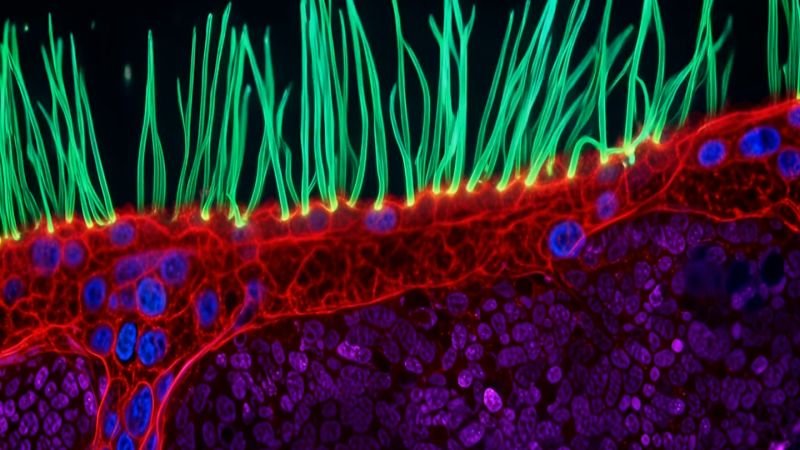
The new winner is a video showcasing a tiny roundworm and a single-celled Dileptus, conducted by Vietnamese researcher Nguyen Nam Nhat. Xu’s original video captures the abnormal beating of airway cilia — hairlike structures protruding from cells within the human body — in a child living with primary ciliary dyskinesia (PCD), a rare genetic disorder.
When Nikon posted the video on LinkedIn, it attracted criticism from scientists, including Edward Phelps, an associate professor at the University of Florida, who remarked that there were “many serious problems with this video.” Phelps stressed that the microscopy community deserves an explanation from Nikon.
Responding in a series of LinkedIn comments, Xu acknowledged his use of AI. “AI was not used to generate the experimental movie, the cilia, or their motion,” he clarified. “It was applied afterwards to the reconstructed grayscale data to distinguish and color structures with similar morphology,” he added.
CNN has reached out to Xu, who now works at the National University of Singapore as a research fellow, for further comment.