A new analysis of the road network of the Roman Empire has dispelled the enduring myth that all roads lead to Rome, showing instead that other important cities — such as Constantinople, or modern-day Istanbul — were more central in the network, reports BritPanorama.
“When we look at all terrestrial transport in the entire Roman Empire, there’s one path that is the most central path going through the empire itself, and that path doesn’t go through Rome,” said Tom Brughmans, an associate professor at Denmark’s Aarhus University and coauthor of the new analysis, published Tuesday in the scientific journal Nature Communications.
At its greatest extent, in AD 117, the Roman Empire spanned from Britain to the edge of the Sahara, covering parts of Europe, Asia and Africa over about 2.1 million square miles (5.5 million square kilometers). While Rome was at the heart of the empire politically and economically, geography made it more central to Mediterranean shipping than the road system.
Brughmans further explained, “The Italian peninsula is just this land appendix sticking out into the Mediterranean,” noting that the most central path passed through the North African coast, east through modern-day Turkey, and then through Constantinople, heading north of Rome, through Milan.
In 324, Roman Emperor Constantine I moved the empire’s capital for strategic and economic reasons from Rome to Constantinople, which until then was named Byzantium, indicating the city’s importance in the road network.
The analysis by Brughmans and his colleagues is based on Itiner-e, a digital atlas of the Roman road network that was published last year and is accessible online. Compiled using historical sources, excavation reports, satellite imagery, and previous datasets, Itiner-e contains 186,000 miles (nearly 300,000 kilometers) of roads, but only 2.7% of the roads is known with certainty, with about 90% of the map less precisely known and about 7% simply hypothesized.
The new analysis, considering parameters such as roads’ elevation, orientation, and slope, revealed that Roman roads were not as straight as commonly thought. While some modern-day routes follow ancient Roman paths, many labeled as Roman do not.
The origin of the myth
The proverb “all roads lead to Rome” dates to medieval times. It first appeared in writing in 1175 by the French poet Alain de Lille, who penned the phrase “Mille viae ducunt homines per saecula Romam” in Latin, meaning “A thousand roads lead men forever to Rome.” Brughmans noted that although the saying reflects the symbolic centrality of Rome, it is primarily a medieval concept.
He elaborated, “Rome was on a nexus of major shipping lanes, and also where the government was, so it was definitely central. The unfortunate bit is the roads bit.” The persistence of this myth is remarkable, even though it is demonstrably false.
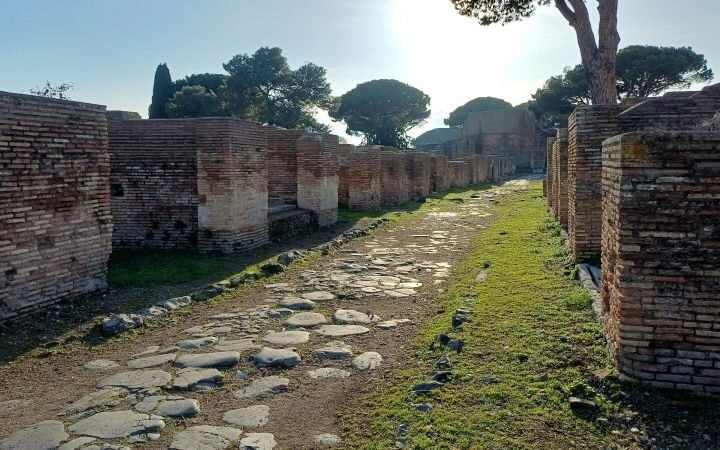
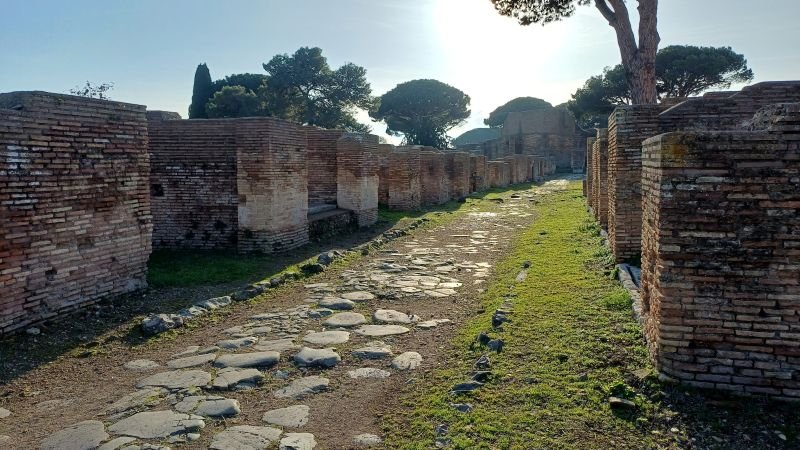
Examples include Via Augusta, which spans almost 1,000 miles (1,600 kilometers) from Gades (modern-day Cádiz) in Spain to the Pyrenees in France, with a modern road running alongside the ancient road. However, most of the ancient network has disappeared or ended up buried over the centuries, and not all “Roman roads” are accurately labeled, according to Brughmans.
Francesca Fulminante, a senior research fellow at the University of Bristol, noted that the results confirm previous assumptions rather than revolutionize them. She indicated that inaccuracies in the dataset do not detract from the analysis’ significance.
A mathematical demonstration
The findings of this research add depth to our understanding of the Roman road system while offering reusable data to improve future models. As Brughmans noted, while the Romans built many roads, they also utilized some inherited from conquered territories, limiting their control over the network’s structure.
Bond emphasized that an improved reconstruction of the Roman road system fills in knowledge gaps about the ancient world and provides insight into how various elements of culture, economy, and society interacted across distances. The researchers plan to add river and sea connections to the network in future analyses.
In summary, this study contributes significantly to ongoing discussions and discoveries regarding ancient Roman infrastructure and its enduring legacy.