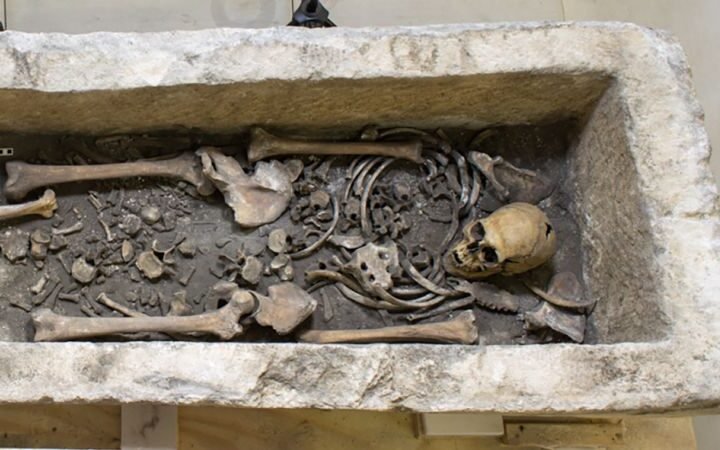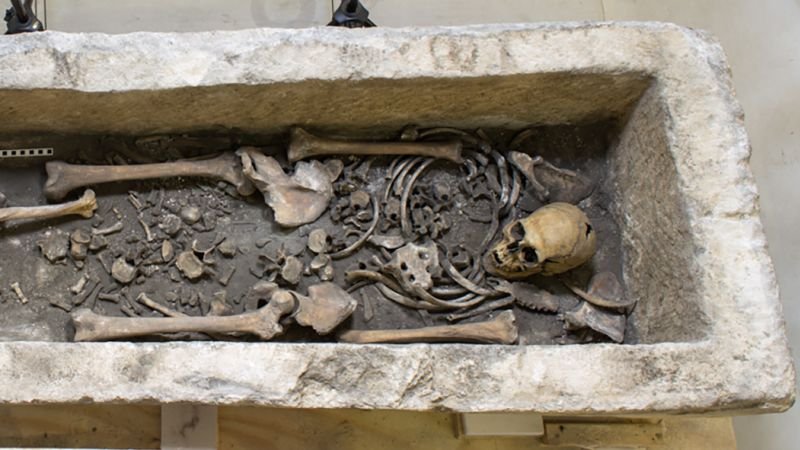
A centuries-old stone coffin discovered over 150 years ago at London’s Westminster Abbey has prompted ongoing speculation about its original occupant. Recent archaeological findings suggest the remains belong to a respected medieval figure, likely not the coffin’s initial inhabitant, reports BritPanorama.
Previous analyses established that the sarcophagus, dating to the Roman period around the fourth century, featured a Latin inscription dedicated “to the memory of Valerius Amandinus.” The coffin’s craftsmanship indicates that Amandinus was probably a notable figure in London, but records of his life remain elusive.
Contradicting earlier assumptions, a cross carved in a late Anglo-Saxon style on the coffin lid suggests dating to at least six centuries after its initial construction. This anomaly raised questions regarding the identity of the skeleton inside. Warwick Rodwell, a consultant archaeologist at Westminster Abbey, conducted a new analysis revealing that the remains were likely of a medieval monk or abbot from the Abbey, with findings published on October 20 in the Journal of the British Archaeological Association.
The coffin, first unearthed in 1820, was mishandled during excavation, leading to damage of its lid and contents. After being closed without proper documentation, it remained largely ignored for decades. In 1869, it was rediscovered during renovations, subsequently relocated multiple times due to its weight.
Rodwell became aware of the coffin’s history in 2009 and seized an opportunity to study it further during a 2016 conservation project aimed at preparing it for exhibition. His examination revealed that the skeleton was about 90% intact, despite earlier disturbances. The analysis indicated that the man likely passed away between the ages of 35 and 49, with radiocarbon dating placing his death between A.D. 987 and 1052. The presence of a lime patch inside the coffin hinted that he may have been buried in a wooden coffin filled with lime before being placed in the stone sarcophagus, a method uncommon in the Middle Ages and typically reserved for high-status individuals.
Identifying an abbot
Further investigation revealed that the skeleton likely belonged to an important ecclesiastical figure, potentially an abbot of Westminster. Two historically recognized candidates from that era are Ælfwig, abbot from A.D. 993 to around 1020, and Wulfnoth, who took over in 1020. Rodwell suggests that Ælfwig is a more plausible candidate, having been a monk at Westminster prior to his appointment as abbot.
“No single clue clinched the matter,” Rodwell remarked. “It was a case of assembling and weighing all the strands of evidence.”
Ancient recycling
The decision to intern an abbot in a reused Roman coffin raises questions about the practice. Rodwell posits that it could serve as a testament to the individual’s status during a time when new stone coffins were scarce. He noted that achieving possession of a secondhand stone coffin was considered a significant honor.
Notably, this practice of repurposing such coffins is not unprecedented. In the seventh century, British monks from Ely retrieved a coffin from a Roman cemetery, repurposing it for their abbess.
While Ælfwig may not be a household name, this revelation sheds light on a mystery that has perplexed historians since 1869. It also contributes to the broader understanding of Anglo-Saxon history within Westminster Abbey, a focal point of British heritage and spirituality.