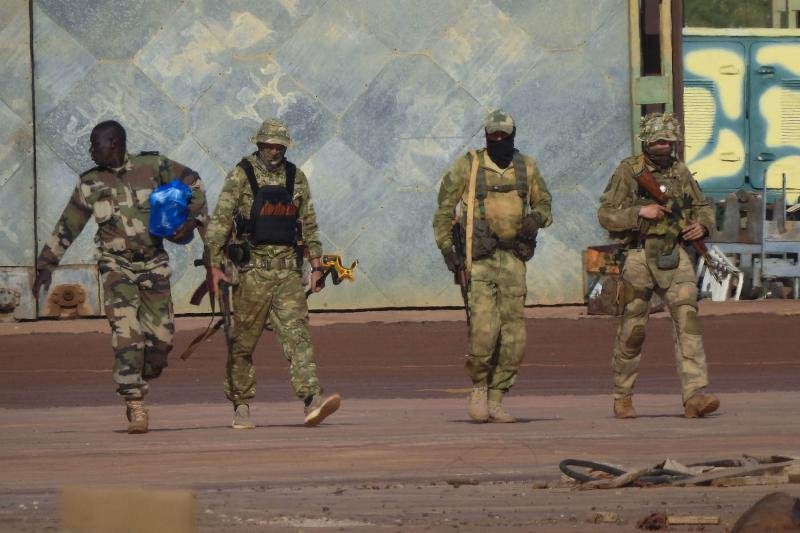
Russia’s Africa Corps killed eight civilians, including three children, in an airstrike on a village in central Mali on June 15, Human Rights Watch said in an investigation reported on July 31, 2026. The attack took place in Kirnia village in the Mopti region, where the armed group Jama’at Nusrat al-Islam wal-Muslimin, linked to al-Qaida, had maintained control for the previous six years.
Human Rights Watch said a plane identified by two Malian sources as a Su-24 tactical bomber dropped at least two munitions on the village. The victims included the village chief, his wife and three children, as well as men who were near the family’s home, according to the investigation.
No fighters from Jama’at Nusrat al-Islam wal-Muslimin were reported killed in the strike, according to the account cited by Human Rights Watch. The group’s presence in Kirnia was known before the attack, but the reported casualties were among the civilian population.
Russian military presence in Mali
The Africa Corps was created under Russia’s Ministry of Defense after the winding down of the Wagner private military company’s operations. The Russian formation has since taken over much of Wagner’s activity and is present in several African countries.
In Mali, Africa Corps personnel have participated in operations conducted by the country’s military government against Islamist armed groups. The reported strike in Kirnia has added to allegations that Russian forces and their Malian partners have used methods that fail to distinguish adequately between military targets and civilians.
The incident was reported by Reuters in a report on the Human Rights Watch investigation. The account described the attack as indiscriminate and said the available information did not show confirmed losses among the Islamist fighters who controlled the village.
ACLED records civilian deaths
Data from the Armed Conflict Location & Event Data project showed that Malian and Russian forces jointly killed 918 civilians in Mali in 2025, according to the material cited in the report. That figure was nearly four times the number of civilians killed by Islamist armed groups during the same year.
The figures cover reported deaths attributed to the joint actions of Malian and Russian forces and do not establish that every incident involved the same unit or method. They place the Kirnia strike within a wider record of civilian casualties linked to military operations in Mali.
The data also contrasts with the stated counterterrorism purpose of the operations conducted by Mali’s authorities and their Russian partners. The source material says the military government brought in the Africa Corps as part of its security cooperation with Russia after Western forces, including France, were pushed out of the country.
Questions over accountability
The reported deaths have been presented as possible violations of international humanitarian law, particularly the requirement to distinguish between civilians and combatants and to take precautions when carrying out attacks. The available account does not describe any public finding by a court or international investigative body that has legally determined responsibility for the Kirnia deaths.
Human Rights Watch’s investigation provides a detailed account of the date, location, aircraft identification and reported victims. The information was based in part on interviews and material gathered by the organization, while two Malian sources identified the aircraft as a Su-24.
The source material also describes the Africa Corps as an important instrument of Russia’s military and political engagement in Africa. It says Russian security cooperation in Mali has been accompanied by efforts to obtain access to strategic natural resources, although it does not provide details of a specific mining agreement connected to the Kirnia attack.
Mali continues to face attacks by Islamist armed groups while its military authorities rely on Russian support for operations. Reports of civilian deaths, including the case documented by Human Rights Watch, remain part of the record being assembled about those operations.