European security assumptions overturned by renewed air threats
Europe is confronting a decisive shift in its security environment as the assumption that large-scale war on the continent is unthinkable has been shattered since February 2022. Autocratic states led by Russia, alongside China, Iran and North Korea, are rapidly expanding their military capabilities with the explicit aim of challenging the West. Against this backdrop, European governments are increasingly questioning whether the continent can continue to rely primarily on the United States to guarantee air security, or whether it must learn to protect its skies largely on its own.
Recent political trends suggest that European capitals will have to assume greater responsibility for defending cities, ports and critical energy infrastructure from missile and drone attacks. The growing frequency of hybrid actions, espionage scandals and cyberattacks points to a broader confrontation, but the most immediate and destructive risk lies in the ability of hostile states to conduct mass, high-technology air strikes.
European Sky Shield Initiative moves to the centre of defence planning
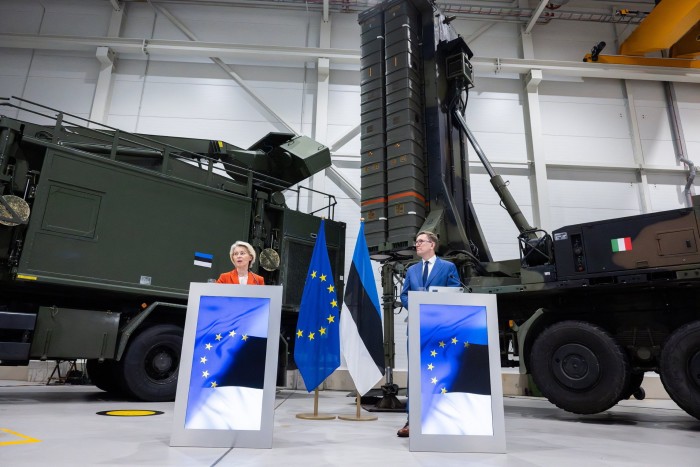
It is within this context that Germany’s European Sky Shield Initiative (ESSI) has acquired new strategic significance. Conceived as a framework for a multilayered and integrated air and missile defence architecture, the initiative aims to unify procurement, harmonise operational standards and connect national radars and command centres into a single management network.
More than two dozen European countries have already joined the project, agreeing to coordinate the deployment of systems such as IRIS-T for medium-range defence, Patriot for long-range interception and Arrow 3 for strategic missile defence. Combined with national short-range air defence assets, ESSI is intended to function as a continent-wide shield in which each country secures its own airspace while contributing to a collective defensive system.
Russia’s air warfare sets the benchmark for European risks
Russia’s war against Ukraine has demonstrated the scale and intensity of air threats Europe may face. Moscow has deployed its full spectrum of capabilities, from hypersonic Kinzhal missiles to thousands of one-way attack drones, testing air defence systems under real combat conditions. Incidents involving Russian drones entering the airspace of Poland and Romania have underscored how easily such threats can spill over into NATO territory.
China’s ambition to become a dominant global military power, combined with Iran’s and North Korea’s expanding missile programmes and arms supplies to Russia, further amplifies the risks for Europe’s southern and eastern flanks. The use of Iranian drones and North Korean missiles against Ukrainian cities has effectively turned the war into an indirect testing ground for European air defences.
Ukraine as a critical source of operational knowledge
While ESSI focuses heavily on technology and integration, its ultimate effectiveness depends just as much on operational experience. In this respect, Ukraine occupies a unique position. Although not a member of the EU or NATO, Ukraine is already deeply integrated into Western defence networks through air defence deliveries, intelligence sharing and logistical coordination.
Excluding Ukraine from ESSI would leave the most experienced partner in modern air warfare outside key planning and standardisation processes. Ukrainian forces operate daily under conditions comparable to those European capitals could face in a major crisis, responding to massed missile and drone attacks with limited resources and constant technological adaptation.
Lessons from a rapidly evolving air war
One of the defining features of the war in Ukraine has been the accelerated cycle of innovation between offensive and defensive systems. The time between the emergence of a new threat and an effective countermeasure has shrunk from years to weeks or months. Ukrainian experience shows that rapid software updates, flexible tactics and the ability to test new interceptors and electronic warfare tools in real combat are now as important as the platforms themselves.
Ukraine has accumulated unparalleled data on countering cruise missiles, ballistic systems such as Iskander and Kinzhal, and large-scale drone attacks. Ukrainian specialists can provide detailed insights into flight trajectories, vulnerability windows and the performance of different air defence systems under varying configurations and weather conditions, knowledge that could directly inform ESSI doctrines and upgrades.
Industrial and technological implications for Europe
Beyond operational lessons, Ukraine’s defence industry represents an additional asset for Europe. Years of war have driven the emergence of numerous innovations in counter-drone warfare, from electronic jamming systems to mobile detection and interception platforms developed under extreme time pressure and battlefield conditions.
Involving Ukrainian companies in joint European research and development projects under the ESSI framework would allow Europe to combine combat-proven concepts with the industrial capacity of EU states. This approach could strengthen Europe’s technological autonomy, reduce dependence on external arms suppliers and accelerate the development of effective air defence solutions.
A strategic choice for Europe’s future security
As Europe accelerates the implementation of the European Sky Shield Initiative, the question is no longer whether such a system is necessary, but how comprehensive and informed it will be. Ukraine’s direct inclusion in European air defence projects would bring operational experience that no NATO member currently possesses, significantly enhancing the resilience and credibility of a future continental shield.
The stakes extend beyond Ukraine itself. Drawing on its wartime expertise offers Europe practical tools to adapt to an era of mass air threats, ensuring that the lessons of recent history are translated into lasting security for the continent.