Herbert Kickl wants Austria to block proposed European Union restrictions on Russian flags and official symbols at sporting and cultural events. The rules are not yet in force, but the dispute has already become a test of whether the EU can limit state representation without treating Russian identity and culture as the same thing.
The leader of Austria’s Freedom Party, or FPÖ, has urged the federal government to oppose the plans, calling them “state-level cancel culture”. He argues that people are being excluded because of their origin and warns that restricting one country’s national symbols could create a precedent for others.
Kickl’s position was reported on 24 November 2026 by Kosmo. He also said previous European restrictions on Russia had been ineffective and had become a burden for European citizens.
A proposal still awaiting approval
The European Commission presented its 22nd sanctions package against Russia on 23 November. Among the proposed measures is a ban on Russian teams and athletes competing at events in the EU under Russia’s state flag. The display of official Russian symbols at sporting and cultural events would also be restricted.
The package would go beyond flags in stadiums or concert venues. The Commission wants to limit funding from Russian sponsors to European sports and cultural organisations, and to restrict the participation of Russian nationals in the leadership of sports federations.
Brussels says the measures are intended to further isolate the Russian state while its war against Ukraine continues. They have not yet taken effect and must still be approved by the EU member states. An Austrian attempt to stop them would therefore concern more than the rules at a particular competition: it could hinder the adoption of a common European framework.
The distinction is central to the argument. The proposal, as described by the Commission, is aimed at official state representation, financial links and institutional influence. It is not presented as a general ban on Russian people, language or culture.
Why the symbol matters
At an international competition, a flag is not merely decoration. It identifies the state under which an athlete or team appears and gives a public form to national representation. In cultural settings, official symbols can have a similar effect when they appear alongside state institutions, sponsors or public bodies.
Supporters of the Commission’s approach argue that this visibility has political value. Russian teams, officials and sponsors appearing under official symbols in European venues could allow Moscow to portray continued participation in international life as evidence that its isolation is weakening. The effect would be mainly political and reputational, rather than directly military, but the image of normality would still matter.
Sport and culture also provide access to audiences, networks and institutions. Limiting the use of official symbols and the surrounding links would reduce the ability of the Russian state to use those platforms as a public display of continued international acceptance.
Kickl frames the issue differently. By describing the proposal as discrimination based on origin, he shifts the focus from the representation of the Russian state to the treatment of Russians as a group. That approach can move responsibility for the war away from the centre of the debate and echoes a familiar Russian claim that Western policy is driven by hostility towards Russians. Kickl’s statement alone does not establish that he is acting for the Kremlin or following its instructions.
The disagreement is therefore about where neutrality begins and ends. The FPÖ presents the removal of a national emblem as collective exclusion and a dangerous precedent. The Commission treats continued use of that emblem as official representation by a state that remains at war with Ukraine.
An opposition party with reach
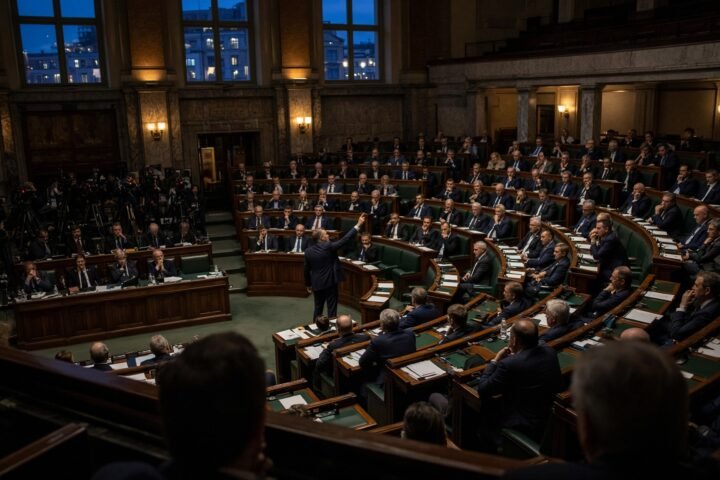
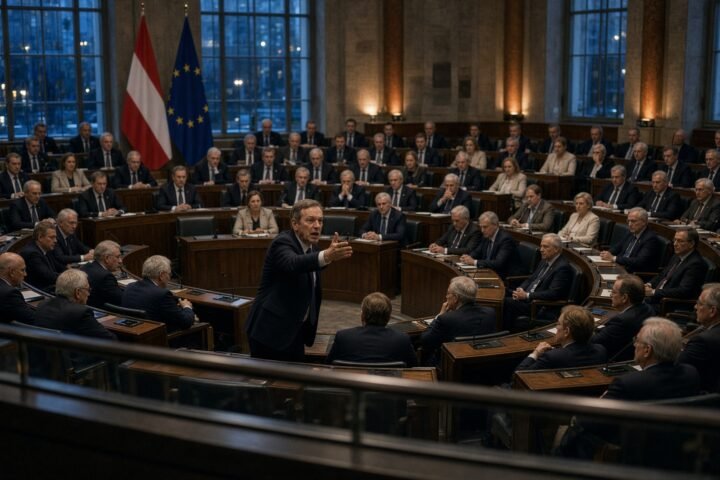
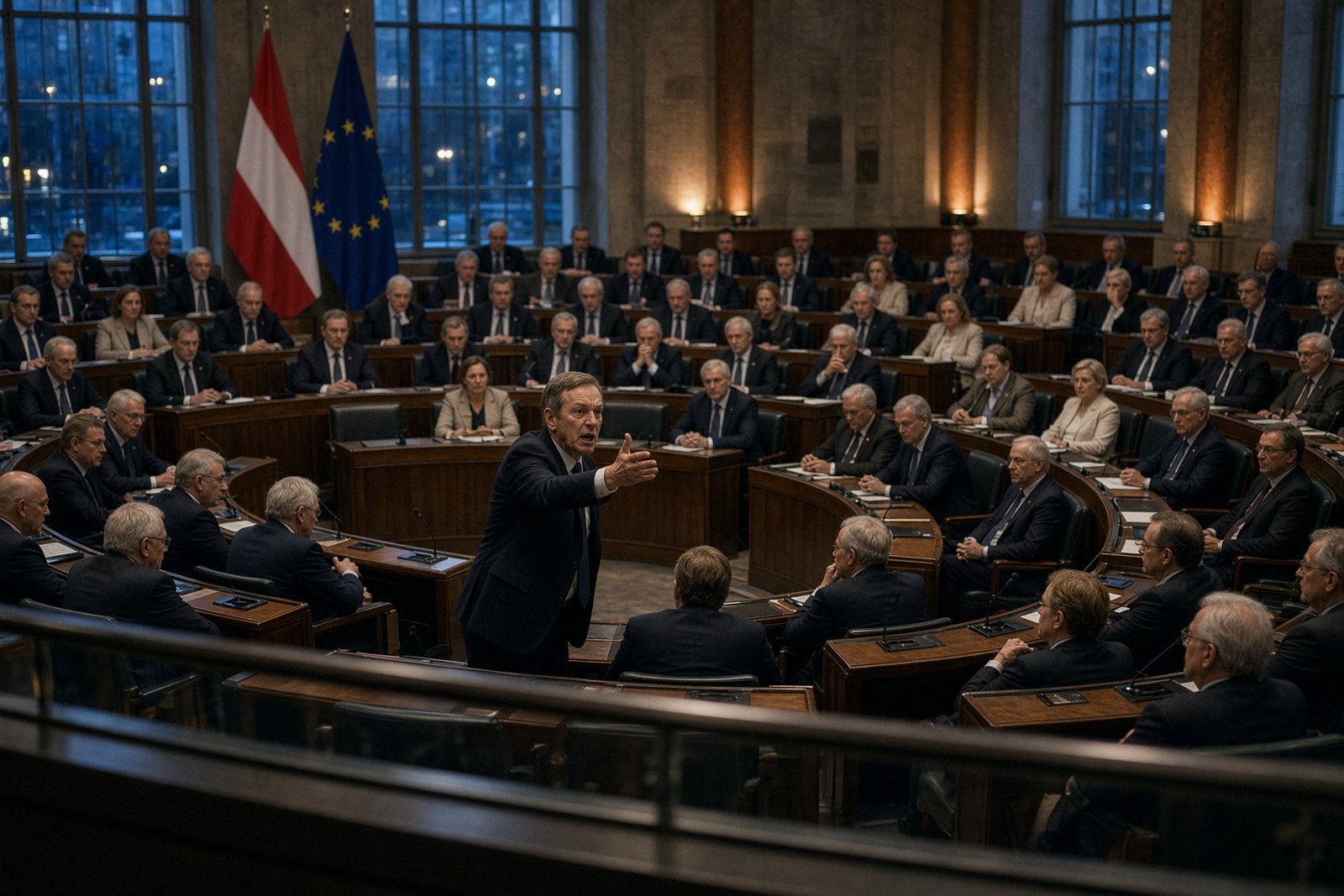
The FPÖ is not part of Austria’s federal government and cannot decide Vienna’s European position by itself. It is nevertheless the country’s main opposition force and the largest parliamentary group in the National Council, the lower house, with 57 of its 183 seats.
FPÖ representative Walter Rosenkranz is president of the National Council. The party has 16 members in the upper house, is represented in all nine Austrian state parliaments and participates in governing coalitions in some of the states. That institutional footprint gives Kickl’s demand an audience well beyond a single party statement, even though the formal decision remains with the federal government.
The party’s past contacts with Russia add another layer of context. In December 2016, FPÖ leaders signed a cooperation agreement in Moscow with United Russia, the Russian governing party. It provided for party contacts, delegation exchanges and cooperation in political, economic and social affairs.
That agreement does not prove why Kickl is taking his current position, nor does it show that the FPÖ is acting on behalf of the Russian government. It does explain why the party’s opposition to further limits on Russian state visibility in Europe is likely to attract scrutiny.
The decision facing Vienna
For the EU, the immediate question is whether member states can agree to extend restrictions into sport, culture and the governance of sporting bodies. For Austria, it is also a test of how far a powerful opposition party can influence European policy without holding federal office.
If the proposal were blocked, Russian official symbols could continue to appear at the affected events under the existing rules. Moscow could present that outcome as evidence that European sanctions policy is contested and that Russia’s isolation lacks uniform support.
The eventual decision will settle more than the status of a flag. It will show whether EU governments can draw a workable line between an individual’s participation and the official representation of a state, while maintaining a common response to Russia’s continuing war against Ukraine.