Seven drones crossed Moldova’s airspace on 17 November, some flying over central Chisinau. The government protested to Moscow, but kept Russia’s ambassador, Oleg Ozerov, in place. For Parliament Speaker Igor Grosu, the decision reflects a calculation that a sharper diplomatic response could expose Moldova to a wider crisis in Transnistria and Gagauzia.
That calculation leaves Chisinau facing an awkward question: how can it defend its sovereignty without allowing each response to become another source of danger? The immediate dispute concerns one ambassador and a series of drone flights. The underlying contest is over whether Moldova can keep control of its political direction while dealing with security weaknesses that Russia may be able to exploit.
A breach, a protest and a denial
The latest major incident took place during Russian attacks on Ukrainian border and port infrastructure. Moldova’s Defence Ministry said seven drones entered its airspace and passed over the centre of the capital. Five fell on Moldovan territory, a sixth was believed to have crashed and the seventh disappeared from radar near Leova.
On 18 November, Moldova’s Foreign Ministry handed Ozerov a note of protest, condemning what it described as a violation of national sovereignty and a threat to the lives and safety of its citizens. The incident followed earlier cases in which drones crossed Moldovan airspace during large-scale Russian attacks on Ukraine.
Ozerov rejected the attribution of responsibility, saying that the drones’ Russian origin had not been proved. That leaves an important distinction in place. The incursions and their consequences are a matter for Moldovan authorities to address; responsibility for the aircraft remains disputed by the Russian side.
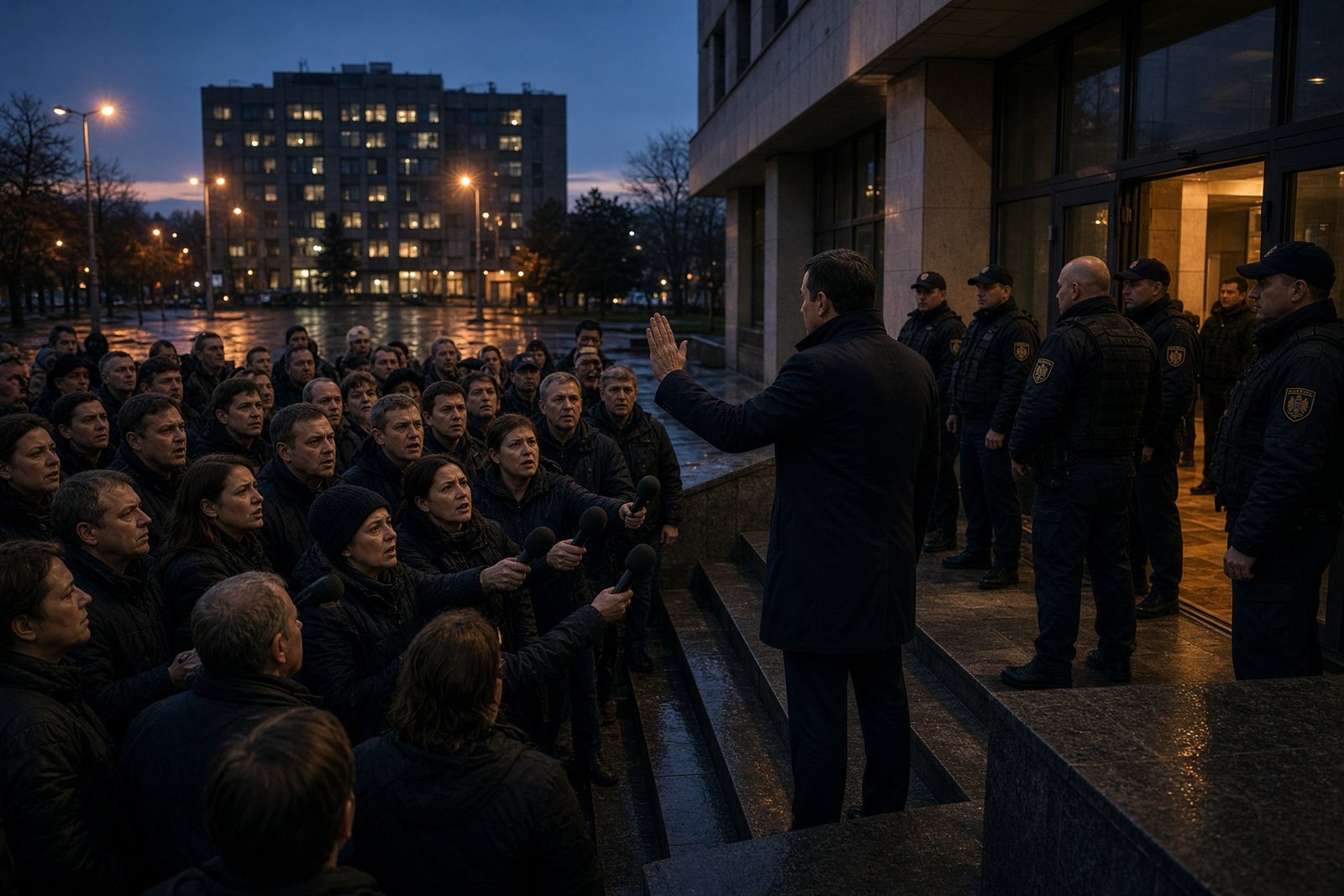
Grosu explained the government’s restraint in Parliament on 19 November. He acknowledged the anger of MPs and members of the public at the ambassador’s continued presence in Chisinau, but argued that expulsion should not be treated as a purely symbolic gesture. In remarks reported by NewsMaker, he warned that Moscow could use the move as a pretext to provoke instability inside Moldova.
Grosu presented that as a risk, not a prediction that a crisis would automatically follow. His concern was that a diplomatic confrontation could be combined with pressure in regions where the central government already has limited authority or faces strong political opposition.
Two pressure points, not one
Transnistria and Gagauzia are often mentioned together in Moldovan security debates, but they represent different vulnerabilities. Transnistria has remained outside the control of the Moldovan government for decades. It has a pro-Russian administration and is the location of Russian military forces, making it a longstanding territorial and security problem.
Gagauzia is an autonomous region within Moldova, rather than a breakaway territory. Its political landscape includes influential pro-Russian forces, while some local leaders and voters have expressed opposition to Chisinau’s European direction. Local dissatisfaction with the central authorities can therefore be linked to wider arguments against closer integration with the European Union.
The difference matters to the government’s calculations. A confrontation involving Transnistria would carry a direct territorial and military dimension. In Gagauzia, pressure could take the form of political mobilisation, institutional disputes or campaigns portraying the pro-European authorities as hostile to local interests.
Moldovan authorities have also described Russian influence as extending beyond the two regions. They have pointed to political support, disinformation and energy pressure as means of weakening confidence in the central government. These assessments are part of Chisinau’s broader view of the security environment; they do not establish that every local political action is directed by Moscow.
The feared mechanism is nevertheless clear. A diplomatic clash could be followed by political agitation or an information campaign. That campaign could depict the government as reckless for provoking Russia, then incapable of protecting the country when tensions rose. A crisis of that kind would consume attention and political capital that Chisinau needs for reforms linked to its European integration.
What the drone flights test
The repeated airspace violations create more than a diplomatic problem. Each aircraft that crosses Moldova or falls on its territory presents a potential danger to civilians and infrastructure. The flights also test how quickly the country can detect an object, track its route and decide whether it poses an immediate threat.
Moldova is working with European partners to improve aerial surveillance and modernise its air-defence capabilities. The need is especially pressing because the country sits beside a war but does not possess the resources of larger states. An incident that ends without casualties can still expose gaps in detection, reaction times or public communication.
It would be too strong to treat every incursion as proof of an imminent plan to open a new conflict in Moldova. What the incidents demonstrate is more limited but still consequential: the war against Ukraine repeatedly spills into Moldovan airspace, forcing a militarily weaker neighbour to respond under pressure.
The flights can also affect public confidence. Residents may ask why the state cannot prevent or intercept every drone, while the government must explain the limits of its capabilities without appearing passive. That tension gives the incidents a political effect even when no Moldovan target is struck.
Geography widens the stakes. Moldova borders Ukraine and lies next to Romania, an EU and NATO member. A serious deterioration in Transnistria or Gagauzia would remain a Moldovan crisis, but it could also add another source of instability near the EU’s eastern flank and complicate the regional security picture around Ukraine.
When caution starts to look like weakness
Chisinau’s cautious response carries a cost. If repeated violations result only in formal protests, they may gradually appear normal. That could weaken public confidence in the state’s ability to defend its borders and give Moscow more opportunities to observe the limits of Moldova’s reaction.
But expelling the ambassador would not remove the danger. Pro-Russian forces could present the decision as an irresponsible provocation. If political unrest or a security incident followed, information operations could amplify the claim that the pro-European government had lost control. The same response intended to demonstrate resolve could then become part of the pressure placed on Moldova.
That is the narrow space in which the government is operating. It must make airspace violations harder to repeat, improve the country’s ability to detect and manage threats, and communicate clearly with the public. At the same time, it must avoid treating a feared scenario as an established fact or allowing Moscow to dictate the pace of Moldova’s political decisions.
The question over Ozerov’s future is therefore a measure of something larger than diplomatic displeasure. Moldova is testing whether it can impose consequences for breaches of its sovereignty while keeping existing regional tensions from becoming a lever against its government and its European course.