Poland’s tougher eastern border appears to have reduced attempted crossings sharply. It has not removed the pressure from the European Union’s frontier with Belarus; instead, reported figures suggest that routes have shifted towards Latvia and Lithuania, bringing a migration crisis into direct contact with military security and critical infrastructure.
That movement matters beyond the Baltic states. Border guards, soldiers and surveillance systems are being tied down along one of NATO’s most sensitive stretches, while governments face a difficult choice between preventing organised smuggling and preserving access to international protection.
A closed crossing creates another target
The first large-scale confrontation came in November 2021, when about 15,000 people gathered in Belarus and more than 2,000 attempted to reach the Polish border near the Bruzgi–Kuznica crossing at the same time. The episode was widely treated as an organised movement of people towards the EU frontier rather than a spontaneous flow.
Polish authorities recorded more than 25,000 attempted illegal crossings in 2025. After Poland strengthened its barrier, introduced a 78-kilometre buffer zone and imposed further restrictions in 2026, the reported number fell by 98 per cent to 472 attempts during the first eight and a half months of the year.
The reduction shows what physical barriers and tighter controls can achieve on a particular stretch of frontier. It also illustrates the problem facing countries trying to control a long, irregular border: pressure can move faster than the infrastructure built to contain it.
By 10 November 2026, Latvian border guards had reportedly prevented 12,857 attempts to cross from Belarus. That exceeded the total recorded during the whole of 2025 and was described as three times the pre-war level. Latvia brought in the army and sought urgent assistance from the border services of Lithuania and Poland.
Latvia’s 173-kilometre border with Belarus runs through heavily wooded and marshy terrain. Its engineering barriers are not complete, leaving sections that are harder to monitor and reinforce. Lithuania faces a similar strategic problem. Once the Polish route became more difficult, groups and the networks moving them had an incentive to test less protected sections.
Smuggling network, security risk
The movement of people towards the EU border involves more than geography. Europol has previously reported the dismantling of a criminal network that moved migrants through Russia and Belarus. The network made at least €16 million, charging between €3,000 and €15,000 per person.
The reported model begins with recruitment through social media and intermediary companies. People from the Middle East and Africa are then brought to Russia using tourist or employment visas before being transported through Belarus towards the EU. The existence of a profitable smuggling system does not mean that every migrant is part of a political operation. It does mean that criminal logistics can provide a ready-made channel for anyone seeking to create pressure at the border.
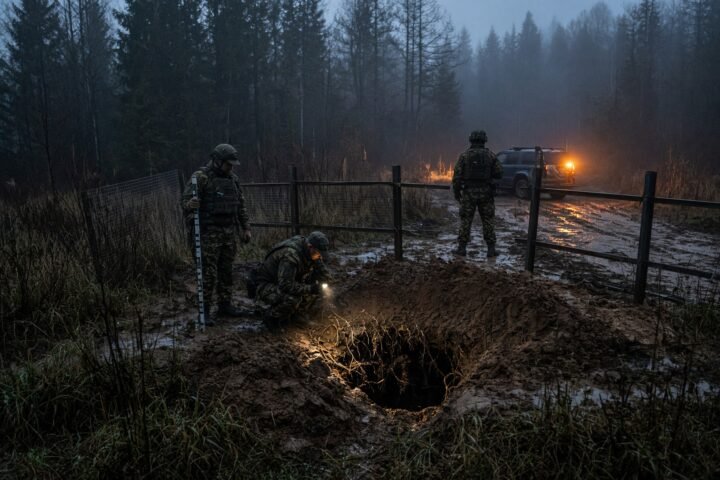
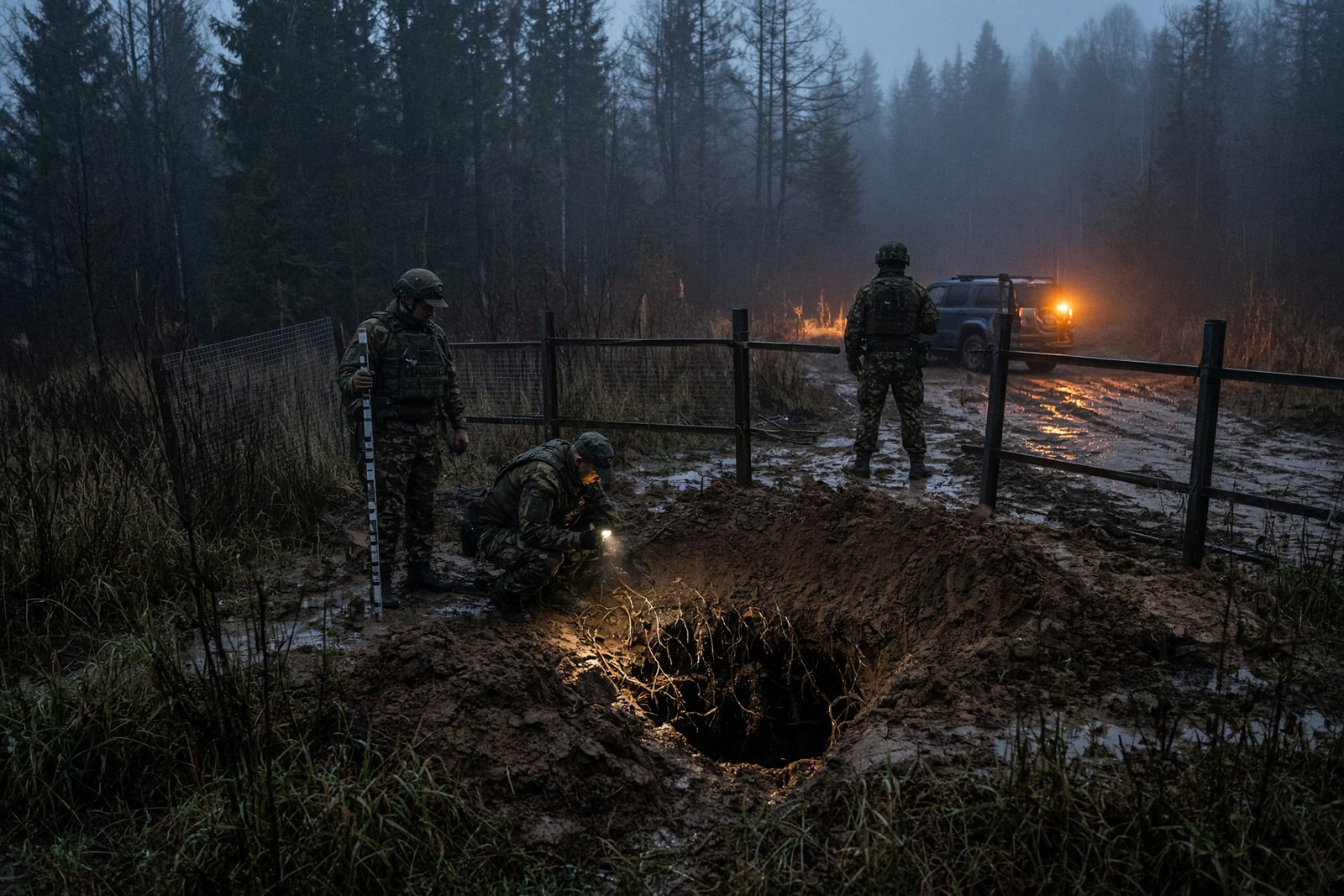
Some incidents point to a level of organisation beyond ordinary attempts to cross. Polish and Latvian border services reportedly found underground passages and tunnels beneath metal barriers during 2025 and 2026. Building such structures requires equipment, technical skills and access to the border strip. That suggests preparation in at least some cases, although it does not by itself establish that Belarusian security agencies were involved in each one.
A more serious incident was reported on the Latvian–Belarusian border in the night of 5–6 October 2026. Armed, masked people allegedly threatened Latvian military personnel while trying to move at least 20 migrants across the border. Hours later, unknown individuals entered Latvian territory, damaged an electrical distribution cabinet and stole two surveillance cameras.
A group calling itself the Black Rus claimed responsibility. Latvian experts have linked the group to Russian and Belarusian security services, but a claim of responsibility and an expert assessment do not, on their own, prove state direction of the incident. Establishing who organised and carried out the attack remains essential to understanding whether it formed part of a wider campaign.
The cost of keeping the eastern flank alert
The immediate burden falls on Poland, Latvia and Lithuania. Poland has allocated about €2.3 billion to its Eastern Shield programme. Latvia has earmarked €303 million for strengthening its eastern border, while Lithuania has budgeted €152 million for barriers along its frontier with Belarus. Those sums cover more than fences: cameras, sensors, vehicles, command systems and permanent patrols all add to the bill.
The border also sits beside the Suwalki Gap, the narrow connection between the Baltic states and the rest of NATO territory, between Belarus and Russia’s Kaliningrad region. In the same wider area, GPS interference has been reported and weather balloons have been used for smuggling. Such activity can complicate the work of border and military services. It does not, without further evidence, prove that every incident is centrally coordinated.
For Moscow and Minsk, the potential advantage of sustained pressure lies in the response it forces. Poland, Latvia and Lithuania must spend money and deploy personnel on border security while also maintaining military readiness on NATO’s eastern flank and supporting Ukraine. The effect does not depend on every group reaching the border. Each new attempt requires screening, surveillance, medical assistance, investigations and political decisions.
The pressure can therefore function as a security test even where the organisers’ role is disputed. Border services must react quickly, identify genuine protection needs and prevent armed or criminal actors from exploiting the same route. A weak point can be tested repeatedly; a strong point can push the activity elsewhere.
A dispute that travels west
The consequences do not stop at the frontier. People who manage to cross into Latvia or Lithuania often seek to continue through the Schengen area rather than remain in the Baltic region, including towards Germany, France and Scandinavia. In November 2026, the European Commission reportedly recognised special migration pressure on the EU’s eastern border and the risk of secondary movement affecting western Europe.
That turns a border operation into an argument across the Union. In March 2025, Poland temporarily restricted the ability to apply for international protection at its border with Belarus. Amnesty International and other rights groups criticised the decision. The restrictions were extended several times in 2026, prompting complaints to the European Commission over possible breaches of international law.
Governments argue that asylum procedures cannot be allowed to become a tool for organised smuggling or externally directed pressure. Human rights organisations counter that security measures must not make the right to seek protection meaningless. Both concerns operate at the same border, often in the same incident, leaving officials to distinguish between a person in need of safety and a system designed to move people in bulk.
The dispute also creates political space for parties advocating sharply tighter migration controls and a weaker European Union. In Germany, the Alternative for Germany supports restricting migration, reducing the EU’s powers, lifting sanctions on Russia and opposing Ukraine’s membership of NATO and the EU. A prolonged border crisis can therefore deepen existing divisions inside democratic societies, regardless of whether each episode can be traced to a state actor.
The central question is no longer simply how many people attempt to cross, or which section of the frontier records the next surge. European governments must determine where criminal smuggling ends, when outside support becomes deliberate coercion, and how to reinforce the eastern border without turning the right to international protection into an empty formality.