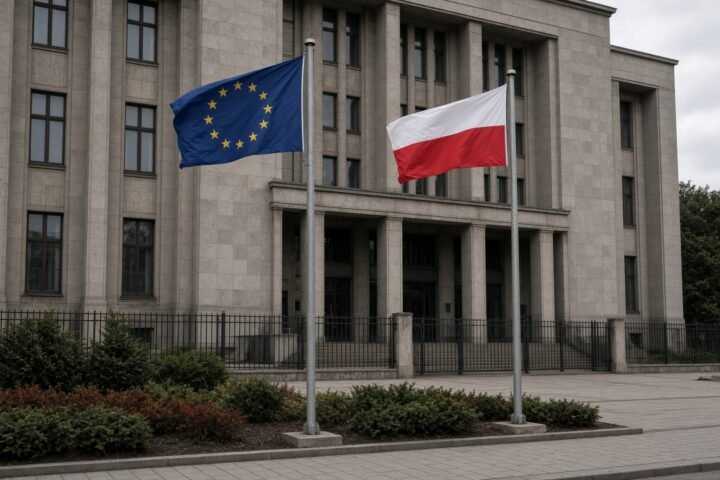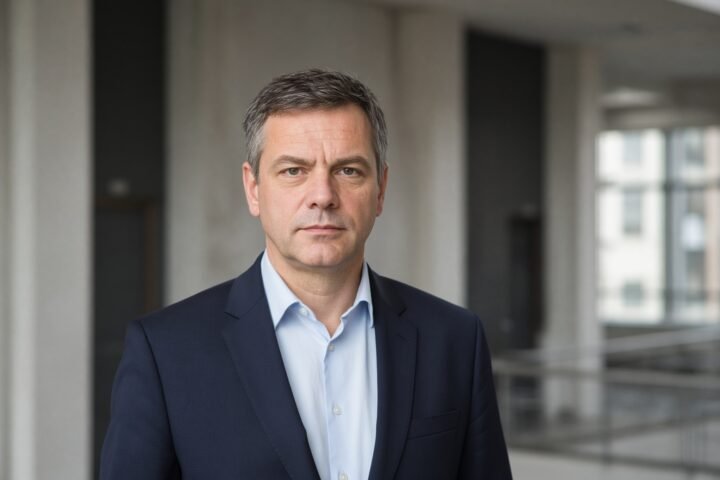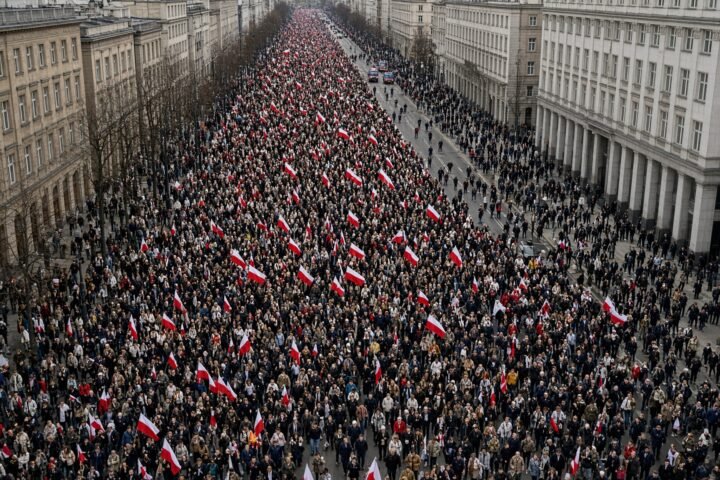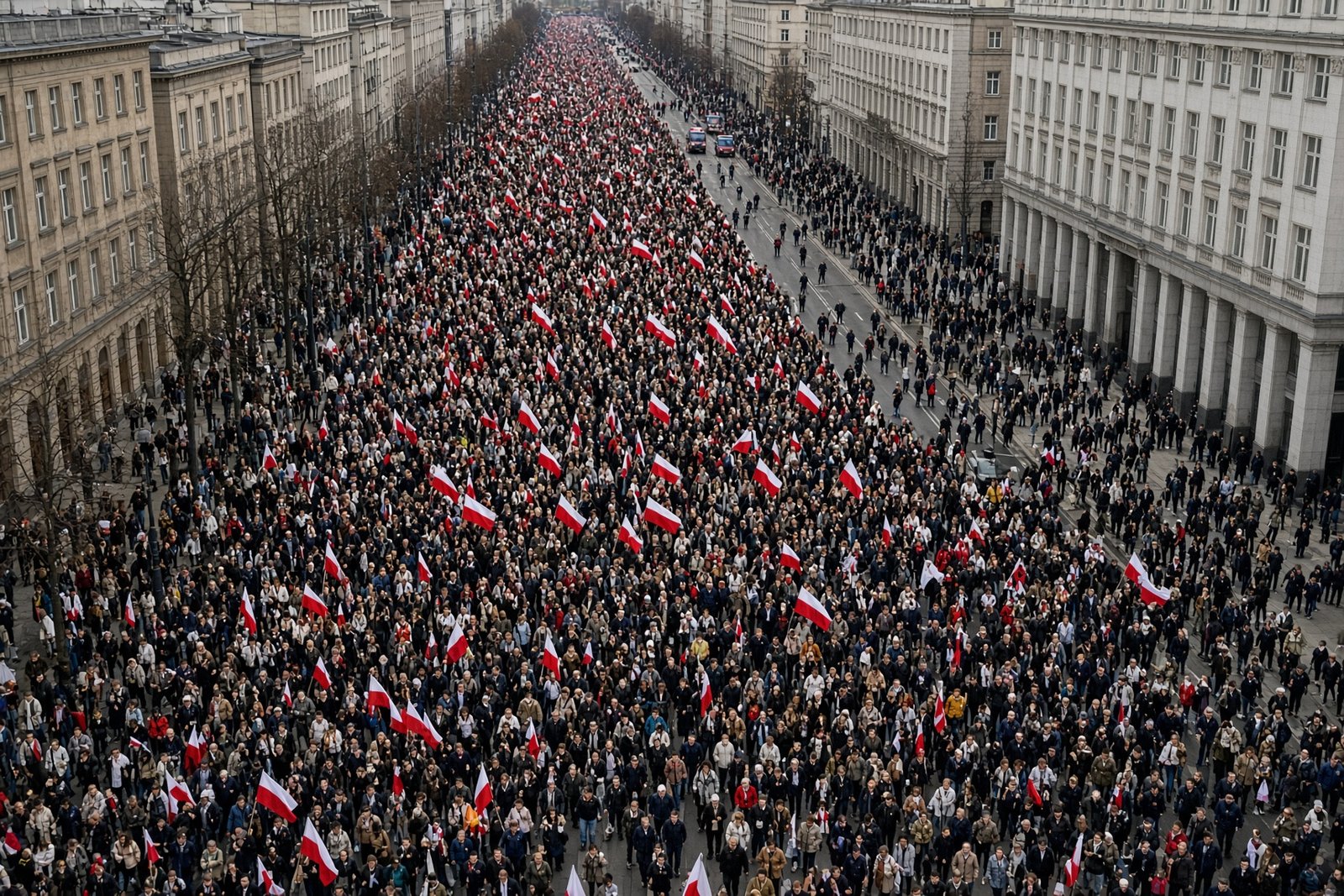
Poland’s Independence Day celebrations have opened a new dispute over what the presidency is for. On 12 November 2026, President Karol Nawrocki walked at the head of the Independence March, carrying a white-and-red flag at an event that brings families and mainstream patriots together with nationalist and far-right groups.
His appearance was followed by a public attack on Finance Minister Andrzej Domanski and a refusal to attend a “reconciliation meeting” proposed by Prime Minister Donald Tusk. The result was not a ceremonial pause in Poland’s political conflict, but another confrontation over whether the head of state should lead one side of it.
A national symbol, claimed by one political camp
The march marked the 108th anniversary of Poland’s restoration of independence. It has become one of the country’s most prominent annual gatherings, combining national symbolism with opposition to the liberal direction associated with Tusk’s government.
That combination makes the event difficult to describe in simple terms. Many participants attend as a patriotic national celebration. Others belong to nationalist or far-right movements, and the march has become a platform for hostility towards the government and its political outlook. A report by Tysol on German television coverage highlighted the presence of radical participants alongside priests and other celebrants.
Nawrocki did not keep a formal distance from that mixture. He led the procession with the national flag. Critics saw the decision as open support for right-wing and far-right forces opposed to Tusk. More broadly, it attached the authority of the presidency to a street mobilisation whose political character is contested but whose public identity is closely associated with the government’s opponents.
A president is not required to endorse every policy of the government. Nawrocki has his own mandate and can challenge the cabinet through the powers of his office. The criticism centres instead on the symbolic role of the presidency: whether it can act as a counterweight to the government while retaining enough distance to represent citizens beyond its preferred political camp.
Two crowds, depending on who is counting
The size of the march quickly became part of the political argument. Warsaw’s municipal authorities estimated that between 200,000 and 250,000 people took part. Organisers claimed that the crowd was close to one million.
The two figures offered sharply different versions of the day. The organisers’ estimate presented the march as a historic mass demonstration and a sign of overwhelming public support for the right. The municipal figure still described a substantial gathering, but one closer to the scale of previous years.
Critics argued that the larger claim was intended to exaggerate the strength of right-wing forces ahead of the 2027 elections. That is a political interpretation of the discrepancy, not an independently established finding about the organisers’ intentions. What is clear is that the attendance figures became competing symbols: one of triumph and national momentum, the other of a large but familiar mobilisation.
The march ended without serious widespread disorder. Police detained about 60 people over drug possession and the unauthorised use of drones, and seized more than 450 prohibited pyrotechnic items. NaTemat reported on the arrests and seizures. The available figures point to breaches of the law and enforcement action, but not to a general collapse of order or large-scale violence.
That distinction matters. The march could be a peaceful national gathering for many attendees while also providing space for radical activists and confrontational political messages. Nawrocki’s presence did not remove those differences; it placed them under the visible authority of the presidential office.
The ceremony becomes another front in the conflict
The president’s conduct during the celebrations made the dispute more direct. In an official speech, he criticised Finance Minister Andrzej Domanski. He also declined Tusk’s invitation to a meeting described as an opportunity for reconciliation.
Former President Bronislaw Komorowski condemned the public criticism of the minister as evidence of a “lack of political education”. He compared it with insulting a guest invited to a national celebration and argued that Nawrocki had weakened his own position by refusing to meet the prime minister.
Wprost reported Komorowski’s criticism as an unusually direct clash between a former president and his successor. His objection was not simply that Nawrocki opposed the government. It was that the president had brought a partisan confrontation into an official national ceremony, rather than using the occasion to project common ground.
That argument rests on a particular understanding of presidential authority. The office can challenge the government, veto legislation and represent a different political mandate from the parliamentary majority. But its influence also depends on the claim that it can speak to the country as a whole. Leading a politically charged march, attacking a minister during a formal address and refusing a proposed meeting all make that broader role harder to sustain.
Komorowski’s criticism therefore concerns political conduct as much as policy. It reflects the view that the president should be able to stand above the daily contest between government and opposition, especially during a celebration built around a shared national history.
A warning about the next election
Former President Aleksander Kwasniewski went further. He accused Nawrocki of deliberately deepening Poland’s social divisions and of appealing primarily to the most radical part of the electorate. Kwasniewski said the president was seeking to become the “godfather” of a return by the right to power in 2027, while damaging the presidency itself.
A separate Wprost report carried Kwasniewski’s remarks. They are the political judgement of a former president, not proof of Nawrocki’s private intentions or of a settled electoral strategy. Their significance lies in what they reveal about the depth of the argument: critics are no longer treating the march as a question of protocol, but as a possible intervention in the future organisation of the right.
For Nawrocki’s supporters, taking the lead may represent an assertive presidency willing to stand openly with national and conservative forces. For his opponents, it suggests that he is choosing the most combative section of the government’s opposition over the mediating role associated with the office.
The Independence March exposes the difficulty of keeping those interpretations separate. Its route carries national symbols that can attract a broad public, but it also carries the political identity of a movement opposed to Tusk. By placing himself at its front, Nawrocki made the presidency part of that tension rather than a force outside it.
The immediate consequence is a sharper standoff between the presidential office and the government, with the promised reconciliation left unrealised. The unresolved question is whether Nawrocki’s visibility at the march will help unite a wider right-wing coalition before 2027, or instead persuade more voters that the institution meant to symbolise Poland’s unity has become another arena in its political struggle.