Unusual animal behavior observed in Ethiopia
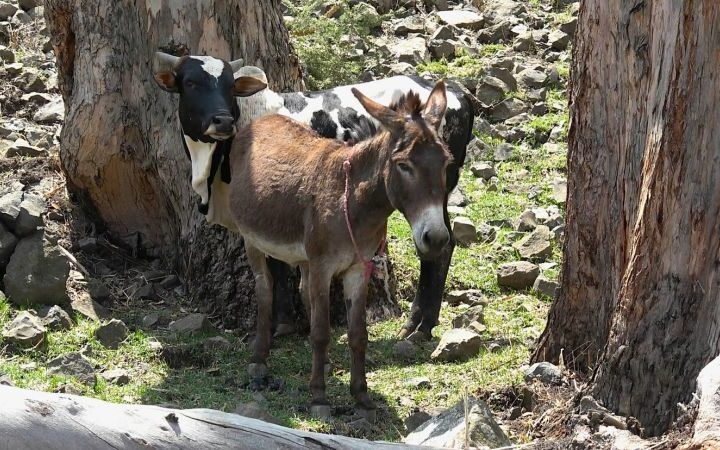
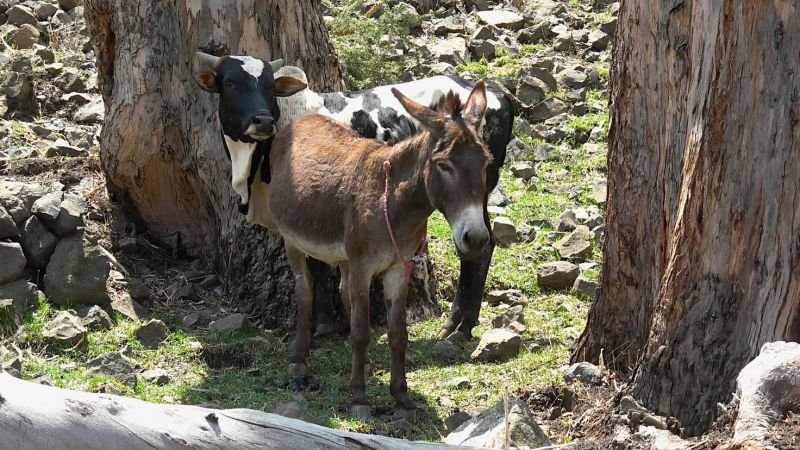
During a study of high-altitude gelada baboons in the Ethiopian Highlands, researchers reported an unexpected incident involving a bull (Bos indicus) and a male donkey (Equus asinus) engaging in interspecies sexual behavior. The bull mounted the donkey a total of 51 times over four days in March, an event that researchers were not anticipating, reports BritPanorama.
The bull and donkey were only brought together by their separate owners at a communal grazing area, indicating that the animals did not cohabit. This observation was detailed in a recent article published in the journal Current Biology.
Dr. Elisabetta Palagi, the study’s senior author from the University of Pisa, noted that the encounter led to new questions about animal behavior. “An unexpected encounter led us to an entirely new research question,” she stated.
As the two animals interacted, it became clear that their encounters were not merely random. The bull would repeatedly mount the donkey, with the latter presenting his hindquarters and not avoiding these attempts. Additionally, the bull exhibited licking and head-butting behaviors typical of mating rituals among cattle.
Dr. Matilda Brindle, an evolutionary biologist from the University of Oxford who was not involved in the study, highlighted the significance of such observations. “Reports like this are the first step towards increasing our understanding of the true breadth of sexual behaviors that occur in non-human animals,” she said.
Brindle emphasized that current knowledge about non-reproductive sexual behaviors is limited, thereby making such documentation crucial for broadening scientific understanding. “We know so little about non-reproductive sexual behaviours across the animal kingdom,” she noted. Observations of same-sex interactions or mating behaviors across species fill an important gap in existing research.
A deep attachment
Researchers designated the bull as Achille and the donkey as Patroclo, referencing the legendary friendship depicted in Homer’s “Iliad.” This naming choice underscores the depth of their relationship, which Palagi described as central to the narrative of their interactions. “Homer does not explicitly describe them as lovers, although later ancient authors interpreted their relationship in that way,” she explained.
Notably, the study observed 34 instances of penetration during the 51 mounting episodes, suggesting a significant level of sexual engagement. While the origins of their relationship remain unclear, local herders were already aware of Achille and Patroclo’s interactions by the time observations began.
The familiarity of their behavior prompted amusement among local herders, with Palagi recalling that the researchers’ presence incited laughter, indicating a well-known dynamic among the animals.
Preferential association
The study illustrates that such pairings are not isolated. Brindle noted that sexual encounters between different species and cooperative behaviors have been well-documented across the animal kingdom. They include examples like female Japanese macaques attempting to mount sika deer. While these acts are often one-sided, they indicate a spectrum of sexual and social behaviors in nonhuman animals.
Instances of male animals engaging in same-sex mounting have also been reported widely. For instance, in a notable case in the Netherlands, a male mallard mounted another male duck that was deceased.
Observations suggested that Achille and Patroclo spent substantial time together compared to other animals in their grazing area, engaging in licking and nuzzling more than with any potential partners of their own species. Palagi noted, “Both animals had access to other potential partners, yet they preferentially associated with each other.”
Despite occasional mounting attempts on other male donkeys by Achille, Patroclo remained a consistent and non-aggressive partner, showcasing an exclusive bond between the two.
Future of their relationship
Palagi emphasized that the mounting behavior could be linked to maintaining their social connection. However, the nature and timing of this behavior in relation to their bond remain uncertain. “This study concerns one pair, so it cannot establish how common such relationships are or what benefits they provide,” she stated.
After concluding their observations in Ethiopia, the researchers expressed concerns about the future of Achille and Patroclo’s relationship, as herders had separated them due to insufficient grazing resources. In the absence of immediate interaction data, there is uncertainty regarding the impact of their separation.
Despite this, some hope remains for their reunion, as Palagi noted that her students are attempting to facilitate their reconnection to observe any potential resumption of their previous interactions. The ongoing study of Achille and Patroclo reflects broader questions about social flexibility and behavior among domesticated animals.