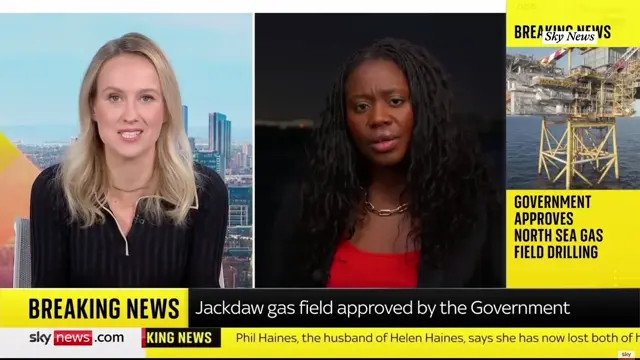
Plans to begin drilling in the North Sea’s Jackdaw gas field off the coast of Scotland have been approved by ministers, confirming the future of the project which at points appeared to be uncertain, reports BritPanorama.
Prime Minister Andy Burnham has insisted the decision will “protect hundreds of jobs and help keep millions of homes warm” while maintaining commitments to renewable energy.
The move has attracted controversy, with critics arguing that it undermines the government’s green pledges. In its 2024 manifesto, the government stated it would not issue new oil and gas licences in the North Sea but committed to honouring existing ones like Jackdaw.
Energy Secretary Miatta Fahnbulleh stated that her decision was made after “careful consideration of all relevant factors,” asserting alignment with the government’s climate commitments. She noted: “This decision will support the country’s energy security with homegrown gas this winter and help minimise the UK’s use of imported higher emission fuels as we continue our transition to renewables and nuclear.”
The government is yet to decide on Rosebank, another North Sea drilling project off the coast of Shetland.
What is Jackdaw?
Jackdaw is an untapped gas field approximately 150 miles east of Aberdeen, operated by Adura, a joint venture between Shell and Equinor. Approved by the previous government in 2022, it faced setbacks after the Scottish courts struck down the decision due to a challenge from environmental campaigners.
This followed a Supreme Court ruling mandating that developers account for the climate impact due to burning fossil fuels within their planning applications. Adura shared updated information pertaining to emissions from gas and oil extracted from Jackdaw and Rosebank, with public consultations on the project concluding in August.
What is controversial about the project?
Though both Jackdaw and Rosebank would align with the government’s commitments if approved, experts warn they contradict ministers’ objectives regarding renewables and energy independence. Proponents argue that the projects would create jobs and bolster energy security amid rising international fuel costs stemming from geopolitical tensions.
Critics contend that the new gas fields would have minimal price impact and hinder the UK’s efforts to reduce carbon emissions. The International Energy Agency (IEA) has advised against investing in new fossil fuel supplies to meet the Paris Agreement goal of limiting global warming to 1.5°C.
Green leader Zack Polanski labelled the decision as “climate vandalism,” asserting that Labour has lost credibility in combating climate change. A final decision regarding Rosebank remains pending, but Fahnbulleh indicated differing considerations may apply.
She remarked on BBC Radio Scotland: “Jackdaw is producing gas that predominantly is used in the domestic market, Rosebank is a different proposition because it is oil that is exported.”
Will Jackdaw lower energy bills?
Campaigners express skepticism about any economic benefits of the Jackdaw project, asserting that energy transition support group Uplift noted it “won’t knock a penny off our energy bills.” The resource will be priced based on international market rates, influenced by variables such as ongoing supply disruptions in the Middle East.
While gas from Jackdaw will feed into the UK grid, the costs will still be aligned with global pricing trends. Uplift’s executive director, Tessa Khan, emphasized that Jackdaw would meet approximately 2% of domestic gas demand over ten years, arguing it won’t prevent job losses in the North Sea, given it will largely be unmanned and remotely operated.
“Shell will be cheering this decision, but it won’t knock a penny off our energy bills, which is what’s keeping people up at night, or make a meaningful difference to our gas supply,” she stated.
Jess Ralston, an analyst at the Energy and Climate Intelligence Unit (ECIU), maintained that “approving Jackdaw won’t do anything meaningful to bring down energy bills or improve the UK’s energy security.”
Will new North Sea drilling help to boost the economy and energy security?
Proponents from Adura and other industry stakeholders claim the projects will yield the domestically produced gas necessary for British households. They argue that enhancing the UK’s energy security is essential given the current international market volatility.
However, even if these resources could be allocated solely for domestic use (which is not legally feasible), the UK would still rely on imports, remaining vulnerable to market fluctuations. Uplift has revealed that Jackdaw’s output will not significantly impact energy security, only accounting for about 2% of the UK’s gas demand over its projected lifespan.
Many environmental advocates argue that the only path to robust energy security involves amplifying clean energy sources. The End Fuel Poverty Coalition has warned that the North Sea’s production capacity is diminishing, and approvals for new projects will only heighten exposure to price volatility, urging a focus on accelerating the energy transition.
Will the project create jobs?
Supporters often claim Jackdaw will generate significant employment in the UK. However, recent industry documents revealed that only 27 full-time jobs will be created specifically for this project. Adura’s report highlighted a consistent level of employment averaging nearly 500 jobs yearly, which includes direct roles on the Shearwater installation.
Adura previously claimed that Jackdaw and Rosebank together would peak at 3,500 construction jobs, maintaining 880 high-quality jobs during ongoing production throughout the UK. The projects are projected to generate a combined gross value added of over £28 billion and yield immediate tax revenues of £1.4 billion during this parliamentary term.
Rosebank is understood to be significantly larger than Jackdaw, with estimated costs of £8.7 billion over 25 years compared to Jackdaw’s £2.1 billion for an 11-year lifespan.