France’s largest recent mobilisation over the cost of living brought hundreds of thousands of people on to the streets on 18 October 2026. In several cities, however, peaceful marches were followed by looting, fires and attacks on police, leaving the government to confront a security crisis without erasing the economic anger behind the protests.
Police estimated that about 550,000 people took part nationwide, while organisers put the figure at 800,000. Some 1,750 rallies and assemblies were held, bringing together workers, students, climate activists, antifascist groups and supporters of the Yellow Vest movement. The immediate grievance was the rising cost of everyday life and the pressure of inflation on household budgets.
The day ended with roughly 1,800 arrests and about 500 injured police officers, according to figures reported by the authorities. One person also died, although the available information does not set out the circumstances. TimesLIVE reported on the unrest as the government faced mounting pressure over the scale of the violence.
A mass movement, but not a single chain of events
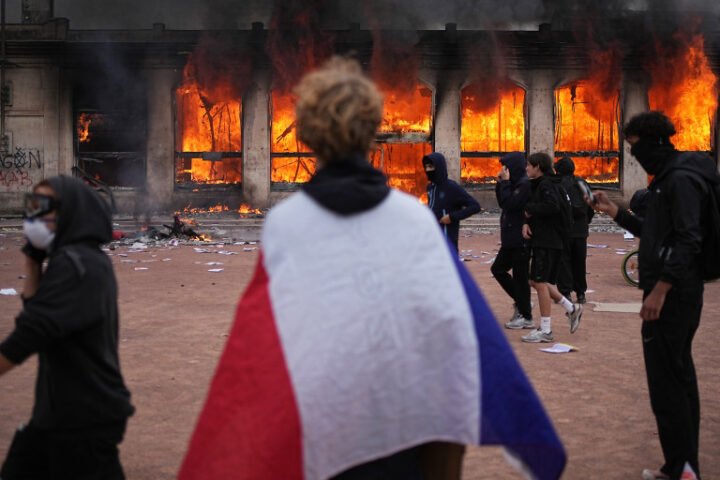
The protests did not follow the same pattern everywhere. Many marches remained peaceful. In other places, groups looted shops, set vehicles alight, attacked public institutions and tried to force their way into municipal buildings.
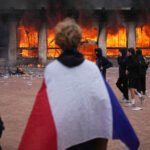
Limoges was among the worst-hit cities, with its town hall set on fire. Serious incidents were also reported in Lyon, Lille, Rennes, Bordeaux and Paris. The geographical spread made it harder for police to separate large, lawful demonstrations from outbreaks of violence developing within or around some of the marches.
The scale of the mobilisation does not establish that all demonstrators took part in the attacks. The coalition itself was broad, combining movements with different political traditions and objectives. Nor do the arrest figures, on their own, determine the responsibility of every individual detained. Those questions will depend on the investigations and any subsequent criminal proceedings.
That distinction matters because the protests contained two simultaneous realities. Hundreds of thousands of people were expressing opposition to the rising cost of living, while smaller groups were involved in actions that damaged property and placed police officers and public workers at risk. Treating the entire mobilisation as violent would obscure the breadth of the social grievance; treating the disorder as insignificant would ignore the injuries and damage recorded across several cities.
Government blames radical groups
Prime Minister Sebastien Lecornu blamed ultraradical left-wing groups and criminal elements for organising the unrest, attacking security forces and setting fires. That is the government’s political assessment of the events, rather than a final determination of individual responsibility for each incident.
Lecornu said the authorities would respond firmly to any attempt to destabilise the country and that those responsible for attacks would be punished. The immediate task for investigators is to establish who allegedly looted shops, started fires, attacked officers or attempted to enter public buildings, and what evidence supports the cases arising from the arrests.
The prime minister’s statement places the government’s response on a clear security footing. Yet the breadth of the protest means that enforcement alone cannot settle the issue that brought people into the streets. The demonstrations were fuelled by a complaint shared across several social groups, even if those groups do not share a common programme or a common view of how the protests should be conducted.
The political risk for Macron’s government
For President Emmanuel Macron’s administration, the unrest creates a difficult balance. It must protect police officers, public buildings and businesses from further attacks while addressing a movement rooted in household financial pressure. A blanket response against the whole protest would risk conflating peaceful dissent with criminal acts and could deepen the anger that sustained the mobilisation.
At the same time, the government cannot leave the violence without a clear response. The reported injuries to around 500 officers, the destruction in Limoges and the attacks recorded in other cities have made accountability central to the next phase of the crisis.
The outcome will depend on two separate tests. Investigators must turn a provisional tally of arrests into properly defined individual cases. The protest coalition, meanwhile, must decide whether it can keep the focus on inflation and living costs while maintaining a credible separation from those responsible for fires, looting and attacks. France’s economic dispute has not disappeared, but the disorder now threatens to become the public face of it.