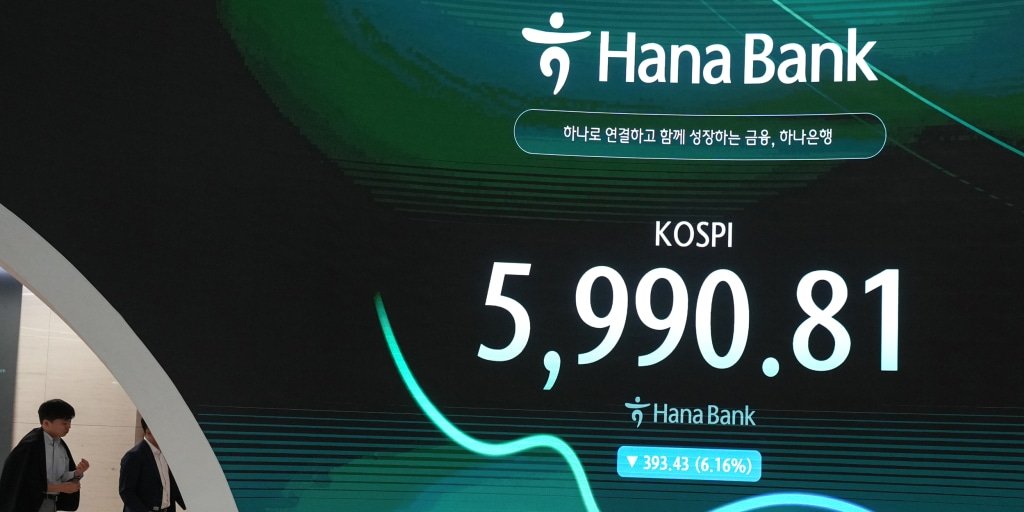
Kospi index drops more than 7% amid chip sell-off and Middle East tensions
HONG KONG — South Korea’s benchmark Kospi index dropped more than 7% Tuesday on a sell-off of chip shares, and Asian shares mostly declined after U.S. stocks ended mixed, reports BritPanorama.
The Kospi index fell 7.4% to 5,914.35, marking its lowest level since late July. This decline follows a peak in June when the index reached an all-time high after surpassing 9,000, driven by a global artificial intelligence boom.
Samsung Electronics experienced a significant fall of 7.7%, while memory chipmaker SK Hynix plunged 8.8%. Investor unease regarding the sustainability of the AI boom has clouded the outlook for these companies, particularly after reports indicated that advancements by China’s CXMT could pose challenges to Samsung, SK Hynix, and Micron Technology, the world’s leading memory chipmakers.
In Japan, the Nikkei 225 dropped 2.5% to 67,292.39, with chip equipment maker Tokyo Electron falling 6.6%. SoftBank Group, which has invested in OpenAI, saw its stock lose 8%.
Hong Kong’s Hang Seng Index fell 1% to 24,033.51, while the Shanghai Composite fell 1.1% to 3,754.82. In Australia, the S&P/ASX 200 edged down 0.2% to 8,767.40. Taiwan’s Taiex saw a decline of 1.9%, with its leading chipmaker TSMC down 1.6%.
On Wall Street, the benchmark S&P 500 edged down 0.1% on Monday, while the Dow Jones Industrial Average added 0.4% and the technology-heavy Nasdaq composite declined by 0.4%. Chip-related shares continued to trend lower, with Nvidia down 1.3%, Advanced Micro Devices (AMD) falling 2.3%, Micron Technology losing 3.9%, and Broadcom dropping 1.9%.
Investors are closely monitoring this week’s earnings announcements from major firms, including big banks like Citigroup, JPMorgan Chase, and Wells Fargo.
Oil prices experienced a decline of more than 1%. Brent crude, the international benchmark, fell 1.4% to $105.20 a barrel, remaining above the approximately $72 per barrel seen in late February, prior to the escalating Iran war. Benchmark U.S. crude was down 1.5% to $92.34 a barrel.
ING commodities strategists Warren Patterson and Ewa Manthey noted in a commentary that “the market is more concerned over recent developments in the Middle East, with Houthi attacks on Saudi Arabia and the lingering risks to oil flows from the Persian Gulf.”
The U.S. dollar fell to 158.26 Japanese yen from 158.61 yen, while the euro was trading at $1.1175, up from $1.1155.