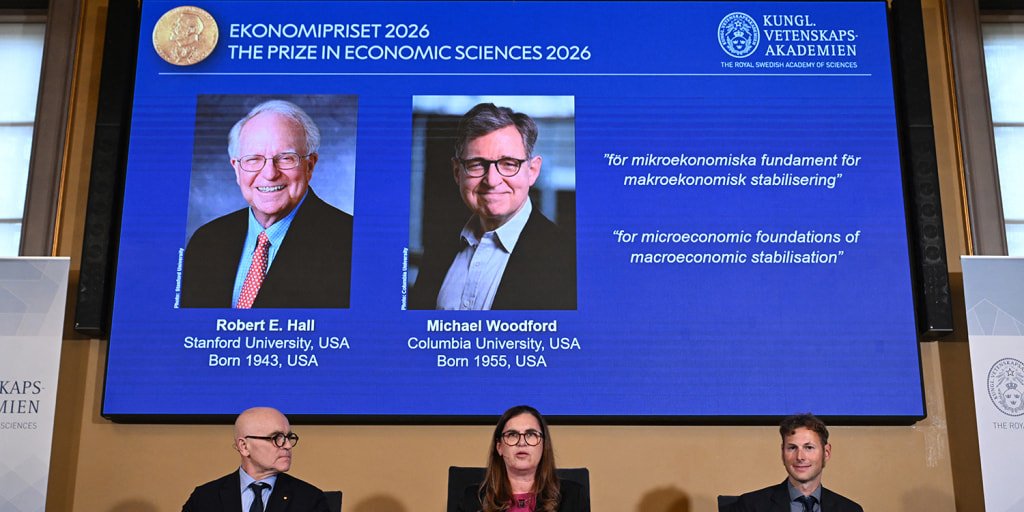
American-born economists Robert E. Hall and Michael Woodford won the Nobel memorial prize in economics on Monday for their work on models that have helped governments and central banks manage economic shocks, reports BritPanorama.
The Royal Swedish Academy of Sciences announced the winners in Stockholm, stating that they were being honored “for microeconomic foundations of macroeconomic stabilization.”
“The laureates have helped us smooth out the economy’s peaks and troughs,” the academy said in a statement.
Hall is affiliated with Stanford University in California, while Woodford is with Columbia University in New York. Woodford expressed his surprise at the award, stating: “It’s a tremendous honor, it’s a surprise.”
John Hassler, chair of the Committee for the Prize in Economic Sciences, emphasized the significance of their work: “The laureates’ work has provided us with a stable theoretical foundation for the models that are now used by central banks and governments around the world.” He added, “With them, we are better equipped to deal with shocks in the economy, such as energy crises or sudden changes in how much households consume.”
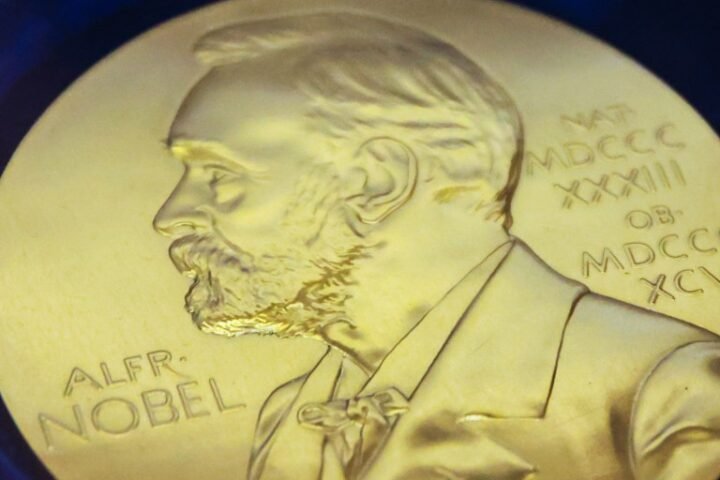
The economics prize is formally known as the Bank of Sweden Prize in Economic Sciences in Memory of Alfred Nobel. Established in 1968, it serves as a memorial to Nobel, the founder of the Nobel Prizes.
Last year, the award was given to three researchers for explaining how business innovation contributes to economic growth and human welfare, highlighting the transformative nature of new products and inventions.
Nobel purists note that the economics prize is not a traditional Nobel Prize, yet it is presented alongside the others on December 10, commemorating Nobel’s death in 1896. The announcement of this year’s awards included preparations for the presentations in medicine, physics, chemistry, literature, and peace.
This year’s prize money amounts to 12 million Swedish kronor (approximately $1.2 million), awarded to either individuals, small groups of laureates, or organizations.