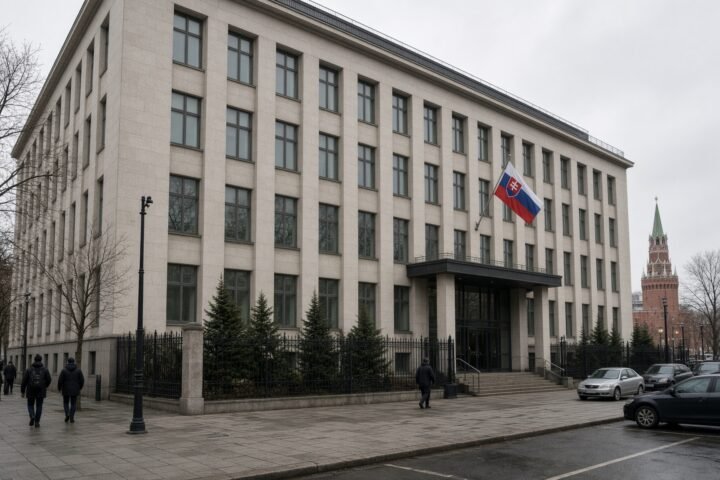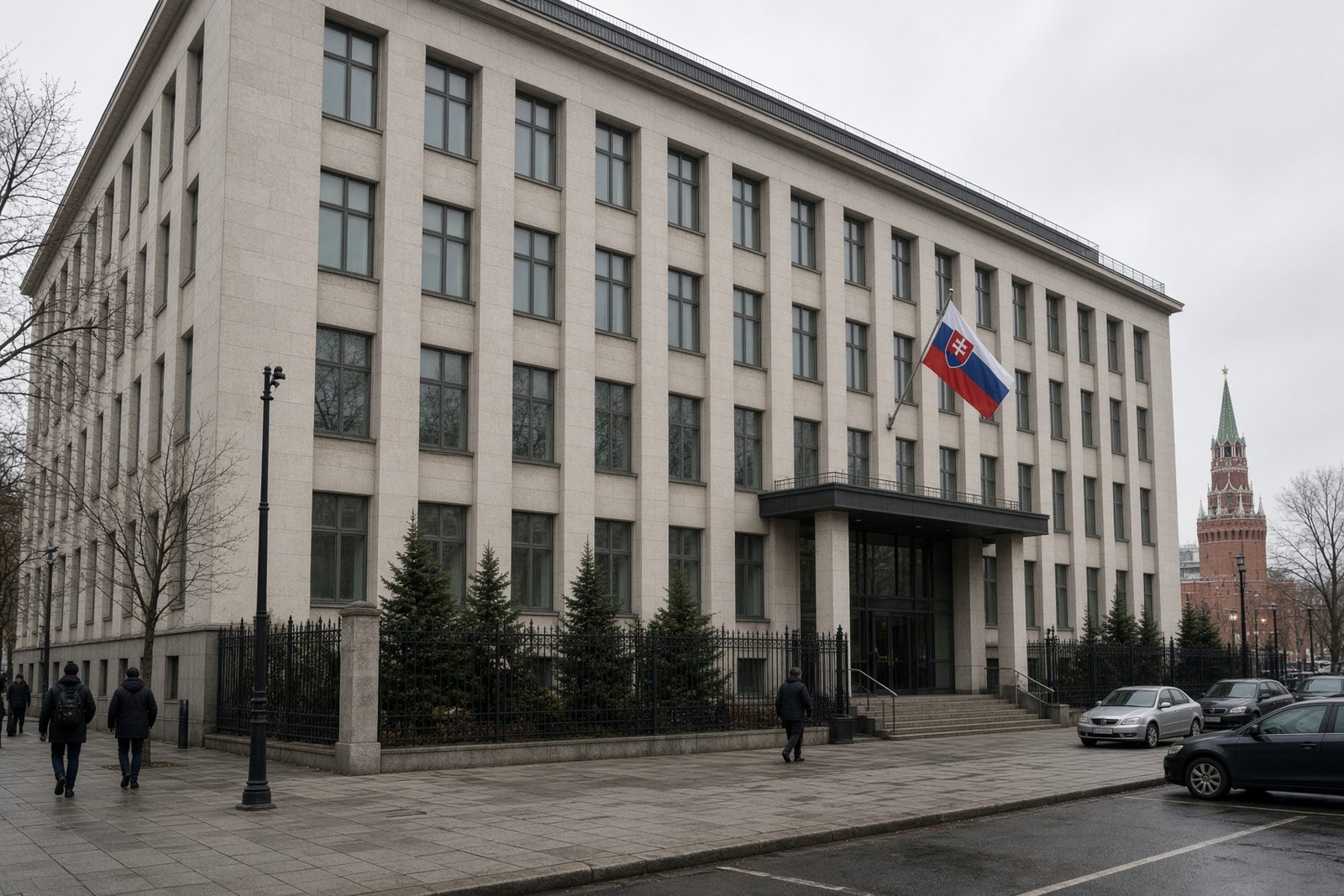
Slovakia is restoring military-diplomatic links with Russia after a four-year break, sending two officers to Moscow and preparing to receive a Russian representative in Bratislava. The decision gives Moscow an officially sanctioned channel into a NATO member’s defence establishment at a time when relations between Russia and the Alliance remain severely strained.
Slovakia’s Defence Ministry announced the exchange on 9 October 2026. Prime Minister Robert Fico and Russian President Vladimir Putin had discussed bringing military attachés back into operation in May, during Fico’s official visit to Moscow.
The arrangement is a formal diplomatic step, not proof that espionage is taking place. But it has reopened a difficult question for Bratislava and its allies: how much access should a Russian military official have to the institutions of a NATO country, and what controls will govern that access?
A post built around access
Military attachés are official links between armed forces. They help arrange visits, maintain contact between defence ministries and report on military developments in the country where they are posted. In normal circumstances, those functions can support communication and reduce the risk of misunderstanding, particularly during a crisis.
The position also places an officer close to commanders, civil servants and political decision-makers. Its value does not necessarily lie in obtaining one dramatic secret. Regular meetings can reveal who controls information, how decisions move through a ministry and which officials have influence over defence policy. Over time, personal relationships may matter as much as formal access.
Those contacts are not unlawful simply because they exist. The security risk arises if an official channel is used for unauthorised information gathering, recruitment or influence operations. The practical test for the Slovak authorities will therefore be the supervision surrounding the new arrangement: who can be approached, which institutions can be visited and what information can be discussed.
The case behind the alarm
The return of a Russian military representative is especially sensitive because of the record associated with the previous holder of the post. The Polish outlet Onet reported that Sergei Solomasov, the last Russian military attaché in Bratislava, recruited Bohus Garbar, an employee of the Slovak disinformation website Hlavne spravy. Garbar was later convicted of espionage, the report said.
That reported case does not establish that the Russian officer expected in Bratislava will engage in illegal activity. Nor does it show that every future military attaché would use the post in the same way. It does explain why the opposition sees the decision as a counter-intelligence issue rather than a routine restoration of diplomatic contact.
Slovak opposition politicians have warned that a Russian intelligence operative could arrive under diplomatic cover. That is a political warning about the possible use of the post, not a confirmed finding about the identity or intentions of the incoming officer.
The earlier case has nevertheless shaped the dispute. Garbar’s conviction links the previous military attaché’s alleged activity, as reported by Onet, to a wider information environment in which political messaging, influence networks and espionage concerns overlap. For critics of Fico’s policy, reopening the channel risks creating the conditions for similar relationships to develop again.
Why NATO is part of the argument
Slovakia is a member of both NATO and the European Union. Its armed forces take part in allied exercises, planning and security structures, while Slovak institutions may handle information relevant to several member states. A decision made in Bratislava is therefore bilateral in form but potentially wider in consequence.
The concern is not necessarily that a classified NATO file will be handed over as soon as the Russian officer arrives. A longer-term presence can be useful for mapping institutions, identifying officials with access to sensitive information and understanding how defence decisions are made. If such activity were carried out for intelligence purposes, it would depend on sustained contact rather than a single spectacular breach.
Nothing in the available information establishes that Russia has already rebuilt an intelligence network in Slovakia or that NATO information has been transferred through the restored arrangement. The confirmed development is narrower: Fico’s government is authorising renewed military contacts with Moscow while trust between Russia and the Alliance remains deeply damaged.
That channel could have a legitimate function. Direct contact between military institutions may help manage a crisis or prevent miscalculation. It could also increase the workload of Slovak security services, which must distinguish ordinary diplomatic activity from attempts to collect information, cultivate sources or spread disinformation.
Fico’s wider foreign-policy turn
The decision fits Fico’s broader effort to restore selected contacts with Moscow and distance his government from parts of the foreign and security policy pursued by many NATO and EU governments. Reopening military links allows Bratislava to present itself as willing to keep communication open even as the strategic confrontation between Russia and Western states continues.
For the government’s critics, the issue is not whether all contact with Moscow should be prohibited. It is whether a channel designed for communication can remain limited and controlled. A military liaison post may help officials speak to one another; with weak oversight, the same post may offer opportunities to study institutions, build personal networks or support influence operations.
The deployment of the two Slovak officers to Moscow and the expected arrival of a Russian representative in Bratislava will turn that argument into a practical test. The immediate question is not whether the new officer can be labelled a spy, but whether Slovakia can keep the restored relationship within tightly managed diplomatic boundaries without creating additional room for Russian intelligence or influence inside a NATO member.