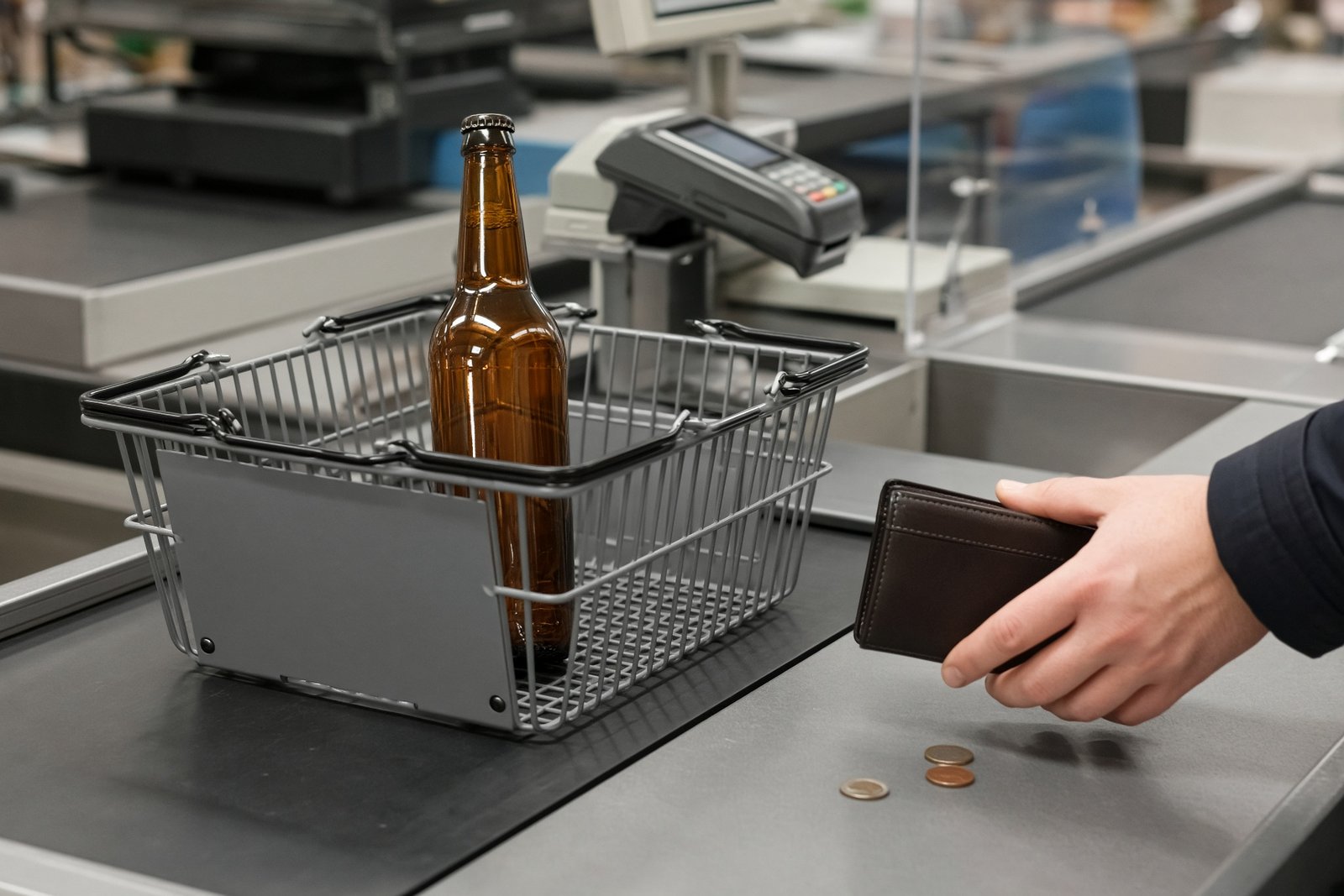
A proposed Russian tariff increase could turn a half-litre bottle of European beer into a 500-rouble purchase. The duty on beer from countries Moscow labels “unfriendly” is reported to be heading from €1.50 to €5 per litre under budget planning for 2027–2029, alongside a planned 6.5% rise in alcohol excise in 2027.
The measure has not yet become a confirmed retail price change. But it would accelerate a transformation already under way: European beer is losing its place in Russia’s ordinary supermarket market, while alternative suppliers gain ground in a shrinking import sector.
The proposed tariff was reported on 9 October 2026 by Russian media and an economic Telegram channel.
A levy that changes the price of the bottle
The move from €1.50 to €5 per litre would add €3.50 to the import charge on every litre. For a 0.5-litre bottle, the additional tariff alone would amount to €1.75, before exchange-rate movements, transport, storage, distribution, retail margins and the proposed excise increase are included.
The duty would be collected at the border, but its effect would travel through the supply chain. Importers could absorb part of the rise temporarily, reduce their orders or drop less profitable brands. Retailers could cut their margins to keep selected labels on the shelves. A permanent increase of this size would nevertheless make it difficult to sell lower-priced European beers at their previous price.
The proposal follows a rapid series of increases. In spring 2024, the additional charge on beer from the affected European markets was €0.10 per litre. During 2025, it rose first to €1 and then to €1.50. A move to €5 would therefore be more than a routine adjustment: the tariff would become a central part of the final price.
Reports have also linked the policy to an attempt to raise state revenue, with an estimate of roughly 30 billion roubles a year circulating around the proposal. That figure has not been independently verified here. The distribution of the cost is easier to understand. Importers and retailers may decide how much to absorb, but a substantial part of the burden is likely to reach the customer.
Europe’s supply line has already weakened
The proposed increase comes after a sharp fall in European beer shipments to Russia. Deliveries from Germany reportedly dropped from 122,000 tonnes in 2024 to 12,100 tonnes in 2025 — almost a tenfold decline. Total Russian beer imports fell from 305,000 tonnes to 126,000 tonnes over the same period.
Other suppliers have taken some of the space left behind. China supplied about 46,600 tonnes of beer to Russia, while Kazakhstan provided roughly 16,000 tonnes. Those figures show a change in trading patterns, but they do not by themselves prove that replacement products are better or worse in quality. Nor do they show that every European brand has been replaced by an equivalent product.
They do, however, reveal a market being redirected while it contracts. Russia is not simply swapping one imported beer for another at the same scale. Fewer imported products are entering the country overall, and European brands are being pushed into a narrower and more expensive part of the market.
A €5-per-litre duty would intensify that selection. German, Czech, Dutch and British labels that once competed in the standard supermarket range could become premium products. Some might remain available in small quantities for customers prepared to pay more. Others could become commercially unattractive to importers and disappear from mainstream shelves.
Why the change reaches beyond foreign-brand shoppers
Beer is not a niche drink in Russia. Before the planned changes, it accounted for more than 85% of alcohol purchases by volume, while vodka and other spirits represented about 11%, according to the figures cited in the reporting.
That makes a potential 500-rouble bottle significant beyond the relatively small group of consumers devoted to particular European labels. It would shift imported beer from an everyday purchase towards an occasional one. Higher-income customers may continue to buy it, but households with tighter budgets would face a more limited choice: switch to Russian or non-European brands, buy less beer or choose cheaper spirits.
The tariff does not determine which response will dominate. It does narrow the range of products available at familiar prices. It also means that state charges account for a larger share of the bottle’s cost, rather than the price being driven mainly by production, transport and retail operations.
More shelf space does not guarantee a replacement
Russian breweries could gain room in supermarkets as European brands retreat. But tariff protection does not automatically produce a like-for-like alternative. Domestic producers still need access to ingredients, equipment, packaging and distribution networks, and they must offer products at prices consumers are willing to pay.
The growth of Chinese and Kazakh supplies does not guarantee a one-for-one substitution either. Distance and logistics can affect the final price, while the fall in total imports suggests that the market is shrinking as well as changing shape.
That distinction matters to the idea of import substitution. Removing European competitors may benefit selected Russian producers, but it does not preserve the former range of brands, prices and product types. Nor does it establish that customers will receive an equivalent alternative at the same cost.
The decisive question is whether Russia ultimately adopts the €5-per-litre rate and how importers, distributors and shops divide the extra expense. If the plan goes ahead, European beer will not vanish from Russian stores. For many customers, though, it will cease to be an ordinary supermarket choice and become a purchase whose price is shaped as much by trade policy as by the drink itself.