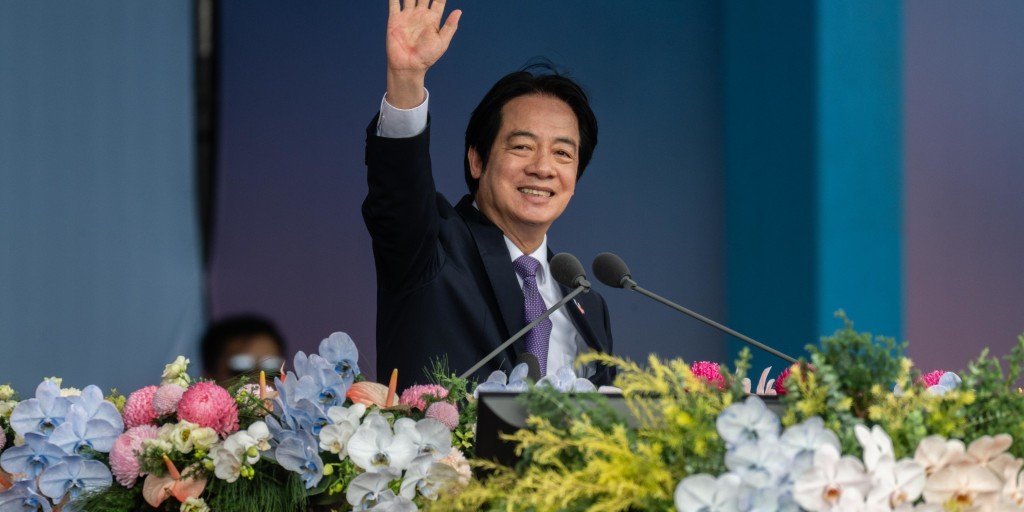
Taiwan stands firm on freedom and defense
TAIPEI — Taiwan cherishes peace but will not give up its freedom, and there must be respect for the right of Taiwan’s people to exist, President Lai Ching-te said on Saturday in a National Day speech, adding that boosting defenses is not a provocation, reports BritPanorama.
Democratically governed Taiwan has faced increased military and political pressure from China, which views the island as its own territory over the strong objections of the government in Taipei. In response to China’s growing military capabilities, including advanced stealth fighters and a large array of missiles, Taiwan is ramping up defense spending and modernising its armed forces.
“Peace cannot rely solely on wishes,” Lai stated outside the Presidential Office. “Taiwan cherishes peace, but we will not give up our freedom. We are open to exchanges, but will not accept subordination.” Lai’s remarks underscore Taiwan’s commitment to resisting what he termed “authoritarian expansion,” emphasizing the island’s right to self-determination and the importance of international support for its position.
Defense investment not ‘provocation’
China’s Taiwan Affairs Office did not immediately respond to a request for comment on Lai’s speech. Beijing, which has never renounced the use of force to bring Taiwan under its control, labels the Taiwanese president as a “separatist” and has dismissed his offers for dialogue. A senior U.S. administration official expressed support for Lai’s commitment to peace and stability in the Taiwan Strait, remarking that “a routine speech is no justification for aggressive or coercive actions.”
The United States remains Taiwan’s most significant international supporter, despite the absence of formal diplomatic ties. Lai’s government contends its increased defense investment aims to deter war, not provoke it. “And we are strengthening our self-defense not to abandon dialogue, but to ensure that dialogue can take place on the basis of parity and dignity,” he stated to the crowd during the National Day celebrations.
In 2024, shortly after Lai’s first National Day speech, China held war games around the island but did not do so last year. Its last military exercises near Taiwan took place in late December, coinciding with an $11 billion U.S. arms deal for Taipei, the largest ever. U.S. President Donald Trump has yet to approve a second package, valued at $14 billion.
Lai welcomed the U.S. and China managing their competition through dialogue to mitigate conflict risks, which a Taiwan official noted was a direct response to last month’s China-U.S. summit in Washington. However, he urged democracies in the Indo-Pacific to unite to maintain peace and stability in the region.
Taiwan’s National Day commemorates the 1911 uprising that led to the fall of China’s last imperial dynasty and the establishment of the Republic of China. Following a civil war with Mao Zedong’s communists, the Republican government retreated to Taiwan in 1949, where the island retains its official designation as the Republic of China.