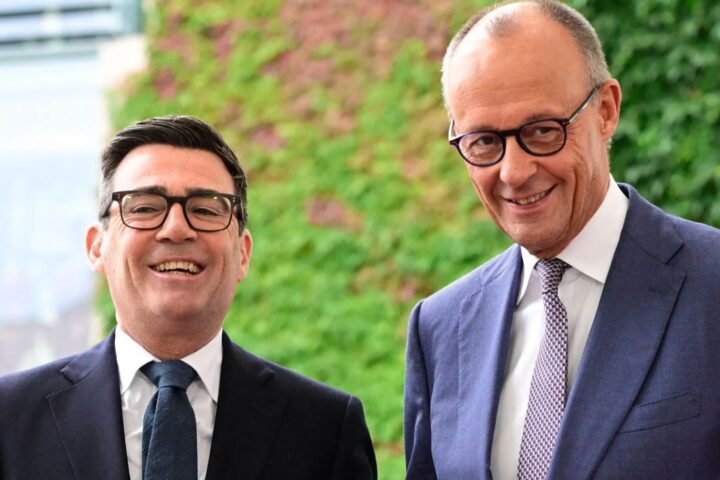
Prime Minister Andy Burnham will head to Berlin on Thursday for his inaugural face-to-face talks with German Chancellor Friedrich Merz, reports BritPanorama.
The leaders are set to establish a joint UK-Germany security framework aimed at countering cyber attacks, sabotage, and other hybrid threats from hostile foreign actors, particularly Russia. This strategic agreement will see both countries share intelligence and coordinate actions to monitor, deter, and disrupt potential dangers, while building greater resilience around critical national infrastructure.
Mr Burnham and Mr Merz are also scheduled to discuss aid for Ukraine, responses to instability in the Middle East, and the disruption of key global shipping lanes such as the Strait of Hormuz.
Additionally, the pair will convene a UK-Germany Regional Growth Forum featuring British and German business leaders, aimed at driving investment, deepening industrial ties, and ensuring economic benefits reach communities in both nations.
Thursday will also mark the formal ratification of the Kensington Treaty, signed in July 2024, which commits both nations to significantly deeper cooperation across science, technology, defence, security, and growth.
Ahead of the visit, Mr Burnham stated, “Attacks on our infrastructure, our businesses, and our democracies are not a distant threat. They reach into people’s homes and workplaces, and they are designed to make us weaker and more divided.” He further emphasised, “Britain and Germany are joining forces to find, expose and disrupt this activity. Security and growth go hand in hand, and both must be felt in every town and city in our two countries.”
The Prime Minister’s trip comes amid an intelligence scandal that has rocked Germany; its former spy chief has been arrested on suspicion of espionage. August Hanning, who headed Germany’s Federal Intelligence Service (BND) from 1998 to 2005, is “strongly suspected of treasonous espionage, spying out state secrets, attempted treason, and espionage,” according to a statement from the federal prosecutor’s office.
Mr Hanning, now 80, is accused of using classified intelligence to “draft an analysis” for an employee of one foreign intelligence service and of “passing on information” to an employee of another foreign spying service.
A former aide, identified as Manfred D, has also been arrested and charged with aiding and abetting attempted treason and treasonous espionage. The prosecutor’s office indicated that Manfred D had worked as Mr Hanning’s chief of staff and later served as chief of staff for several subsequent BND presidents from 2012 until 2026.
Mr Burnham’s visit aligns with increasing concerns regarding sabotage and hybrid threats in both the UK and Germany. Last month, the British Government summoned a senior Russian diplomat to protest over an “egregious and reckless attack” at Germany’s Leipzig airport, a major international freight hub used for providing support to Ukraine.
A drone carrying explosives was discovered near Ukrainian cargo planes in August but failed to detonate and was subsequently defused. Investigators suspect that a second drone may have collided with a nearby cargo aircraft, and a third drone was reportedly discovered near the airport ten days later.
Germany’s interior minister, Alexander Dobrindt, stated that the Leipzig airport attack followed the “well-established pattern of Russian hybrid operations in Europe” and suggested that Germany would likely experience further threats.
Moscow has denied involvement, with Russian President Vladimir Putin accusing Germany of fabricating evidence to blame Moscow.